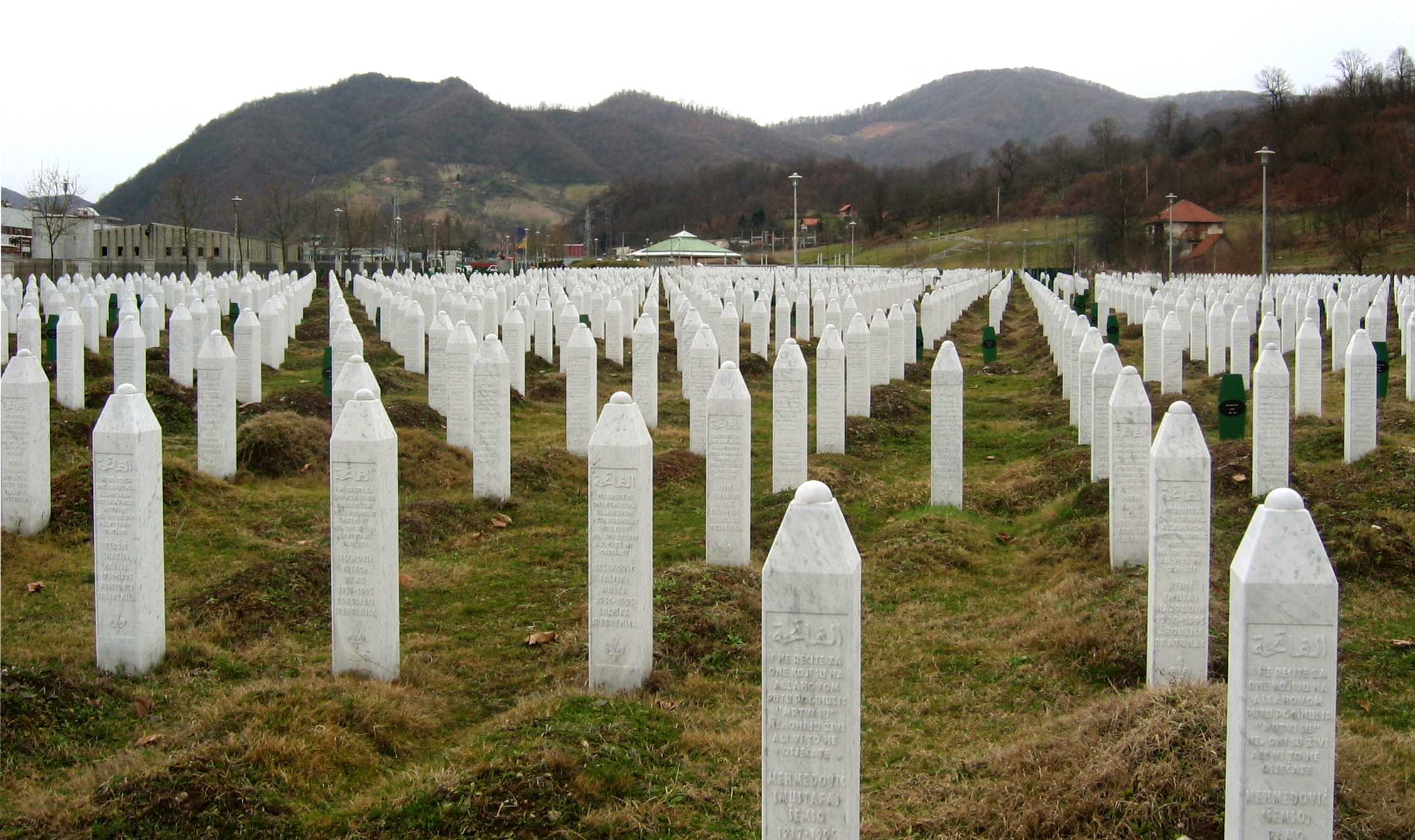
July 11-22, 1995 (Srebrenica genocide); April 1992-December 1995 (Bosnian War)
The Srebrenica Genocide and the Bosnian War
The United Nations called it a safe area. The buses still came for the men and boys.
Michael Büker, CC BY-SA 3.0, via Wikimedia Commons
The question
Was the safe area lost on 11 July 1995, or was it never held, and what does the free record settle about the men taken from it?
On 16 April 1993 the Security Council demanded that Srebrenica and its surroundings be treated as a safe area “free from any armed attack or any other hostile act”.1The peacekeepers who held it were lightly armed and at any one time numbered no more than 600 men.2The force around them was put at between 1,000 and 2,000 soldiers with tanks, armoured vehicles, artillery and mortars.3The Trial Chamber that tried Krstić found that the total number of men executed after the town fell is likely to lie within the range of 7,000 to 8,000.4
2International Criminal Tribunal for the former Yugoslavia, Trial Chamber, Prosecutor v. Radislav Krstić, Judgement (2001)¶ 20
3International Criminal Tribunal for the former Yugoslavia, Trial Chamber, Prosecutor v. Radislav Krstić, Judgement (2001)¶ 21
4International Criminal Tribunal for the former Yugoslavia, Trial Chamber, Prosecutor v. Radislav Krstić, Judgement (2001)¶ 84Exhibit 2
This thesis asks whether the safe area was lost on 11 July 1995 or was never held, and what the free record settles about the men who were taken from it.It makes three claims.First, that the resolution and the force sent under it were never matched, and that the tribunal and the Secretariat agree on the besieging force.Second, that the executions were organised, dated and located in the tribunal's own record, and that the forensic minimum in that record already exceeds the ceiling the denial position sets.Third, that the count of the dead is a range, and that the page states it as a range.
1The Security Council declared a safe area in April 1993 and the force sent to hold it was never sized for the task; the tribunal and the Secretariat agree on the besieging force.
2The killing of the captured men was organised, dated and located in the tribunal's own record, and the record's forensic minimum alone exceeds the denial position's ceiling.
3The count of the dead is a range the record supports, not one number, and this thesis states it as a range.
Shaded sentences are the reading of this thesis
The record
Every primary document this thesis holds was fetched from the tribunal, from the United Nations document system or from a court, and every passage below was sliced from that copy rather than retyped. (the reading of this thesis)The judgments and the resolutions are held as extracts with a paragraph or an operative number; the scholarship is held only as the passages cited, and the Serbian passages are held in Serbian with a rendering that is marked as this thesis's own. (the reading of this thesis)What the record does not hold is listed under the gaps below, by name, with what was tried; the largest gap is the judgment on state responsibility, which this thesis reaches only through the General Assembly's recital of it, so what that court held about Serbia is not reachable here and is not stated. (the reading of this thesis)The tribunal's own statement of the limits of its count comes first. (the reading of this thesis)It found it impossible to determine with precision the number of Bosnian Muslim men killed after the take-over, because the corpses had been broken up and intermingled when they were moved from primary to secondary graves; it recorded that the minimum number of bodies in the graves exhumed was 2028, against a total it put within the range of 7,000 to 8,000 men.56
Notes 5 to 6
5International Criminal Tribunal for the former Yugoslavia, Trial Chamber, Prosecutor v. Radislav Krstić, Judgement (2001)¶ 80
6International Criminal Tribunal for the former Yugoslavia, Trial Chamber, Prosecutor v. Radislav Krstić, Judgement (2001)¶ 84Exhibit 2
Primary documents held with extracts
9 of 11
Scholarship verified to exist as named
16 of 16
Of which read at a free copy and pinned
5
Positions, each with a source by a holder
7 of 7
Sources from the region or in its languages
20
Exhibits with full provenance
5
Findings of this thesis, with their working
4
Extracts stored verbatim
64
What the free record could not reach
The ICJ judgment of 26 February 2007 (Bosnia and Herzegovina v. Serbia and Montenegro)the ICJ site answers the PDF with a Cloudflare challenge page (HTTP 403) and the mirror answered 403; the finding is cited here only as the General Assembly's resolution of 2024 recites itTriedwww.icj-cij.orgicj-cij.orgwww.worldcourts.com
The NIOD report of 2002, in Dutch or in its English editionthe publications host did not answer and niod.nl answered HTTP 429 twice; the report is known here through the Dutch Supreme Court's findings of fact and the BMGN debateTriedpublications.niod.knaw.nlwww.niod.nl
The demographic count of the missing and deadpaywalled; the publisher's PDF link answers a challenge pageTriedlink.springer.com
Honig's strategic reading of the fallpaywalled; no open copy foundTrieddoi.org
The standard monograph on the aftermathpaywalled; no open chapter foundTrieddoi.org
The ethnography of the DNA identificationpaywalled; no open chapter foundTrieddoi.org
Mulaj on remembrance and denialpaywalled; the publisher's PDF link answers a challenge pageTriedlink.springer.com
Vukušić on the Scorpions execution videothe open-access repository answered HTTP 403 to the PDFTrieddigitalcommons.usf.edu
Rijnhout on causation and the 10 per cent liabilitythe journal's article pages answer HTTP 404 since its platform moved; the DOI resolves to the 404Triedwww.utrechtjournal.orgdoi.org
Spijkers on the Hague cases as legal monumentsthe journal's article pages answer HTTP 404 since its platform moved; the DOI resolves to the 404Triedwww.utrechtjournal.orgdoi.org
Delpla's comparison of the UN, French and NIOD inquiriesOpenEdition answers a JavaScript challenge page (Anubis) to every requestTrieddoi.orgjournals.openedition.org
Ringrose on the genocide label in the Security Councilthe open-access repository answered HTTP 403 to the PDFTrieddigitalcommons.usf.edu
Gerstein and Karčić on the 2024 General Assembly resolutionthe publisher answers a bot check (HTTP 202, empty body) to every requestTrieddoi.orgwww.degruyterbrill.com
The Republika Srpska government's reports of 2002 (Bureau for Relations with the Hague Tribunal) and 2004 (Commission for the Investigation of the Events in and around Srebrenica)no open archive found that holds either report; the search endpoint answered a challenge page; both are known here only as Manojlović Pintar describes themTriedhtml.duckduckgo.com
The Mladić appeal judgment (IRMCT, 8 June 2021) and the Karadžić appeal judgment (IRMCT, 20 March 2019)the guessed IRMCT paths answered HTTP 404; both judgments are cited here only as the General Assembly's resolution of 2024 recites themTriedwww.irmct.orgwww.irmct.org
The filmed statement Mladić made on entering Srebrenica on 11 July 1995 and the Erdemović testimony at the Rule 61 hearing of 5 July 1996no free copy of the film or the hearing transcript was reached; the Krstić judgment records that the walk through the town was filmed, and Erdemović's words are held here as the sentencing judgment quotes themTriedwww.icty.org
The argument
1The safe area
The resolution of 16 April 1993 demanded that all parties treat Srebrenica as a safe area, demanded the immediate withdrawal of Bosnian Serb paramilitary units from the areas around it, and demanded that the Federal Republic of Yugoslavia cease supplying them.7It requested the Secretary-General to increase the presence of UNPROFOR in Srebrenica, with a view to monitoring the humanitarian situation.8A resolution that monitors is not a resolution that defends, and the Secretariat's own review says so. (the reading of this thesis)
Exhibit 1DocumentUnited Nations Security Council, 16 April 1993
Security Council resolution 819 (1993), operative paragraph 1
1. Demands that all parties and others concerned treat Srebrenica and its surroundings as a safe area which should be free from any armed attack or any other hostile act;
Locator
operative para. 1
Held by
United Nations Official Document System, S/RES/819 (1993)
Rights
UN document, public
The first UNPROFOR troops arrived on 18 April 1993, were rotated about every six months, and were “lightly armed and at any one time numbered no more than 600 men (a much smaller force than had been originally requested)”.9They “manned thirteen observation posts” on the perimeter, and in January 1995 a battalion from the Netherlands rotated in.10Around them, “Between 1,000 and 2,000 soldiers from three Drina Corps Brigades were deployed around the enclave”, equipped with tanks, armoured vehicles, artillery and mortars.11The Secretariat put the same besieging force at 1,000 to 2,000 well-equipped soldiers from three brigades, and the enclave's own defenders as numerically superior, “3,000 to 4,000 men in the Twenty-eighth Division”, with no heavy weapons.12
Notes 9 to 12
9International Criminal Tribunal for the former Yugoslavia, Trial Chamber, Prosecutor v. Radislav Krstić, Judgement (2001)¶ 20
10International Criminal Tribunal for the former Yugoslavia, Trial Chamber, Prosecutor v. Radislav Krstić, Judgement (2001)¶ 20
11International Criminal Tribunal for the former Yugoslavia, Trial Chamber, Prosecutor v. Radislav Krstić, Judgement (2001)¶ 21
12United Nations Secretary-General, Report of the Secretary-General pursuant to General... (1999)¶ 230
The tribunal also heard that from the outset both parties violated the safe area agreement: a deliberate Bosnian Serb strategy limited the aid convoys, the Dutch commander testified that his personnel, equipment and ammunition were kept out, and some Bosnian Muslims in Srebrenica complained of attacks by Bosnian Serb soldiers.13The Secretariat's conclusion, written four years after the fall, is that the safe areas “were established by the Security Council without the consent of the parties and without the provision of any credible military deterrent”.14
Notes 13 to 14
13International Criminal Tribunal for the former Yugoslavia, Trial Chamber, Prosecutor v. Radislav Krstić, Judgement (2001)¶ 22
14United Nations Secretary-General, Report of the Secretary-General pursuant to General... (1999)¶ 499
2The fall
The offensive began in earnest on 6 July 1995, and in the following days the observation posts in the south of the enclave fell one by one.15By the evening of 9 July the Drina Corps had pressed four kilometres into the enclave and halted one kilometre short of the town; late that night President Karadžić authorised the corps to capture it.16On the morning of 10 July Colonel Karremans sent urgent requests for NATO air support, and no assistance came until around 1430 hours on 11 July 1995, when NATO bombed VRS tanks advancing towards the town.17The Secretariat's account has the Serb flag hoisted above a bakery at the southern end of the town at 1407 hours, the residents fleeing north at approximately 1430, and “at least three (but possibly up to five) requests for air support by Dutchbat” turned down before that at various levels of the chain of command.18In the same account “Dutchbat had also not fired a single shot directly at the advancing Serb forces”.19
Notes 15 to 19
15International Criminal Tribunal for the former Yugoslavia, Trial Chamber, Prosecutor v. Radislav Krstić, Judgement (2001)¶ 31
16International Criminal Tribunal for the former Yugoslavia, Trial Chamber, Prosecutor v. Radislav Krstić, Judgement (2001)¶ 33
17International Criminal Tribunal for the former Yugoslavia, Trial Chamber, Prosecutor v. Radislav Krstić, Judgement (2001)¶ 34
18United Nations Secretary-General, Report of the Secretary-General pursuant to General... (1999)¶ 304
19United Nations Secretary-General, Report of the Secretary-General pursuant to General... (1999)¶ 304
AnalysisThe finding of this thesis, from the rows below
The afternoon of 11 July 1995 on two clocks
Method Every clock time the two fetched records give for the afternoon of 11 July 1995, one row per time, with the event it times and the producer. The result is the range of the column.
Rows the analysis is computed from, each traced to an extract
event
producer
clock
Extract
Serb flag hoisted above a bakery at the southern end of the town
Computed over 4 rows, range of clock = 1407 to 1600; result 1407 to 1600
Four clock times from two records run from 1407 to 1600: the Serb flag over the town at 1407 and the only NATO strike at 1440 in the Secretariat's account, the strike at around 1430 in the tribunal's, and the observers' report of upwards of 20,000 people converging on Potočari at 1600.
Confidence moderate: the two producers put the one strike ten minutes apart, and the tribunal's 'around 1430' is an approximation the Secretariat's 'approximately 1440' does not confirm. Against it the two records disagree by ten minutes on the strike, and neither gives a time for Mladić's entry into the town, so the table cannot say whether the strike came before or after it
srebrenica-genocide
At approximately 1440 hours two NATO aircraft dropped a total of two bombs on what were thought to be Serb vehicles.24The Bosnian Serb army then radioed a threat to shell the town and the compound and to kill the Dutch soldiers it held, the Netherlands Minister of Defence telephoned the Special Representative to ask that the air action stop, and it was halted.25The tribunal records the same abandonment of the air strikes after threats to kill the Dutch troops in VRS custody and to shell the compound where 20,000 to 30,000 civilians had fled.26Late in the afternoon General Mladić walked through the empty streets of the town with General Živanović and General Krstić, and the walk was filmed by a Serbian journalist.27
Notes 24 to 27
24United Nations Secretary-General, Report of the Secretary-General pursuant to General... (1999)¶ 305
25United Nations Secretary-General, Report of the Secretary-General pursuant to General... (1999)¶ 306
26International Criminal Tribunal for the former Yugoslavia, Trial Chamber, Prosecutor v. Radislav Krstić, Judgement (2001)¶ 34
27International Criminal Tribunal for the former Yugoslavia, Trial Chamber, Prosecutor v. Radislav Krstić, Judgement (2001)¶ 36
By the evening of 11 July 1995 approximately 20,000 to 25,000 refugees were gathered at Potočari, and “Several thousand had pressed inside the UN compound itself”; witnesses estimated at least 300 men inside its perimeter and between 600 and 900 men in the crowd outside.28The Dutch commander's message after meeting Mladić described “more than 15,000 people within one square kilometre, including the battalion, in an extreme vulnerable position”.29The Secretariat's own verdict on the battalion is that “the 150 fighting men of Dutchbat were lightly armed and in indefensible positions, and were faced with 2,000 Serbs advancing with the support of armour and artillery”.30
Notes 28 to 30
28International Criminal Tribunal for the former Yugoslavia, Trial Chamber, Prosecutor v. Radislav Krstić, Judgement (2001)¶ 37
29United Nations Secretary-General, Report of the Secretary-General pursuant to General... (1999)¶ 315
30United Nations Secretary-General, Report of the Secretary-General pursuant to General... (1999)¶ 472
AnalysisThe finding of this thesis, from the rows below
One crowd, ten counts
Method Every figure the fetched primary documents give for the number of people who gathered at Potočari on 11 to 13 July 1995, one row per figure, with the document and the moment it counts. The result is the range of the column.
Rows the analysis is computed from, each traced to an extract
Computed over 10 rows, range of count = 15000 to 30000; result 15000 to 30000
The record counts the crowd at Potočari at between 15,000 and 30,000, and the two lowest figures are the two the battalion commander wrote on the day.
Confidence high for the range, which is the extreme of ten figures from seven documents of two producers; the figures count different moments over three days, so the range is a spread of counts, not a change in the crowd. Against it the tribunal's own paragraph 34 gives 20,000 to 30,000 as the number who had fled to the compound and surrounding areas, a wider upper bound than paragraph 37's 25,000 from the same producer; it is included as the last two rows rather than resolved
srebrenica-genocide
3The executions
The men who did not go to Potočari left Šušnjari shortly after midnight on 12 July in a column that may have numbered up to 15,000, perhaps a third of them armed, and the last units left more than 12 hours after the first.41The tribunal's own table of contents lists the mass execution sites by date.42Between 1,000 and 1,500 men captured from the column were bussed or marched to the Kravica Warehouse on the afternoon of 13 July 1995, and at around 18.00 hours, when the warehouse was full, the soldiers began throwing grenades and shooting into the men packed inside.43Witness K, who was only slightly wounded, crossed the warehouse to escape through a window after the shooting stopped: “I was not even able to touch the floor, the concrete floor of the warehouse… After the shooting, I felt a strange kind of heat, warmth, which was actually coming from the blood that covered the concrete floor, and I was stepping on the dead people who were lying around.”44
Notes 41 to 44
41United Nations Secretary-General, Report of the Secretary-General pursuant to General... (1999)¶ 316
42International Criminal Tribunal for the former Yugoslavia, Trial Chamber, Prosecutor v. Radislav Krstić, Judgement (2001)table of contents
43International Criminal Tribunal for the former Yugoslavia, Trial Chamber, Prosecutor v. Radislav Krstić, Judgement (2001)¶ 205
44International Criminal Tribunal for the former Yugoslavia, Trial Chamber, Prosecutor v. Radislav Krstić, Judgement (2001)¶ 206
AnalysisThe finding of this thesis, from the rows below
The execution sites in the tribunal's own table of contents
Method The mass execution sites are listed as the sub-headings (a) to (i) of the Krstić Trial Judgement's section on the Drina Corps' involvement, each with the date the chamber gave it. One row per sub-heading; the result is the count.
Rows the analysis is computed from, each traced to an extract
The chamber's own table of contents lists nine mass execution sites: eight dated from 13 to 16 July 1995, four of them on 13 July, and the ninth, Kozluk, undated in its heading.
Confidence high: the count is of headings in a document held whole, and a heading is either present or not. Against it none found in the Krstić trial judgment's table of contents, which is the only list of sites in the free record; heading (j) covers smaller-scale executions the count leaves out, so nine is the chamber's count of mass execution sites, not of all killings
srebrenica-genocide
At the Branjevo Military Farm the executions started at 10 o’clock in the morning, the men were made to “get off in groups of ten” and lined up with their backs to the firing squad, and the executions continued until about 3 o’clock in the afternoon; Erdemović estimated about 20 buses of approximately 60 men and boys each, and he “believes that he personally killed about seventy people”.54As a prosecution witness in the Krstić trial he said of the men in front of him: “When those men turned their backs to us, we shot at them. We were given orders to shoot.” When he pleaded guilty, he told the chamber what he had been told when he refused: “If you’re sorry for them, stand up, line up with them and we will kill you too.”5556
Notes 54 to 56
54International Criminal Tribunal for the former Yugoslavia, Trial Chamber, Prosecutor v. Dražen Erdemović, Sentencing Judgement (1996)¶ 78
55International Criminal Tribunal for the former Yugoslavia, Trial Chamber, Prosecutor v. Radislav Krstić, Judgement (2001)¶ 234
56International Criminal Tribunal for the former Yugoslavia, Trial Chamber, Prosecutor v. Dražen Erdemović, Sentencing Judgement (1996)¶ 10
4The graves and the count
Commencing in 1996 the prosecution exhumed 21 gravesites; 14 were primary graves where bodies had been put directly after the killing, of which eight were later disturbed and the bodies reburied elsewhere, and seven of the exhumed sites were secondary burial sites.57The reburials took place over several weeks in September and early October 1995, and the chamber read them as “a concerted campaign to conceal the bodies of the men in these primary gravesites”, prompted by international scrutiny.58
Notes 57 to 58
57International Criminal Tribunal for the former Yugoslavia, Trial Chamber, Prosecutor v. Radislav Krstić, Judgement (2001)¶ 71
58International Criminal Tribunal for the former Yugoslavia, Trial Chamber, Prosecutor v. Radislav Krstić, Judgement (2001)¶ 78
AnalysisThe finding of this thesis, from the rows below
How many of the primary graves were dug up
Method From the tribunal's summary of the prosecution's exhumations to 2000: the number of primary gravesites and the number of them later disturbed. The result is the share, disturbed over primary.
Rows the analysis is computed from, each traced to an extract
Computed over 1 rows, sum disturbed / sum primary = 8/14; result 0.5714
Of the 14 primary gravesites the prosecution had exhumed by 2000, 8 had been dug up and their bodies moved: 4 in every 7.
Confidence high: both figures are in one sentence of the judgment, and the share is arithmetic. Against it none found in the Krstić trial judgment, the Secretary-General's report or the Mladić judgment volume held; the share is of the graves exhumed by 2000, not of all graves, and the judgment itself says the graves are still being found
srebrenica-genocide
Investigators found “at least 448 blindfolds on or with the bodies uncovered during the exhumations at ten separate sites” and 423 ligatures at 13 separate sites, most of the ligatures made of wire, and the chamber held that “These ligatures and blindfolds are inconsistent with combat casualties”.60The same chamber did not rule out that a percentage of the bodies in the graves examined were of men killed in combat.61The minimum number of bodies in the graves exhumed was 2028, against a total the chamber put within the range of 7,000 to 8,000 men.6263
Notes 60 to 63
60International Criminal Tribunal for the former Yugoslavia, Trial Chamber, Prosecutor v. Radislav Krstić, Judgement (2001)¶ 75
61International Criminal Tribunal for the former Yugoslavia, Trial Chamber, Prosecutor v. Radislav Krstić, Judgement (2001)¶ 77
62International Criminal Tribunal for the former Yugoslavia, Trial Chamber, Prosecutor v. Radislav Krstić, Judgement (2001)¶ 80
63International Criminal Tribunal for the former Yugoslavia, Trial Chamber, Prosecutor v. Radislav Krstić, Judgement (2001)¶ 84Exhibit 2
Exhibit 2DocumentICTY Trial Chamber, 2 August 2001
Krstić Trial Judgement, paragraph 84
84. The Trial Chamber is satisfied that, in July 1995, following the take-over of Srebrenica, Bosnian Serb forces executed several thousand Bosnian Muslim men. The total number is likely to be within the range of 7,000 -8,000 men.
Locator
¶ 84
Held by
ICTY court records, IT-98-33-T
Rights
UN tribunal record, public
On 23 May 2024 the General Assembly designated 11 July an international day of commemoration and noted that at least 8,372 lives were lost, a figure above the tribunal's range of 7,000 to 8,000; the resolution also calls for the completion of the process of finding and identifying the remaining victims.6465The resolution condemns without reservation any denial of the genocide as a historical event.66The two counts are set beside the denial position's figure in the disagreements below, and this thesis states no single number. (the reading of this thesis)
Notes 64 to 66
64United Nations General Assembly, Resolution 78/282. International Day of Reflection and... (2024)whole document
65International Criminal Tribunal for the former Yugoslavia, Trial Chamber, Prosecutor v. Radislav Krstić, Judgement (2001)¶ 84Exhibit 2
66United Nations General Assembly, Resolution 78/282. International Day of Reflection and... (2024)whole document
the memorial cemetery at Potočari as it stood in March 2009, fourteen years after the killing
Does not show
anything of July 1995; the graves photographed are reburials after identification, not the primary or secondary graves the tribunal describes
5The verdicts
The Trial Chamber concluded that the intent to kill all the Bosnian Muslim men of military age in Srebrenica constitutes an intent to destroy the group in part and “therefore must be qualified as a genocide”.67It found the prosecution had proven beyond all reasonable doubt that genocide, crimes against humanity and violations of the laws or customs of war were perpetrated against the Bosnian Muslims at Srebrenica in July 1995.68The Appeals Chamber held that the forces “targeted for extinction the forty thousand Bosnian Muslims living in Srebrenica” and that the law “calls the massacre at Srebrenica by its proper name: genocide”.69It set aside Krstić's conviction as a participant in a joint criminal enterprise to commit genocide, found him guilty of aiding and abetting genocide, and sentenced him to 35 years.70
Notes 67 to 70
67International Criminal Tribunal for the former Yugoslavia, Trial Chamber, Prosecutor v. Radislav Krstić, Judgement (2001)¶ 598
68International Criminal Tribunal for the former Yugoslavia, Trial Chamber, Prosecutor v. Radislav Krstić, Judgement (2001)¶ 599
69International Criminal Tribunal for the former Yugoslavia, Appeals Chamber, Prosecutor v. Radislav Krstić, Judgement (Appeals Chamber) (2004)¶ 37
70International Criminal Tribunal for the former Yugoslavia, Appeals Chamber, Prosecutor v. Radislav Krstić, Judgement (Appeals Chamber) (2004)disposition
The chamber that tried Mladić found him not guilty of Count 1, genocide in the municipalities, where it found the physical perpetrators lacked the intent to destroy a substantial part of the protected groups, guilty of Count 2, genocide, and guilty of persecution, extermination, murder, deportation, forcible transfer, terror, unlawful attacks on civilians and the taking of hostages, and sentenced him to life imprisonment.7172The General Assembly's resolution recites eight tribunal judgments with guilty verdicts for genocide at Srebrenica and the judgment of the International Court of Justice of 26 February 2007 “in which the Court determined that the acts committed in Srebrenica constituted acts of genocide”.73The Secretariat's report reproduces the words of the judge who confirmed the indictment of 16 November 1995: “These are truly scenes from hell, written on the darkest pages of human history.”74
Notes 71 to 74
71International Criminal Tribunal for the former Yugoslavia, Trial Chamber, Prosecutor v. Ratko Mladić, Judgement, Volume IV of V (2017)¶ 5214
72International Criminal Tribunal for the former Yugoslavia, Trial Chamber, Prosecutor v. Ratko Mladić, Judgement, Volume IV of V (2017)¶ 4234
73United Nations General Assembly, Resolution 78/282. International Day of Reflection and... (2024)whole document
74United Nations Secretary-General, Report of the Secretary-General pursuant to General... (1999)¶ 2
6The reckoning
The Secretariat wrote that “Through error, misjudgement and an inability to recognize the scope of the evil confronting us, we failed to do our part to help save the people of Srebrenica from the Serb campaign of mass murder”.75Its cardinal lesson is that “a deliberate and systematic attempt to terrorize, expel or murder an entire people must be met decisively with all necessary means”.76Its judgment on the battalion is that it cannot be said with any certainty that stronger action by Dutchbat would have saved lives, and that such efforts could have done more harm than good.77
Notes 75 to 77
75United Nations Secretary-General, Report of the Secretary-General pursuant to General... (1999)¶ 503Exhibit 4
76United Nations Secretary-General, Report of the Secretary-General pursuant to General... (1999)¶ 502
77United Nations Secretary-General, Report of the Secretary-General pursuant to General... (1999)¶ 473
Exhibit 4DocumentUnited Nations Secretary-General, 15 November 1999
The Secretary-General's report, paragraph 503
503. The United Nations experience in Bosnia was one of the most difficult and painful in our history. It is with the deepest regret and remorse that we have reviewed our own actions and decisions in the face of the assault on Srebrenica. Through error, misjudgement and an inability to recognize the scope of the evil confronting us, we failed to do our part to help save the people of Srebrenica from the Serb campaign of mass murder. No one regrets more than we the opportunities for achieving peace and justice that were missed. No one laments more than we the failure of the international community to take decisive action to halt the suffering and end a war that had produced so many victims. Srebrenica crystallized a truth understood only too late by the United Nations and the world at large: that Bosnia was as much a moral cause as a military conflict. The tragedy of Srebrenica will haunt our history forever.
Locator
¶ 503
Held by
United Nations Official Document System, A/54/549
Rights
UN document, public
The Supreme Court of the Netherlands held that Dutchbat's acts until 23:00 on 11 July 1995 were under the command and control of the United Nations and cannot be attributed to the State, that the State cannot be held liable for the capture of Srebrenica, and that it was wrongful not to offer the male refugees inside the compound the choice of staying there at the end of the afternoon of 13 July 1995.78It estimated the chance that those men would have escaped the Bosnian Serbs at 10%, and limited the State's liability to 10% of the damage to their surviving relatives.79In doing so it set aside the judgment of the Court of Appeal of The Hague of 27 June 2017.80
Notes 78 to 80
78Supreme Court of the Netherlands (Hoge Raad), Civil Law Division, Mothers of Srebrenica (2019)§ 5
79Supreme Court of the Netherlands (Hoge Raad), Civil Law Division, Mothers of Srebrenica (2019)§ 5
80Supreme Court of the Netherlands (Hoge Raad), Civil Law Division, Mothers of Srebrenica (2019)§ 6
The Strasbourg court found that operations under Chapter VII are fundamental to the mission of the United Nations and that the Convention cannot subject the Security Council's acts and omissions to domestic jurisdiction without the accord of the United Nations.81It noted that the only instrument on which individuals could base a remedy against the United Nations for UNPROFOR's acts is the status agreement of 15 May 1993, Article 48 of which requires a claims commission, and that it would appear this has not been done.82It found the grant of immunity served a legitimate purpose and was not disproportionate, and declared the application inadmissible.8384
Notes 81 to 84
81European Court of Human Rights, Third Section, Stichting Mothers of Srebrenica and Others v. the... (2013)¶ 154
82European Court of Human Rights, Third Section, Stichting Mothers of Srebrenica and Others v. the... (2013)¶ 162
83European Court of Human Rights, Third Section, Stichting Mothers of Srebrenica and Others v. the... (2013)¶ 169
84European Court of Human Rights, Third Section, Stichting Mothers of Srebrenica and Others v. the... (2013)disposition
Exhibit 5PhotographPaul Katzenberger, 11 July 2010
Rows of graves at the Potočari memorial on the day of the 2010 funeral
Bosnian Serb forces executed several thousand captured men after the fall, in the range of 7,000 to 8,000, with the intent to destroy the Bosnian Muslims of Srebrenica in part, which the law names genocide.
Omits
What the record of the crime says about the fall itself: the judgments settle what was done to the captured men, not what the Security Council, UNPROFOR or the Bosnian government could have done before 11 July 1995.
Tested against the primary record
QualifiedThe total number of men executed is likely to be within the range of 7,000 to 8,000.
Rests on documents from: International Criminal Tribunal for the former Yugoslavia; United Nations General Assembly.
The tribunal's 2001 range rests on exhumations to 2000 and a stated minimum of 2,028 bodies; the General Assembly's 2024 resolution counts at least 8,372 lives lost. Two producers, two figures; the later and larger count is the one the record now carries, so the tribunal's range stands as a floor, not a total.
The 3 extracts it rests on
International Criminal Tribunal for the former Yugoslavia, Trial Chamber, Prosecutor v. Radislav Krstić, Judgement (2001)¶ 84Exhibit 2
84. The Trial Chamber is satisfied that, in July 1995, following the take-over of Srebrenica, Bosnian Serb forces executed several thousand Bosnian Muslim men. The total number is likely to be within the range of 7,000 -8,000 men.
International Criminal Tribunal for the former Yugoslavia, Trial Chamber, Prosecutor v. Radislav Krstić, Judgement (2001)¶ 80
80. It is impossible to determine with precision the number of Bosnian Muslim men killed by Bosnian Serb forces following the take-over of Srebrenica in July 1995. During the course of the exhumations conducted by the OTP, the process of identifying the number of bodies was complicated by the fact that, in the course of being removed from primary gravesites to secondary gravesites, the corpses were broken up and body parts became intermingled. However, as already noted, experts were able to conservatively determine that the minimum number of bodies in the graves exhumed was 2028.165
United Nations General Assembly, Resolution 78/282. International Day of Reflection and... (2024)whole document
Resolution adopted by the General Assembly on 23 May 2024 [without reference to a Main Committee (A/78/L.67/Rev.1)] 78/282. International Day of Reflection and Commemoration of the 1995 Genocide in Srebrenica The General Assembly, Guided by the Charter of the United Nations, the Universal Declaration of Human Rights1 and the Convention on the Prevention and Punishment of the Crime of Genocide,2 Recalling Security Council resolution 819 (1993) of 16 April 1993 declaring Srebrenica a safe area, resolution 827 (1993) of 25 May 1993 concerning the establishment of the International Tribunal for the Former Yugoslavia and resolution 1966 (2010) of 22 December 2010 concerning the establishment of the International Residual Mechanism for Criminal Tribunals, Recalling also all judgments of the International Tribunal for the Former Yugoslavia, in particular eight that contain guilty verdicts for the crime of genocide against Bosnian Muslims committed at Srebrenica in 1995, most notably the Tribunal Appeals Chamber judgment of 19 April 2004 (The Prosecutor v. Krstić), the International Residual Mechanism for Criminal Tribunals Appeals Chamber judgment of 8 June 2021 (The Prosecutor v. Mladić) and the Mechanism Appeals Chamber judgment of 20 March 2019 (The Prosecutor v. Karadžić), as well as the judgment of the International Court of Justice of 26 February 2007, in which the Court determined that the acts committed in Srebrenica constituted acts of genocide, Reaffirming its strong opposition to impunity for genocide, crimes against humanity, war crimes or other violations of international humanitarian law and international human rights law, and emphasizing in this context the responsibility of States to end impunity and, to that end, to thoroughly investigate and prosecute, in __________________ 1 Resolution 217 A (III). 2 Resolution 260 A (III), annex. A/RES/78/282 International Day of Reflection and Commemoration of the 1995 Genocide in Srebrenica 24-09647 2/3 accordance with their relevant international legal obligations and their domestic law, persons responsible for such acts, in order to avoid their recurrence and to seek sustainable peace, justice, truth and reconciliation, for which the participation of victims and survivors as well as their family members is central, Welcoming the important progress made by international courts in recent years with respect to the fight against impunity and in ensuring accountability for genocide, crimes against humanity, war crimes and other egregious crimes achieved through the international criminal justice system, Recognizing in this regard the particular contribution of the International Tribunal for the Former Yugoslavia, and emphasizing the importance of the international community being prepared to take collective action through the Security Council, in accordance with the Charter, and on a case-by-case basis to further ensure accountability for and the prevention of genocide, Reiterating that criminal accountability under international law for the crime of genocide is individualized and cannot be attributed to any ethnic, religious or other group or community as a whole, Taking note of the role of the Special Advisers to the Secretary-General on the Prevention of Genocide and on the Responsibility to Protect, and noting the importance of regular briefings on human rights and international humanitarian law violations as well as on hate speech and incitement in raising early awareness of potential genocide, Noting that the prosecution of persons responsible for genocide and other international crimes in national justice systems, including the Court of Bosnia and Herzegovina, and the International Tribunal for the Former Yugoslavia as well as the International Residual Mechanism for Criminal Tribunals, remains central to the process of national reconciliation and trust-building and to the restoration and maintenance of peace in Bosnia and Herzegovina, and recognizing that strong regional cooperation between national prosecutors’ offices is essential in fostering peace, justice, truth and reconciliation among countries in the region, Reiterating the unwavering commitment to maintaining stability and fostering unity in diversity in Bosnia and Herzegovina, Noting that 2025 will mark the thirtieth anniversary of the genocide in Srebrenica, in which at least 8,372 lives were lost, thousands were displaced and families and communities were devastated, 1. Decides to designate 11 July as the International Day of Reflection and Commemoration of the 1995 Genocide in Srebrenica, to be observed annually; 2. Condemns without reservation any denial of the Srebrenica genocide as a historical event, and urges Member States to preserve the established facts, including through their educational systems by developing appropriate programmes, also in remembrance, towards preventing denial and distortion, and occurrence of genocides in the future; 3. Also condemns without reservation actions that glorify those convicted of war crimes, crimes against humanity and genocide by international courts, including those responsible for the Srebrenica genocide; 4. Emphasizes the importance of completing the process of finding and identifying the remaining victims of the Srebrenica genocide and according them dignified burials, and calls for the continued prosecution of those perpetrators of the Srebrenica genocide who have yet to face justice; International Day of Reflection and Commemoration of the 1995 Genocide in Srebrenica A/RES/78/282 3/3 24-09647 5. Urges all States to fully adhere to their obligations under the Convention on the Prevention and Punishment of the Crime of Genocide, as applicable, and customary international law on the prevention and punishment of genocide, with due regard to relevant decisions of the International Court of Justice; 6. Requests the Secretary-General to establish an outreach programme entitled “The Srebrenica Genocide and the United Nations”, starting its activities with preparations for the thirtieth anniversary in 2025, and also requests the Secretary- General to bring the present resolution to the attention of all Member States, organizations of the United Nations system and civil society organizations for appropriate observance; 7. Invites all Member States, organizations of the United Nations system, other international and regional organizations and civil society, including non- governmental organizations, academic institutions and other relevant stakeholders to observe the International Day, including special observances and activities in memory and honour of the victims of the 1995 genocide in Srebrenica, as well as appropriate education and public awareness-raising activities. 82nd plenary meeting
QualifiedThe bodies in the graves were not combat casualties but executed prisoners.
Rests on documents from: International Criminal Tribunal for the former Yugoslavia; United Nations Secretary-General.
The Secretariat's report reproduces the confirming judge's 1995 summary of the same evidence, so a second producer records the same finding; but the tribunal itself does not rule out that a share of the bodies were men killed in combat, and a claim the court hedges cannot be stronger on this page than in the judgment.
The 3 extracts it rests on
International Criminal Tribunal for the former Yugoslavia, Trial Chamber, Prosecutor v. Radislav Krstić, Judgement (2001)¶ 75
75. The results of the forensic investigations suggest that the majority of bodies exhumed were not killed in combat; they were killed in mass executions. Investigators discovered at least 448 blindfolds on or with the bodies uncovered during the exhumations at ten separate sites.151 423 ligatures were located during exhumations at 13 separate sites.152 Some of the ligatures were made of cloth and string, but predominately they were made of wire.153 These ligatures and blindfolds are inconsistent with combat casualties. The Prosecution also relied on forensic evidence that the overwhelming majority of victims located in the graves, for who a cause of death could be determined, were killed by gunshot wounds.154 The exhumations also revealed that some of the victims were severely handicapped and, for that reason, unlikely to have been combatants.155
International Criminal Tribunal for the former Yugoslavia, Trial Chamber, Prosecutor v. Radislav Krstić, Judgement (2001)¶ 77
77. The Trial Chamber cannot rule out the possibility that a percentage of the bodies in the gravesites examined may have been of men killed in combat.
United Nations Secretary-General, Report of the Secretary-General pursuant to General... (1999)¶ 2
2. On 16 November 1995, the International Tribunal for the Former Yugoslavia indicted Radovan Karad• ie (“President of the Republika Srpska”) and Ratko Mladie (Commander of the Bosnian Serb Army) for their alleged direct responsibility for the atrocities committed in July 1995 against the Bosnian Muslim population of the United Nations-designated safe area of Srebrenica. After a review of the evidence submitted by the Prosecutor, Judge Riad confirmed the indictment, stating that: “After Srebrenica fell to besieging Serbian forces in July 1995, a truly terrible massacre of the Muslim population appears to have taken place. The evidence tendered by the Prosecutor describes scenes of unimaginable savagery: thousands of men executed and buried in mass grave s, hundreds of men buried alive, men and women mutilated and slaughtered, children killed before their mothers’ eyes, a grandfather forced to eat the liver of his own grandson. These are truly scenes from hell, written on the darkest pages of human history.”1
The United Nations' own account
Holders
The Secretary-General (A/54/549, 1999); The Security Council (resolution 819, 1993); The General Assembly (resolution 78/282, 2024)
The safe area was declared without the consent of the parties and without a credible military deterrent, and the failure to hold it ran from the Council to the field.
Omits
The perpetrators' own chain of command, which an account of institutional failure passes over, and the count of the dead, which the Secretariat's report leaves to the tribunal.
Tested against the primary record
SupportedThe Netherlands battalion was lightly armed and outnumbered by a besieging force of 1,000 to 2,000 well-equipped soldiers.
Rests on documents from: International Criminal Tribunal for the former Yugoslavia; United Nations Secretary-General.
The tribunal, from its own evidence, puts the peacekeepers at no more than 600 lightly armed men and the Drina Corps at between 1,000 and 2,000 soldiers with tanks, armoured vehicles, artillery and mortars, which is the Secretariat's account in different words. Two producers agree on the numbers and the arms.
The 4 extracts it rests on
United Nations Secretary-General, Report of the Secretary-General pursuant to General... (1999)¶ 230
230. In contrast to the lightly armed Netherlands peacekeepers, the Serbs were prepared for war. They used 1,000 to 2,000 well-equipped soldiers from three brigades of the BSA Fifth “Drina” Corps to maintain the siege around the enclave. Additional units, including reconnaissance and special forces, could be brought in from other areas when needed. The Serbs were armed with tanks, tracked armoured vehicles, artillery and mortars. They had a well-developed system of command, control and communications, as well as superior capabilities in basic intelligence, information and psychological operations. The Serbs were also well supplied, and officers were paid with funds provided by the Yugoslav Army. Combined with their control of the most important strategic positions, the BSA was assessed to enjoy an overwhelming military advantage over the Bosnian Government forces in the enclave. Although the Bosniacs were numerically superior (3,000 to 4,000 men in the Twenty-eighth Division), they had no heavy weapons, with the exception of a small number of anti-tank missiles that had been smuggled in (but which, it turned out, they did not know how to operate), and some light mortars.
United Nations Secretary-General, Report of the Secretary-General pursuant to General... (1999)¶ 472
472. It is true that the UNPROFOR troops in Srebrenica never fired at the attacking Serbs. They fired warning shots over the Serbs’ heads and their mortars fired flares, but they never fired directly on any Serb units. Had they engaged the attacking Serbs directly it is possible that events would have unfolded differently. At the same time, it must be recognized that the 150 fighting men of Dutchbat were lightly armed and in indefensible positions, and were faced with 2,000 Serbs advancing with the support of armour and artillery.
International Criminal Tribunal for the former Yugoslavia, Trial Chamber, Prosecutor v. Radislav Krstić, Judgement (2001)¶ 20
20. On 18 April 1993, the first group of UNPROFOR troops arrived in Srebrenica. Fresh troops were rotated approximately every six months after that. The peacekeepers were lightly armed and at any one time numbered no more than 600 men (a much smaller force than had been originally requested).22 They established a small command centre (the “Bravo Company compound”) in Srebrenica itself and a larger main compound about five kilometres north of the town in Potocari. In addition, the UNPROFOR peacekeepers manned thirteen observation posts (“Ops ) marking the perimeter of the enclave. Most of the time, groups of Bosnian Serb and Bosnian Muslim soldiers also maintained shadow positions near these outposts. In January 1995, a new set of UNPROFOR troops (a battalion from the Netherlands, colloquially referred to as “Dutch Bat”) rotated into the enclave.
International Criminal Tribunal for the former Yugoslavia, Trial Chamber, Prosecutor v. Radislav Krstić, Judgement (2001)¶ 21
21. Generally, the Bosnian Serb forces surrounding the enclave were considered well disciplined and well armed.23 The VRS was organised on a geographic basis and Srebrenica fell within the domain of the Drina Corps. Between 1,000 and 2,000 soldiers from three Drina Corps Brigades were deployed around the enclave.24 These Bosnian Serb forces were equipped with tanks, armoured vehicles, artillery and mortars. The unit of the ABiH that remained in the enclave – the 28th Division - was not well organised or well equipped. A firm command structure and communications system was lacking,25 some ABiH soldiers carried old hunting rifles or no weapons at all and few had proper uniforms.26 However, the Trial Chamber also heard evidence that the 28th Division was not as weak as they have been portrayed in some quarters.27
Cannot be tested from the free recordUp to 20,000 people were killed in and around the six safe areas.
Rests on an absence in the free record.
No document in the free record counts the dead across all six safe areas; the tribunal counts Srebrenica alone. The figure stands as the Secretariat's and nothing here can test it.
The extract it rests on
United Nations Secretary-General, Report of the Secretary-General pursuant to General... (1999)¶ 3
3. The United Nations had a mandate to “deter attacks” on Srebrenica and five other “safe areas” in Bosnia and Herzegovina. Despite that mandate, up to 20,000 people, overwhelmingly from the Bosnian Muslim community, were killed in and around the safe areas. In addition, a majority of the 117 members of the United Nations Protection Force (UNPROFOR) who lost their lives in Bosnia and Herzegovina died in or around the safe areas. In requesting the submission of the present report, the General Assembly has afforded me the opportunity to explain why the United Nations failed to deter the Serb attack on Srebrenica and the appalling events that followed.
The courts on liability
Holders
Supreme Court of the Netherlands (2019); European Court of Human Rights (2013); Rijnhout; Spijkers
Rianka Rijnhout, Mothers of Srebrenica (2021)Tier B, by a holder, not read free
Otto Spijkers, Legal Monuments for Srebrenica in the Hague (2021)Tier B, by a holder, not read free
Claims
The Dutch State is liable for 10 per cent of the damage to the relatives of the men evacuated from the compound on 13 July 1995 and for nothing before 23:00 on 11 July; the United Nations keeps its immunity.
Omits
The men outside the compound, whom the Dutch judgment does not reach, and the perpetrators, whom a civil suit against a state cannot name as defendants.
Tested against the primary record
QualifiedAbout 350 male refugees were inside the compound on 13 July 1995.
Rests on documents from: Supreme Court of the Netherlands (Hoge Raad); International Criminal Tribunal for the former Yugoslavia.
The tribunal's witnesses put at least 300 men inside the perimeter of the compound on the evening of 11 July and 600 to 900 in the crowd outside; the Dutch court's approximately 350 male refugees still in the compound on 13 July is of the same order and from a different producer. The two counts are not of the same day, so they agree without confirming each other.
The 2 extracts it rests on
Supreme Court of the Netherlands (Hoge Raad), Civil Law Division, Mothers of Srebrenica (2019)§ 4
4.6.5 Part 3.4.2 complains about the Court of Appeal's opinion (in para. 63.4) that the State has insufficiently substantiated the argument that the living conditions in the compound were such that it was impossible to keep the approx. 350 male refugees behind in the compound.
International Criminal Tribunal for the former Yugoslavia, Trial Chamber, Prosecutor v. Radislav Krstić, Judgement (2001)¶ 37
37. Faced with the reality that Srebrenica had fallen under Bosnian Serb forces control, thousands of Bosnian Muslim residents from Srebrenica fled to Poto~ari seeking protection within the UN compound. By the evening of 11 July 1995, approximately 20,000 to 25,000 Bosnian Muslim refugees were gathered in Potocari. Several thousand had pressed inside the UN compound itself, while the rest were spread throughout the neighbouring factories and fields. Though the vast majority were women, children, elderly or disabled,63 witnesses estimated that there were at least 300 men inside the perimeter of the UN compound and between 600 and 900 men in the crowd outside.64
QualifiedThe United Nations' immunity from Dutch jurisdiction served a legitimate purpose and was not disproportionate.
Rests on documents from: European Court of Human Rights. One producer, so the verdict is capped at qualified.
The Strasbourg court's own decision is the only record of this holding in the free ledger, and the same decision records that the claims commission the 1993 status agreement required was never set up. One producer, so the verdict is capped at qualified, and the court's own finding of the unmet remedy is the qualification.
The 3 extracts it rests on
European Court of Human Rights, Third Section, Stichting Mothers of Srebrenica and Others v. the... (2013)¶ 154
154. The Court finds that since operations established by United Nations Security Council resolutions under Chapter VII of the United Nations Charter are fundamental to the mission of the United Nations to secure international peace and security, the Convention cannot be interpreted in a manner which would subject the acts and omissions of the Security Council to domestic jurisdiction without the accord of the United Nations.
European Court of Human Rights, Third Section, Stichting Mothers of Srebrenica and Others v. the... (2013)¶ 169
169. The above findings lead the Court to find that in the present case the grant of immunity to the United Nations served a legitimate purpose and was not disproportionate.
European Court of Human Rights, Third Section, Stichting Mothers of Srebrenica and Others v. the... (2013)¶ 162
162. The only international instrument on which individuals could base a right to a remedy against the United Nations in relation to the acts and omissions of UNPROFOR is the Agreement on the status of the United Nations Protection Force in Bosnia and Herzegovina of 15 May 1993, 1722 United Nations Treaty Series (UNTS) 77, Article 48 of which requires that a claims commission be set up for that purpose. However, it would appear that this has not been done.
The Dutch inquiry and its critics
Holders
Blom, de Graaff and Schoonoord (NIOD, 2003); Brouwer (2003)
Netherlands Institute for War Documentation (NIOD), Srebrenica (2002)Tier A, by a holder, not read free
Claims
The NIOD report was accepted by parliament as thorough and balanced, and its reviewers disagreed sharply on whether its length and its lateness were faults or the price of the method.
Omits
The report's own text, which the free record does not hold, so this position is known here through the debate about it and through the Dutch Supreme Court's use of it.
Tested against the primary record
QualifiedThe NIOD report's findings of fact were adopted by the Dutch courts as the established facts of the case.
Rests on documents from: Supreme Court of the Netherlands (Hoge Raad). One producer, so the verdict is capped at qualified.
The Supreme Court's judgment builds its established facts on the NIOD report and cites it by page, so the report's authority in the Dutch record is documented; but the judgment is one producer and the report itself could not be read, so the verdict is capped at qualified.
The extract it rests on
Supreme Court of the Netherlands (Hoge Raad), Civil Law Division, Mothers of Srebrenica (2019)§ 5
5.1 Briefly put, the foregoing entails that the State is liable to a more limited degree than determined by the Court of Appeal. In so far as this case concerns the acts of Dutchbat until 23:00 on 11 July 1995, those acts were performed under the command and control of the UN, without the State exercising effective control in that regard. Those acts cannot be attributed to the State for that reason. The State cannot be held liable for the fact that Dutchbat was unable to prevent Srebrenica from being captured by the Bosnian Serbs. In the period starting from 23:00 on 11 July 1995, after Srebrenica had been conquered and after it was decided to evacuate the Bosnian Muslims who had fled to the mini safe area, the State did have effective control of Dutchbat's conduct. That conduct can be attributed to the State for that reason. The evacuation – which, in hindsight, turned into deportation of the male refugees by the Bosnian Serbs – commenced in the afternoon of Wednesday, 12 July 1995, with Dutchbat's cooperation. From the evening of 12 July 1995 Dutchbat became aware that the male refugees, after being separated from the other refugees by the Bosnian Serbs, ran a real risk of violation of their rights to physical integrity and life by the Bosnian Serbs. The continued cooperation in the evacuation of refugees on Thursday, 13 July 1995, was not wrongful, however. Although Dutchbat knew of the aforementioned realistic danger to the male refugees, Dutchbat discontinuing its cooperation could not have changed this, as the Bosnian Serbs would continue the evacuation. By continuing to cooperate in the evacuation, in any event Dutchbat could prevent women, children and the elderly from being trampled. This is why it was not wrongful for Dutchbat to continue its cooperation in the evacuation. However, the latter is different in respect of the evacuation at the end of the afternoon of 13 July 1995 of the refugees who were inside the compound. Dutchbat failed to offer the male refugees in the compound the choice of staying behind there, even though that was possible. As a result, Dutchbat withheld from these male refugees the chance of escaping from the Bosnian Serbs. That was wrongful. The chance that the male refugees, had they been offered this choice, would have escaped the Bosnian Serbs was small, but not negligible. That chance is estimated at 10%. This is why the liability of the State is limited to 10% of the damage suffered by the surviving relatives of these male refugees.
No genocide occurred, because no statement by a Republika Srpska official wanting the Muslim population destroyed can be found; the real number of Muslim victims was between 800 and 1,200; the figure of 8,000 was constructed for propaganda by the United States and the Bosnian leadership.
Omits
The forensic record of blindfolds, ligatures and reburied graves that the tribunal set out, and the count of bodies exhumed, which the position's own abstract does not mention.
У раду је истовремено указано на динамику промена званичних тумачења рата, од првобитних покушаја прикривања злочина, преко периода током кога је дошло до промена у процесу усклађивања политике историје са пресудама међународних судова МКСЈ, МСП и одлукама политичких организација УН и ЕУ, до одлучног супротстављања и негирања историјских интерпретација које су утемељене на чињеницама презентованим у судским процесима.
Void translation, not a published quotationThe paper at the same time points to the dynamics of change in official interpretations of the war, from initial attempts to conceal the crime, through a period in which changes came in the process of aligning the politics of history with the judgments of the international courts, the ICTY and the ICJ, and the decisions of the political organisations of the UN and the EU, to resolute opposition to and denial of historical interpretations grounded in the facts presented in court proceedings.
Tested against the primary record
ContradictedThe real number of Muslim victims is between 800 and 1,200, and the figure of 8,000 is exaggerated.
Rests on documents from: International Criminal Tribunal for the former Yugoslavia; United Nations General Assembly.
By 2000 the prosecution's exhumations had established a minimum of 2,028 bodies in the graves examined, above the position's ceiling of 1,200 before a single unexhumed grave is counted; the tribunal's range is 7,000 to 8,000, and the General Assembly's resolution recites at least 8,372 lives lost, a recital of a figure and not a count of its own. Two producers, the tribunal and the General Assembly, contradict the figure.
The 3 extracts it rests on
International Criminal Tribunal for the former Yugoslavia, Trial Chamber, Prosecutor v. Radislav Krstić, Judgement (2001)¶ 80
80. It is impossible to determine with precision the number of Bosnian Muslim men killed by Bosnian Serb forces following the take-over of Srebrenica in July 1995. During the course of the exhumations conducted by the OTP, the process of identifying the number of bodies was complicated by the fact that, in the course of being removed from primary gravesites to secondary gravesites, the corpses were broken up and body parts became intermingled. However, as already noted, experts were able to conservatively determine that the minimum number of bodies in the graves exhumed was 2028.165
International Criminal Tribunal for the former Yugoslavia, Trial Chamber, Prosecutor v. Radislav Krstić, Judgement (2001)¶ 84Exhibit 2
84. The Trial Chamber is satisfied that, in July 1995, following the take-over of Srebrenica, Bosnian Serb forces executed several thousand Bosnian Muslim men. The total number is likely to be within the range of 7,000 -8,000 men.
United Nations General Assembly, Resolution 78/282. International Day of Reflection and... (2024)whole document
Resolution adopted by the General Assembly on 23 May 2024 [without reference to a Main Committee (A/78/L.67/Rev.1)] 78/282. International Day of Reflection and Commemoration of the 1995 Genocide in Srebrenica The General Assembly, Guided by the Charter of the United Nations, the Universal Declaration of Human Rights1 and the Convention on the Prevention and Punishment of the Crime of Genocide,2 Recalling Security Council resolution 819 (1993) of 16 April 1993 declaring Srebrenica a safe area, resolution 827 (1993) of 25 May 1993 concerning the establishment of the International Tribunal for the Former Yugoslavia and resolution 1966 (2010) of 22 December 2010 concerning the establishment of the International Residual Mechanism for Criminal Tribunals, Recalling also all judgments of the International Tribunal for the Former Yugoslavia, in particular eight that contain guilty verdicts for the crime of genocide against Bosnian Muslims committed at Srebrenica in 1995, most notably the Tribunal Appeals Chamber judgment of 19 April 2004 (The Prosecutor v. Krstić), the International Residual Mechanism for Criminal Tribunals Appeals Chamber judgment of 8 June 2021 (The Prosecutor v. Mladić) and the Mechanism Appeals Chamber judgment of 20 March 2019 (The Prosecutor v. Karadžić), as well as the judgment of the International Court of Justice of 26 February 2007, in which the Court determined that the acts committed in Srebrenica constituted acts of genocide, Reaffirming its strong opposition to impunity for genocide, crimes against humanity, war crimes or other violations of international humanitarian law and international human rights law, and emphasizing in this context the responsibility of States to end impunity and, to that end, to thoroughly investigate and prosecute, in __________________ 1 Resolution 217 A (III). 2 Resolution 260 A (III), annex. A/RES/78/282 International Day of Reflection and Commemoration of the 1995 Genocide in Srebrenica 24-09647 2/3 accordance with their relevant international legal obligations and their domestic law, persons responsible for such acts, in order to avoid their recurrence and to seek sustainable peace, justice, truth and reconciliation, for which the participation of victims and survivors as well as their family members is central, Welcoming the important progress made by international courts in recent years with respect to the fight against impunity and in ensuring accountability for genocide, crimes against humanity, war crimes and other egregious crimes achieved through the international criminal justice system, Recognizing in this regard the particular contribution of the International Tribunal for the Former Yugoslavia, and emphasizing the importance of the international community being prepared to take collective action through the Security Council, in accordance with the Charter, and on a case-by-case basis to further ensure accountability for and the prevention of genocide, Reiterating that criminal accountability under international law for the crime of genocide is individualized and cannot be attributed to any ethnic, religious or other group or community as a whole, Taking note of the role of the Special Advisers to the Secretary-General on the Prevention of Genocide and on the Responsibility to Protect, and noting the importance of regular briefings on human rights and international humanitarian law violations as well as on hate speech and incitement in raising early awareness of potential genocide, Noting that the prosecution of persons responsible for genocide and other international crimes in national justice systems, including the Court of Bosnia and Herzegovina, and the International Tribunal for the Former Yugoslavia as well as the International Residual Mechanism for Criminal Tribunals, remains central to the process of national reconciliation and trust-building and to the restoration and maintenance of peace in Bosnia and Herzegovina, and recognizing that strong regional cooperation between national prosecutors’ offices is essential in fostering peace, justice, truth and reconciliation among countries in the region, Reiterating the unwavering commitment to maintaining stability and fostering unity in diversity in Bosnia and Herzegovina, Noting that 2025 will mark the thirtieth anniversary of the genocide in Srebrenica, in which at least 8,372 lives were lost, thousands were displaced and families and communities were devastated, 1. Decides to designate 11 July as the International Day of Reflection and Commemoration of the 1995 Genocide in Srebrenica, to be observed annually; 2. Condemns without reservation any denial of the Srebrenica genocide as a historical event, and urges Member States to preserve the established facts, including through their educational systems by developing appropriate programmes, also in remembrance, towards preventing denial and distortion, and occurrence of genocides in the future; 3. Also condemns without reservation actions that glorify those convicted of war crimes, crimes against humanity and genocide by international courts, including those responsible for the Srebrenica genocide; 4. Emphasizes the importance of completing the process of finding and identifying the remaining victims of the Srebrenica genocide and according them dignified burials, and calls for the continued prosecution of those perpetrators of the Srebrenica genocide who have yet to face justice; International Day of Reflection and Commemoration of the 1995 Genocide in Srebrenica A/RES/78/282 3/3 24-09647 5. Urges all States to fully adhere to their obligations under the Convention on the Prevention and Punishment of the Crime of Genocide, as applicable, and customary international law on the prevention and punishment of genocide, with due regard to relevant decisions of the International Court of Justice; 6. Requests the Secretary-General to establish an outreach programme entitled “The Srebrenica Genocide and the United Nations”, starting its activities with preparations for the thirtieth anniversary in 2025, and also requests the Secretary- General to bring the present resolution to the attention of all Member States, organizations of the United Nations system and civil society organizations for appropriate observance; 7. Invites all Member States, organizations of the United Nations system, other international and regional organizations and civil society, including non- governmental organizations, academic institutions and other relevant stakeholders to observe the International Day, including special observances and activities in memory and honour of the victims of the 1995 genocide in Srebrenica, as well as appropriate education and public awareness-raising activities. 82nd plenary meeting
ContradictedNo statement by a Republika Srpska official wanting the Muslim population destroyed can be found, so there was no intent and no genocide.
Rests on documents from: International Criminal Tribunal for the former Yugoslavia; Marko P. Atlagić and Aleksandar L. Martinović; United Nations General Assembly.
The position's strongest line is that its authors could not find a statement of intent. The tribunal did not infer intent from a statement: the Trial Chamber found the intent to kill all the military-aged men to be, in itself, an intent to destroy the group in part, and the Appeals Chamber affirmed that the forces deliberately and methodically killed the male prisoners solely on the basis of their identity and called the crime genocide; the Mladić chamber convicted on the Srebrenica genocide count; the General Assembly recites eight genocide verdicts and the ICJ's 2007 determination. The absence the position relies on is not the test the courts applied, and two producers carry the finding.
The 5 extracts it rests on
Marko P. Atlagić and Aleksandar L. Martinović, The Srebrenica massacre of 1995 is the biggest triumph... (2021)p. 16
Searching in their research, the authors could not find a single statement by Republika Srpska officials who, before the war, during the war or during Operation Srebrenica, stated that they wanted to destroy the Muslim population, their language or script or cultural and religious monuments. During the liberation of Srebrenica, the Republika Srpska Army passed through 42 Muslim villages and did not leave behind a single killed civilian, woman, child or wounded. That was the biggest surprise for the directors of the war and Srebrenica. Furthermore, the Army of the Republika Srpska had no plan to destroy the Muslim population or capture Srebrenica, it just wanted to reduce the enclave to Srebrenica. The crime in Srebrenica was prepared by Bill Clinton, Alija Izetbegović and Franjo Tuđman. Clinton told Izetbegović that at least 5,000 Muslims must be killed for NATO to bomb Serbs.
International Criminal Tribunal for the former Yugoslavia, Trial Chamber, Prosecutor v. Radislav Krstić, Judgement (2001)¶ 598
598. The Chamber concludes that the intent to kill all the Bosnian Muslim men of military age in Srebrenica constitutes an intent to destroy in part the Bosnian Muslim group within the meaning of Article 4 and therefore must be qualified as a genocide.
International Criminal Tribunal for the former Yugoslavia, Appeals Chamber, Prosecutor v. Radislav Krstić, Judgement (Appeals Chamber) (2004)¶ 37
37. The gravity of genocide is reflected in the stringent requirements which must be satisfied before this conviction is imposed. These requirements – the demanding proof of specific intent and the showing that the group was targeted for destruction in its entirety or in substantial part – guard against a danger that convictions for this crime will be imposed lightly. Where these requirements are satisfied, however, the law must not shy away from referring to the crime committed by its proper name. By seeking to eliminate a part of the Bosnian Muslims, the Bosnian Serb forces committed genocide. They targeted for extinction the forty thousand Bosnian Muslims living in Srebrenica, a group which was emblematic of the Bosnian Muslims in general. They stripped all the male Muslim prisoners, military and civilian, elderly and young, of their personal belongings and identification, and deliberately and methodically killed them solely on the basis of their identity. The Bosnian Serb forces were aware, when they embarked on this genocidal venture, that the harm they caused would continue to plague the Bosnian Muslims. The Appeals Chamber states unequivocally that the law condemns, in appropriate terms, the deep and lasting injury inflicted, and calls the massacre at Srebrenica by its proper name: genocide.
International Criminal Tribunal for the former Yugoslavia, Trial Chamber, Prosecutor v. Ratko Mladić, Judgement, Volume IV of V (2017)¶ 5214
5214. For all the foregoing reasons, pursuant to Articles 23 and 24 of the Statute and Rules 98 ter, 101, and 103 of the Rules, and having considered all of the evidence and the parties’ submissions, the Trial Chamber finds the Accused, Ratko Mladić: NOT GUILTY of Count 1: Genocide; and GUILTY of the following counts pursuant to Article 7(1) of the Statue: Count 2: Genocide; Count 3: Persecution, a crime against humanity; Count 4: Extermination, a crime against humanity; Count 5: Murder, a crime against humanity; Count 6: Murder, a violation of the laws or customs of war; Count 7: Deportation, a crime against humanity; Count 8: Inhumane acts (forcible transfer), a crime against humanity; Count 9: Terror, a violation of the laws or customs of war; Count 10: Unlawful attacks on civilians, a violation of the laws or customs of war; and Count 11: Taking of Hostages, a violation of the laws or customs of war. 5215. The Trial Chamber sentences Ratko Mladić to life imprisonment.
United Nations General Assembly, Resolution 78/282. International Day of Reflection and... (2024)whole document
Resolution adopted by the General Assembly on 23 May 2024 [without reference to a Main Committee (A/78/L.67/Rev.1)] 78/282. International Day of Reflection and Commemoration of the 1995 Genocide in Srebrenica The General Assembly, Guided by the Charter of the United Nations, the Universal Declaration of Human Rights1 and the Convention on the Prevention and Punishment of the Crime of Genocide,2 Recalling Security Council resolution 819 (1993) of 16 April 1993 declaring Srebrenica a safe area, resolution 827 (1993) of 25 May 1993 concerning the establishment of the International Tribunal for the Former Yugoslavia and resolution 1966 (2010) of 22 December 2010 concerning the establishment of the International Residual Mechanism for Criminal Tribunals, Recalling also all judgments of the International Tribunal for the Former Yugoslavia, in particular eight that contain guilty verdicts for the crime of genocide against Bosnian Muslims committed at Srebrenica in 1995, most notably the Tribunal Appeals Chamber judgment of 19 April 2004 (The Prosecutor v. Krstić), the International Residual Mechanism for Criminal Tribunals Appeals Chamber judgment of 8 June 2021 (The Prosecutor v. Mladić) and the Mechanism Appeals Chamber judgment of 20 March 2019 (The Prosecutor v. Karadžić), as well as the judgment of the International Court of Justice of 26 February 2007, in which the Court determined that the acts committed in Srebrenica constituted acts of genocide, Reaffirming its strong opposition to impunity for genocide, crimes against humanity, war crimes or other violations of international humanitarian law and international human rights law, and emphasizing in this context the responsibility of States to end impunity and, to that end, to thoroughly investigate and prosecute, in __________________ 1 Resolution 217 A (III). 2 Resolution 260 A (III), annex. A/RES/78/282 International Day of Reflection and Commemoration of the 1995 Genocide in Srebrenica 24-09647 2/3 accordance with their relevant international legal obligations and their domestic law, persons responsible for such acts, in order to avoid their recurrence and to seek sustainable peace, justice, truth and reconciliation, for which the participation of victims and survivors as well as their family members is central, Welcoming the important progress made by international courts in recent years with respect to the fight against impunity and in ensuring accountability for genocide, crimes against humanity, war crimes and other egregious crimes achieved through the international criminal justice system, Recognizing in this regard the particular contribution of the International Tribunal for the Former Yugoslavia, and emphasizing the importance of the international community being prepared to take collective action through the Security Council, in accordance with the Charter, and on a case-by-case basis to further ensure accountability for and the prevention of genocide, Reiterating that criminal accountability under international law for the crime of genocide is individualized and cannot be attributed to any ethnic, religious or other group or community as a whole, Taking note of the role of the Special Advisers to the Secretary-General on the Prevention of Genocide and on the Responsibility to Protect, and noting the importance of regular briefings on human rights and international humanitarian law violations as well as on hate speech and incitement in raising early awareness of potential genocide, Noting that the prosecution of persons responsible for genocide and other international crimes in national justice systems, including the Court of Bosnia and Herzegovina, and the International Tribunal for the Former Yugoslavia as well as the International Residual Mechanism for Criminal Tribunals, remains central to the process of national reconciliation and trust-building and to the restoration and maintenance of peace in Bosnia and Herzegovina, and recognizing that strong regional cooperation between national prosecutors’ offices is essential in fostering peace, justice, truth and reconciliation among countries in the region, Reiterating the unwavering commitment to maintaining stability and fostering unity in diversity in Bosnia and Herzegovina, Noting that 2025 will mark the thirtieth anniversary of the genocide in Srebrenica, in which at least 8,372 lives were lost, thousands were displaced and families and communities were devastated, 1. Decides to designate 11 July as the International Day of Reflection and Commemoration of the 1995 Genocide in Srebrenica, to be observed annually; 2. Condemns without reservation any denial of the Srebrenica genocide as a historical event, and urges Member States to preserve the established facts, including through their educational systems by developing appropriate programmes, also in remembrance, towards preventing denial and distortion, and occurrence of genocides in the future; 3. Also condemns without reservation actions that glorify those convicted of war crimes, crimes against humanity and genocide by international courts, including those responsible for the Srebrenica genocide; 4. Emphasizes the importance of completing the process of finding and identifying the remaining victims of the Srebrenica genocide and according them dignified burials, and calls for the continued prosecution of those perpetrators of the Srebrenica genocide who have yet to face justice; International Day of Reflection and Commemoration of the 1995 Genocide in Srebrenica A/RES/78/282 3/3 24-09647 5. Urges all States to fully adhere to their obligations under the Convention on the Prevention and Punishment of the Crime of Genocide, as applicable, and customary international law on the prevention and punishment of genocide, with due regard to relevant decisions of the International Court of Justice; 6. Requests the Secretary-General to establish an outreach programme entitled “The Srebrenica Genocide and the United Nations”, starting its activities with preparations for the thirtieth anniversary in 2025, and also requests the Secretary- General to bring the present resolution to the attention of all Member States, organizations of the United Nations system and civil society organizations for appropriate observance; 7. Invites all Member States, organizations of the United Nations system, other international and regional organizations and civil society, including non- governmental organizations, academic institutions and other relevant stakeholders to observe the International Day, including special observances and activities in memory and honour of the victims of the 1995 genocide in Srebrenica, as well as appropriate education and public awareness-raising activities. 82nd plenary meeting
Cannot be tested from the free recordThe United States asked the Bosnian leadership to have 5,000 Muslims killed to justify bombing the Serbs.
Rests on an absence in the free record.
No document in the free record carries this conversation or anything about it, and a claim about a private conversation cannot be tested against artifacts that do not mention it. It is published here as the position's own words, in the article's own English summary, and nothing more.
The 2 extracts it rests on
Marko P. Atlagić and Aleksandar L. Martinović, The Srebrenica massacre of 1995 is the biggest triumph... (2021)p. 16
Searching in their research, the authors could not find a single statement by Republika Srpska officials who, before the war, during the war or during Operation Srebrenica, stated that they wanted to destroy the Muslim population, their language or script or cultural and religious monuments. During the liberation of Srebrenica, the Republika Srpska Army passed through 42 Muslim villages and did not leave behind a single killed civilian, woman, child or wounded. That was the biggest surprise for the directors of the war and Srebrenica. Furthermore, the Army of the Republika Srpska had no plan to destroy the Muslim population or capture Srebrenica, it just wanted to reduce the enclave to Srebrenica. The crime in Srebrenica was prepared by Bill Clinton, Alija Izetbegović and Franjo Tuđman. Clinton told Izetbegović that at least 5,000 Muslims must be killed for NATO to bomb Serbs.
Marko P. Atlagić and Aleksandar L. Martinović, The Srebrenica massacre of 1995 is the biggest triumph... (2021)abstract
Исто тако, САД желеле су изазвати бомбардовање Републике Српске, зато је Клинтон тражио од Изетбеговића да се побије 5000 муслимана да би бомбардовао Србе. Углавном, аутори констатују да се у Сребреници десио злочин над муслиманима, након што су муслиманске снаге побиле преко 3.000 Срба у околини Сребренице. Констатују да су српске снаге прошле кроз 42 муслиманска села и да нису убиле нити једном цивила, жену, дете, нити болесника. Исто тако, међу убијеним муслиманима нема жена, а оне су кључ за геноцид. Стварни број муслиманских жртава процењују између 800 и 1.200 у Сребреници и околини. Масакр у Сребреници 1995. године и број од 7000 убијених муслимана био је тријумф пропаганде САД и Алије Изетбеговића.
Void translation, not a published quotationLikewise, the USA wanted to provoke the bombing of Republika Srpska, which is why Clinton asked Izetbegović to have 5000 Muslims killed so that he could bomb the Serbs. In general, the authors state that a crime against Muslims took place in Srebrenica, after Muslim forces had killed over 3,000 Serbs in the surroundings of Srebrenica. They state that Serb forces passed through 42 Muslim villages and did not kill a single civilian, woman, child or sick person. Likewise, among the killed Muslims there are no women, and they are the key to genocide. They estimate the real number of Muslim victims at between 800 and 1,200 in Srebrenica and its surroundings. The massacre in Srebrenica in 1995 and the figure of 7000 killed Muslims was a triumph of the propaganda of the USA and Alija Izetbegović.
Serbian critical historiography
Holders
Manojlović Pintar (Institute for Recent History of Serbia, 2024)
Three official reports on Srebrenica, of 2002, 2004 and 2021, reached conflicting conclusions, and they reflect shifts in Republika Srpska's official political discourse.
Omits
The reports themselves, which the free record does not hold, so what they concluded is known here only as this scholarship summarises them.
Tested against the primary record
SupportedBoth the International Court of Justice and the tribunal classified the crime as genocide.
Rests on documents from: International Criminal Tribunal for the former Yugoslavia; United Nations General Assembly.
The Appeals Chamber's judgment names the crime genocide, and the General Assembly's 2024 resolution recites the ICJ's determination of 26 February 2007 that the acts committed in Srebrenica were genocide. Two producers, the tribunal and the General Assembly, carry the two classifications.
The 2 extracts it rests on
International Criminal Tribunal for the former Yugoslavia, Appeals Chamber, Prosecutor v. Radislav Krstić, Judgement (Appeals Chamber) (2004)¶ 37
37. The gravity of genocide is reflected in the stringent requirements which must be satisfied before this conviction is imposed. These requirements – the demanding proof of specific intent and the showing that the group was targeted for destruction in its entirety or in substantial part – guard against a danger that convictions for this crime will be imposed lightly. Where these requirements are satisfied, however, the law must not shy away from referring to the crime committed by its proper name. By seeking to eliminate a part of the Bosnian Muslims, the Bosnian Serb forces committed genocide. They targeted for extinction the forty thousand Bosnian Muslims living in Srebrenica, a group which was emblematic of the Bosnian Muslims in general. They stripped all the male Muslim prisoners, military and civilian, elderly and young, of their personal belongings and identification, and deliberately and methodically killed them solely on the basis of their identity. The Bosnian Serb forces were aware, when they embarked on this genocidal venture, that the harm they caused would continue to plague the Bosnian Muslims. The Appeals Chamber states unequivocally that the law condemns, in appropriate terms, the deep and lasting injury inflicted, and calls the massacre at Srebrenica by its proper name: genocide.
United Nations General Assembly, Resolution 78/282. International Day of Reflection and... (2024)whole document
Resolution adopted by the General Assembly on 23 May 2024 [without reference to a Main Committee (A/78/L.67/Rev.1)] 78/282. International Day of Reflection and Commemoration of the 1995 Genocide in Srebrenica The General Assembly, Guided by the Charter of the United Nations, the Universal Declaration of Human Rights1 and the Convention on the Prevention and Punishment of the Crime of Genocide,2 Recalling Security Council resolution 819 (1993) of 16 April 1993 declaring Srebrenica a safe area, resolution 827 (1993) of 25 May 1993 concerning the establishment of the International Tribunal for the Former Yugoslavia and resolution 1966 (2010) of 22 December 2010 concerning the establishment of the International Residual Mechanism for Criminal Tribunals, Recalling also all judgments of the International Tribunal for the Former Yugoslavia, in particular eight that contain guilty verdicts for the crime of genocide against Bosnian Muslims committed at Srebrenica in 1995, most notably the Tribunal Appeals Chamber judgment of 19 April 2004 (The Prosecutor v. Krstić), the International Residual Mechanism for Criminal Tribunals Appeals Chamber judgment of 8 June 2021 (The Prosecutor v. Mladić) and the Mechanism Appeals Chamber judgment of 20 March 2019 (The Prosecutor v. Karadžić), as well as the judgment of the International Court of Justice of 26 February 2007, in which the Court determined that the acts committed in Srebrenica constituted acts of genocide, Reaffirming its strong opposition to impunity for genocide, crimes against humanity, war crimes or other violations of international humanitarian law and international human rights law, and emphasizing in this context the responsibility of States to end impunity and, to that end, to thoroughly investigate and prosecute, in __________________ 1 Resolution 217 A (III). 2 Resolution 260 A (III), annex. A/RES/78/282 International Day of Reflection and Commemoration of the 1995 Genocide in Srebrenica 24-09647 2/3 accordance with their relevant international legal obligations and their domestic law, persons responsible for such acts, in order to avoid their recurrence and to seek sustainable peace, justice, truth and reconciliation, for which the participation of victims and survivors as well as their family members is central, Welcoming the important progress made by international courts in recent years with respect to the fight against impunity and in ensuring accountability for genocide, crimes against humanity, war crimes and other egregious crimes achieved through the international criminal justice system, Recognizing in this regard the particular contribution of the International Tribunal for the Former Yugoslavia, and emphasizing the importance of the international community being prepared to take collective action through the Security Council, in accordance with the Charter, and on a case-by-case basis to further ensure accountability for and the prevention of genocide, Reiterating that criminal accountability under international law for the crime of genocide is individualized and cannot be attributed to any ethnic, religious or other group or community as a whole, Taking note of the role of the Special Advisers to the Secretary-General on the Prevention of Genocide and on the Responsibility to Protect, and noting the importance of regular briefings on human rights and international humanitarian law violations as well as on hate speech and incitement in raising early awareness of potential genocide, Noting that the prosecution of persons responsible for genocide and other international crimes in national justice systems, including the Court of Bosnia and Herzegovina, and the International Tribunal for the Former Yugoslavia as well as the International Residual Mechanism for Criminal Tribunals, remains central to the process of national reconciliation and trust-building and to the restoration and maintenance of peace in Bosnia and Herzegovina, and recognizing that strong regional cooperation between national prosecutors’ offices is essential in fostering peace, justice, truth and reconciliation among countries in the region, Reiterating the unwavering commitment to maintaining stability and fostering unity in diversity in Bosnia and Herzegovina, Noting that 2025 will mark the thirtieth anniversary of the genocide in Srebrenica, in which at least 8,372 lives were lost, thousands were displaced and families and communities were devastated, 1. Decides to designate 11 July as the International Day of Reflection and Commemoration of the 1995 Genocide in Srebrenica, to be observed annually; 2. Condemns without reservation any denial of the Srebrenica genocide as a historical event, and urges Member States to preserve the established facts, including through their educational systems by developing appropriate programmes, also in remembrance, towards preventing denial and distortion, and occurrence of genocides in the future; 3. Also condemns without reservation actions that glorify those convicted of war crimes, crimes against humanity and genocide by international courts, including those responsible for the Srebrenica genocide; 4. Emphasizes the importance of completing the process of finding and identifying the remaining victims of the Srebrenica genocide and according them dignified burials, and calls for the continued prosecution of those perpetrators of the Srebrenica genocide who have yet to face justice; International Day of Reflection and Commemoration of the 1995 Genocide in Srebrenica A/RES/78/282 3/3 24-09647 5. Urges all States to fully adhere to their obligations under the Convention on the Prevention and Punishment of the Crime of Genocide, as applicable, and customary international law on the prevention and punishment of genocide, with due regard to relevant decisions of the International Court of Justice; 6. Requests the Secretary-General to establish an outreach programme entitled “The Srebrenica Genocide and the United Nations”, starting its activities with preparations for the thirtieth anniversary in 2025, and also requests the Secretary- General to bring the present resolution to the attention of all Member States, organizations of the United Nations system and civil society organizations for appropriate observance; 7. Invites all Member States, organizations of the United Nations system, other international and regional organizations and civil society, including non- governmental organizations, academic institutions and other relevant stakeholders to observe the International Day, including special observances and activities in memory and honour of the victims of the 1995 genocide in Srebrenica, as well as appropriate education and public awareness-raising activities. 82nd plenary meeting
Cannot be tested from the free recordThe Republika Srpska government's reports of 2002 and 2004 reached conflicting conclusions.
Rests on an absence in the free record.
Neither report could be read from an open archive, so the conflict between them is recorded here as this scholarship describes it and cannot be tested against the documents.
The extract it rests on
Olga Manojlović Pintar, Upotreba istorije, poricanje zločina i koncept... (2024)p. 32
У чланку су приказани супротстављени закључци три извештаја о Сребреници: Бироа владе Републике Српске за односе са Хашким трибуналом владе Републике Српске (2002), Комисије за истраживање догађаја у и око Сребренице од 10. до 19. јула 1995. године (2004) и Независне међународне комисије за истраживање страдања свих народа у сребреничкој регији у периоду 1992–1995. године (2021).
Void translation, not a published quotationThe article presents the conflicting conclusions of three reports on Srebrenica: of the Bureau of the Government of Republika Srpska for Relations with the Hague Tribunal of the Government of Republika Srpska (2002), of the Commission for the Investigation of the Events in and around Srebrenica from 10 to 19 July 1995 (2004), and of the Independent International Commission for the Investigation of the Suffering of All Peoples in the Srebrenica Region in the Period 1992–1995 (2021).
Bosniak scholarship and memory
Holders
Karčić (Institute for the Islamic Tradition of Bosniaks, 2022); Bakić (University of Sarajevo, 2021); Gerstein and Karčić (2025)
Ben Gerstein and Hikmet Karčić, The United Nations General Assembly Resolution on... (2025)Tier B, by a holder, not read free
Claims
The killing of the enclave's imams from 1992 was one segment of a genocide against the Bosniaks of the Drina valley, and the memorial at Potočari is the ground on which continuing denial is fought.
Omits
The wartime conduct of the enclave's own forces, which the tribunal's record discusses and this scholarship leaves to the courts.
Tested against the primary record
SupportedA genocide took place in and around Srebrenica, and its denial continues.
Rests on documents from: International Criminal Tribunal for the former Yugoslavia; United Nations General Assembly.
The tribunal's appellate finding and the General Assembly's 2024 resolution, which condemns any denial of the genocide as a historical event, carry both halves of the claim from two producers.
The 2 extracts it rests on
International Criminal Tribunal for the former Yugoslavia, Appeals Chamber, Prosecutor v. Radislav Krstić, Judgement (Appeals Chamber) (2004)¶ 37
37. The gravity of genocide is reflected in the stringent requirements which must be satisfied before this conviction is imposed. These requirements – the demanding proof of specific intent and the showing that the group was targeted for destruction in its entirety or in substantial part – guard against a danger that convictions for this crime will be imposed lightly. Where these requirements are satisfied, however, the law must not shy away from referring to the crime committed by its proper name. By seeking to eliminate a part of the Bosnian Muslims, the Bosnian Serb forces committed genocide. They targeted for extinction the forty thousand Bosnian Muslims living in Srebrenica, a group which was emblematic of the Bosnian Muslims in general. They stripped all the male Muslim prisoners, military and civilian, elderly and young, of their personal belongings and identification, and deliberately and methodically killed them solely on the basis of their identity. The Bosnian Serb forces were aware, when they embarked on this genocidal venture, that the harm they caused would continue to plague the Bosnian Muslims. The Appeals Chamber states unequivocally that the law condemns, in appropriate terms, the deep and lasting injury inflicted, and calls the massacre at Srebrenica by its proper name: genocide.
United Nations General Assembly, Resolution 78/282. International Day of Reflection and... (2024)whole document
Resolution adopted by the General Assembly on 23 May 2024 [without reference to a Main Committee (A/78/L.67/Rev.1)] 78/282. International Day of Reflection and Commemoration of the 1995 Genocide in Srebrenica The General Assembly, Guided by the Charter of the United Nations, the Universal Declaration of Human Rights1 and the Convention on the Prevention and Punishment of the Crime of Genocide,2 Recalling Security Council resolution 819 (1993) of 16 April 1993 declaring Srebrenica a safe area, resolution 827 (1993) of 25 May 1993 concerning the establishment of the International Tribunal for the Former Yugoslavia and resolution 1966 (2010) of 22 December 2010 concerning the establishment of the International Residual Mechanism for Criminal Tribunals, Recalling also all judgments of the International Tribunal for the Former Yugoslavia, in particular eight that contain guilty verdicts for the crime of genocide against Bosnian Muslims committed at Srebrenica in 1995, most notably the Tribunal Appeals Chamber judgment of 19 April 2004 (The Prosecutor v. Krstić), the International Residual Mechanism for Criminal Tribunals Appeals Chamber judgment of 8 June 2021 (The Prosecutor v. Mladić) and the Mechanism Appeals Chamber judgment of 20 March 2019 (The Prosecutor v. Karadžić), as well as the judgment of the International Court of Justice of 26 February 2007, in which the Court determined that the acts committed in Srebrenica constituted acts of genocide, Reaffirming its strong opposition to impunity for genocide, crimes against humanity, war crimes or other violations of international humanitarian law and international human rights law, and emphasizing in this context the responsibility of States to end impunity and, to that end, to thoroughly investigate and prosecute, in __________________ 1 Resolution 217 A (III). 2 Resolution 260 A (III), annex. A/RES/78/282 International Day of Reflection and Commemoration of the 1995 Genocide in Srebrenica 24-09647 2/3 accordance with their relevant international legal obligations and their domestic law, persons responsible for such acts, in order to avoid their recurrence and to seek sustainable peace, justice, truth and reconciliation, for which the participation of victims and survivors as well as their family members is central, Welcoming the important progress made by international courts in recent years with respect to the fight against impunity and in ensuring accountability for genocide, crimes against humanity, war crimes and other egregious crimes achieved through the international criminal justice system, Recognizing in this regard the particular contribution of the International Tribunal for the Former Yugoslavia, and emphasizing the importance of the international community being prepared to take collective action through the Security Council, in accordance with the Charter, and on a case-by-case basis to further ensure accountability for and the prevention of genocide, Reiterating that criminal accountability under international law for the crime of genocide is individualized and cannot be attributed to any ethnic, religious or other group or community as a whole, Taking note of the role of the Special Advisers to the Secretary-General on the Prevention of Genocide and on the Responsibility to Protect, and noting the importance of regular briefings on human rights and international humanitarian law violations as well as on hate speech and incitement in raising early awareness of potential genocide, Noting that the prosecution of persons responsible for genocide and other international crimes in national justice systems, including the Court of Bosnia and Herzegovina, and the International Tribunal for the Former Yugoslavia as well as the International Residual Mechanism for Criminal Tribunals, remains central to the process of national reconciliation and trust-building and to the restoration and maintenance of peace in Bosnia and Herzegovina, and recognizing that strong regional cooperation between national prosecutors’ offices is essential in fostering peace, justice, truth and reconciliation among countries in the region, Reiterating the unwavering commitment to maintaining stability and fostering unity in diversity in Bosnia and Herzegovina, Noting that 2025 will mark the thirtieth anniversary of the genocide in Srebrenica, in which at least 8,372 lives were lost, thousands were displaced and families and communities were devastated, 1. Decides to designate 11 July as the International Day of Reflection and Commemoration of the 1995 Genocide in Srebrenica, to be observed annually; 2. Condemns without reservation any denial of the Srebrenica genocide as a historical event, and urges Member States to preserve the established facts, including through their educational systems by developing appropriate programmes, also in remembrance, towards preventing denial and distortion, and occurrence of genocides in the future; 3. Also condemns without reservation actions that glorify those convicted of war crimes, crimes against humanity and genocide by international courts, including those responsible for the Srebrenica genocide; 4. Emphasizes the importance of completing the process of finding and identifying the remaining victims of the Srebrenica genocide and according them dignified burials, and calls for the continued prosecution of those perpetrators of the Srebrenica genocide who have yet to face justice; International Day of Reflection and Commemoration of the 1995 Genocide in Srebrenica A/RES/78/282 3/3 24-09647 5. Urges all States to fully adhere to their obligations under the Convention on the Prevention and Punishment of the Crime of Genocide, as applicable, and customary international law on the prevention and punishment of genocide, with due regard to relevant decisions of the International Court of Justice; 6. Requests the Secretary-General to establish an outreach programme entitled “The Srebrenica Genocide and the United Nations”, starting its activities with preparations for the thirtieth anniversary in 2025, and also requests the Secretary- General to bring the present resolution to the attention of all Member States, organizations of the United Nations system and civil society organizations for appropriate observance; 7. Invites all Member States, organizations of the United Nations system, other international and regional organizations and civil society, including non- governmental organizations, academic institutions and other relevant stakeholders to observe the International Day, including special observances and activities in memory and honour of the victims of the 1995 genocide in Srebrenica, as well as appropriate education and public awareness-raising activities. 82nd plenary meeting
Cannot be tested from the free recordThe Islamic Community's May 1995 report counted 51 imams in the Srebrenica area, and they were sought out to be killed.
Rests on an absence in the free record.
No judgment or UN document in the free record counts the enclave's imams or records the targeting of clergy as such, so the claim stands on the scholarship's own war reports and testimonies and cannot be tested here.
The extract it rests on
Hikmet Karčić, Elitocide (2022)p. 2
The Srebrenica Islamic Community Committee's May 1995 report states that there are 51 imams in their area, most of whom have been involved in the work of the Islamic Community. This paper deals with elitocide on the example of the murders of imams in Srebrenica and its surroundings from 1992 to 1995. Elitocide is one of the key segments of the genocide against Bosniaks in Podrinje, which has not been the subject of significant research so far. This paper specifically deals with the murder of imams as an important aspect of elitocide in the context of Podrinje and Bosnia and Herzegovina. The work is based on information gathered from war reports, as well as the testimonies of surviving imams and witnesses to their killings or disappearances.
The Dutch debate is held here only at its opening. (the reading of this thesis)The parliamentary inquiry commission of January 2003 confirmed the motion's judgment ‘dat het NIOD een gedegen en evenwichtig onderzoek heeft verricht’.85In English, that the institute had carried out a thorough and balanced inquiry. (the reading of this thesis)The institute's authors replied that the review articles differed sharply in tone and standpoint, and quoted the objection that the report was too long and came too late.86The denial position is described in the Serbian critical account as the end of a movement in Republika Srpska's official readings of the war, from attempts to conceal the crime to opposition to and denial of interpretations grounded in the facts presented in court.87Its own English summary says that its authors “could not find a single statement by Republika Srpska officials who, before the war, during the war or during Operation Srebrenica, stated that they wanted to destroy the Muslim population”, that the army passed through the Muslim villages without leaving a killed civilian behind it, that it never meant to capture the town, and that the killings were prepared by the American, Bosnian and Croatian leaderships as the price of NATO bombing.88Its Serbian abstract puts the real number of Muslim victims at a fraction of the figure it disputes and calls that figure exaggerated and politically constructed; the figures are set out in the disagreements below.8990The Serbian critical account names three official reports, of 2002, 2004 and 2021, describes their conclusions as conflicting, and reads them as reflecting shifts in official political discourse.91The Bosniak scholarship counts 51 imams in the Srebrenica area in the Islamic Community's report of May 1995 and treats their killing from 1992 to 1995 as one segment of the genocide.92
Notes 85 to 92
85J. W. L. Brouwer, Gedegen en evenwichtig? Het NIOD-rapport nader beschouwd (2003)p. 1
86J. C. H. Blom, B. G. J. de Graaff and D. C. L. Schoonoord, Oordelen in uitersten (2003)p. 1
87Olga Manojlović Pintar, Upotreba istorije, poricanje zločina i koncept... (2024)abstract
88Marko P. Atlagić and Aleksandar L. Martinović, The Srebrenica massacre of 1995 is the biggest triumph... (2021)p. 16
89Marko P. Atlagić and Aleksandar L. Martinović, The Srebrenica massacre of 1995 is the biggest triumph... (2021)abstract
90Marko P. Atlagić and Aleksandar L. Martinović, The Srebrenica massacre of 1995 is the biggest triumph... (2021)p. 1
91Olga Manojlović Pintar, Upotreba istorije, poricanje zločina i koncept... (2024)p. 37
92Hikmet Karčić, Elitocide (2022)p. 2
Where the record disagrees
How many men and boys were killed after the fall of Srebrenica
The safe areas were established by the Security Council without the consent of the parties and without any credible military deterrent; the fundamental mistakes lay above the units in the field.
96United Nations Secretary-General, Report of the Secretary-General pursuant to General... (1999), ¶ 499
From the outset both parties violated the safe area agreement; the Bosnian Serb strategy of limiting aid convoys is documented, and the enclave's 28th Division was not as weak as it has been portrayed.
97International Criminal Tribunal for the former Yugoslavia, Trial Chamber, Prosecutor v. Radislav Krstić, Judgement (2001), ¶ 22
The Dutch State cannot be held liable for Dutchbat's inability to prevent the capture of Srebrenica; its acts until 23:00 on 11 July 1995 were under UN command and control.
98Supreme Court of the Netherlands (Hoge Raad), Civil Law Division, Mothers of Srebrenica (2019), § 5
There was no genocide because genocide did not occur; crimes were committed, but the Army of Republika Srpska did not intend to commit genocide.
102Marko P. Atlagić and Aleksandar L. Martinović, The Srebrenica massacre of 1995 is the biggest triumph... (2021), § summary
What the record omits
Statements about this ledger, not about the world. Each is attached to the position it cuts against.
No source in this record was written by a soldier of the Netherlands battalion or by its commander, other than the messages the Secretariat's report quotes.cuts against The United Nations' own account
No source in this record is an order, a log or an intercept of the Bosnian Serb army in its own words; the army is known here only as the tribunal describes it.cuts against The tribunal's findings
No source in this record dates the order to move the bodies from the primary graves, only the weeks in which it was carried out.cuts against The tribunal's findings
No source in this record is by a survivor of the column in his own words; the one survivor quoted, at Kravica, is known here through the chamber that heard him.cuts against Bosniak scholarship and memory
No source in this record is the text of either Republika Srpska report on Srebrenica; both are known here as one Serbian scholar summarises them.cuts against Serbian critical historiography
No source in this record is the text of the Dutch institute's report; it is known here through the Dutch courts' findings of fact and the reviews that answered it.cuts against The Dutch inquiry and its critics
No source in this record is the judgment of the court that ruled on state responsibility in 2007; the General Assembly's recital of it is the only copy the free record reached.cuts against The United Nations' own account
9International Criminal Tribunal for the former Yugoslavia, Trial Chamber, Prosecutor v. Radislav Krstić, Judgement (2001)¶ 20
10International Criminal Tribunal for the former Yugoslavia, Trial Chamber, Prosecutor v. Radislav Krstić, Judgement (2001)¶ 20
11International Criminal Tribunal for the former Yugoslavia, Trial Chamber, Prosecutor v. Radislav Krstić, Judgement (2001)¶ 21
12United Nations Secretary-General, Report of the Secretary-General pursuant to General... (1999)¶ 230
13International Criminal Tribunal for the former Yugoslavia, Trial Chamber, Prosecutor v. Radislav Krstić, Judgement (2001)¶ 22
14United Nations Secretary-General, Report of the Secretary-General pursuant to General... (1999)¶ 499
15International Criminal Tribunal for the former Yugoslavia, Trial Chamber, Prosecutor v. Radislav Krstić, Judgement (2001)¶ 31
16International Criminal Tribunal for the former Yugoslavia, Trial Chamber, Prosecutor v. Radislav Krstić, Judgement (2001)¶ 33
17International Criminal Tribunal for the former Yugoslavia, Trial Chamber, Prosecutor v. Radislav Krstić, Judgement (2001)¶ 34
18United Nations Secretary-General, Report of the Secretary-General pursuant to General... (1999)¶ 304
19United Nations Secretary-General, Report of the Secretary-General pursuant to General... (1999)¶ 304
20United Nations Secretary-General, Report of the Secretary-General pursuant to General... (1999)¶ 304
21International Criminal Tribunal for the former Yugoslavia, Trial Chamber, Prosecutor v. Radislav Krstić, Judgement (2001)¶ 34
22United Nations Secretary-General, Report of the Secretary-General pursuant to General... (1999)¶ 305
23United Nations Secretary-General, Report of the Secretary-General pursuant to General... (1999)¶ 308
24United Nations Secretary-General, Report of the Secretary-General pursuant to General... (1999)¶ 305
25United Nations Secretary-General, Report of the Secretary-General pursuant to General... (1999)¶ 306
26International Criminal Tribunal for the former Yugoslavia, Trial Chamber, Prosecutor v. Radislav Krstić, Judgement (2001)¶ 34
27International Criminal Tribunal for the former Yugoslavia, Trial Chamber, Prosecutor v. Radislav Krstić, Judgement (2001)¶ 36
28International Criminal Tribunal for the former Yugoslavia, Trial Chamber, Prosecutor v. Radislav Krstić, Judgement (2001)¶ 37
29United Nations Secretary-General, Report of the Secretary-General pursuant to General... (1999)¶ 315
30United Nations Secretary-General, Report of the Secretary-General pursuant to General... (1999)¶ 472
31International Criminal Tribunal for the former Yugoslavia, Trial Chamber, Prosecutor v. Radislav Krstić, Judgement (2001)n. 2
32International Criminal Tribunal for the former Yugoslavia, Trial Chamber, Prosecutor v. Radislav Krstić, Judgement (2001)n. 2
33International Criminal Tribunal for the former Yugoslavia, Trial Chamber, Prosecutor v. Radislav Krstić, Judgement (2001)n. 2
34International Criminal Tribunal for the former Yugoslavia, Trial Chamber, Prosecutor v. Radislav Krstić, Judgement (2001)n. 2
35International Criminal Tribunal for the former Yugoslavia, Trial Chamber, Prosecutor v. Radislav Krstić, Judgement (2001)¶ 37
36International Criminal Tribunal for the former Yugoslavia, Trial Chamber, Prosecutor v. Radislav Krstić, Judgement (2001)¶ 37
37United Nations Secretary-General, Report of the Secretary-General pursuant to General... (1999)¶ 308
38United Nations Secretary-General, Report of the Secretary-General pursuant to General... (1999)¶ 315
39International Criminal Tribunal for the former Yugoslavia, Trial Chamber, Prosecutor v. Radislav Krstić, Judgement (2001)¶ 34
40International Criminal Tribunal for the former Yugoslavia, Trial Chamber, Prosecutor v. Radislav Krstić, Judgement (2001)¶ 34
41United Nations Secretary-General, Report of the Secretary-General pursuant to General... (1999)¶ 316
42International Criminal Tribunal for the former Yugoslavia, Trial Chamber, Prosecutor v. Radislav Krstić, Judgement (2001)table of contents
43International Criminal Tribunal for the former Yugoslavia, Trial Chamber, Prosecutor v. Radislav Krstić, Judgement (2001)¶ 205
44International Criminal Tribunal for the former Yugoslavia, Trial Chamber, Prosecutor v. Radislav Krstić, Judgement (2001)¶ 206
45International Criminal Tribunal for the former Yugoslavia, Trial Chamber, Prosecutor v. Radislav Krstić, Judgement (2001)table of contents
46International Criminal Tribunal for the former Yugoslavia, Trial Chamber, Prosecutor v. Radislav Krstić, Judgement (2001)table of contents
47International Criminal Tribunal for the former Yugoslavia, Trial Chamber, Prosecutor v. Radislav Krstić, Judgement (2001)table of contents
48International Criminal Tribunal for the former Yugoslavia, Trial Chamber, Prosecutor v. Radislav Krstić, Judgement (2001)table of contents
49International Criminal Tribunal for the former Yugoslavia, Trial Chamber, Prosecutor v. Radislav Krstić, Judgement (2001)table of contents
50International Criminal Tribunal for the former Yugoslavia, Trial Chamber, Prosecutor v. Radislav Krstić, Judgement (2001)table of contents
51International Criminal Tribunal for the former Yugoslavia, Trial Chamber, Prosecutor v. Radislav Krstić, Judgement (2001)table of contents
52International Criminal Tribunal for the former Yugoslavia, Trial Chamber, Prosecutor v. Radislav Krstić, Judgement (2001)table of contents
53International Criminal Tribunal for the former Yugoslavia, Trial Chamber, Prosecutor v. Radislav Krstić, Judgement (2001)table of contents
54International Criminal Tribunal for the former Yugoslavia, Trial Chamber, Prosecutor v. Dražen Erdemović, Sentencing Judgement (1996)¶ 78
55International Criminal Tribunal for the former Yugoslavia, Trial Chamber, Prosecutor v. Radislav Krstić, Judgement (2001)¶ 234
56International Criminal Tribunal for the former Yugoslavia, Trial Chamber, Prosecutor v. Dražen Erdemović, Sentencing Judgement (1996)¶ 10
57International Criminal Tribunal for the former Yugoslavia, Trial Chamber, Prosecutor v. Radislav Krstić, Judgement (2001)¶ 71
58International Criminal Tribunal for the former Yugoslavia, Trial Chamber, Prosecutor v. Radislav Krstić, Judgement (2001)¶ 78
59International Criminal Tribunal for the former Yugoslavia, Trial Chamber, Prosecutor v. Radislav Krstić, Judgement (2001)¶ 71
60International Criminal Tribunal for the former Yugoslavia, Trial Chamber, Prosecutor v. Radislav Krstić, Judgement (2001)¶ 75
61International Criminal Tribunal for the former Yugoslavia, Trial Chamber, Prosecutor v. Radislav Krstić, Judgement (2001)¶ 77
62International Criminal Tribunal for the former Yugoslavia, Trial Chamber, Prosecutor v. Radislav Krstić, Judgement (2001)¶ 80
63International Criminal Tribunal for the former Yugoslavia, Trial Chamber, Prosecutor v. Radislav Krstić, Judgement (2001)¶ 84Exhibit 2
64United Nations General Assembly, Resolution 78/282. International Day of Reflection and... (2024)whole document
65International Criminal Tribunal for the former Yugoslavia, Trial Chamber, Prosecutor v. Radislav Krstić, Judgement (2001)¶ 84Exhibit 2
66United Nations General Assembly, Resolution 78/282. International Day of Reflection and... (2024)whole document
67International Criminal Tribunal for the former Yugoslavia, Trial Chamber, Prosecutor v. Radislav Krstić, Judgement (2001)¶ 598
68International Criminal Tribunal for the former Yugoslavia, Trial Chamber, Prosecutor v. Radislav Krstić, Judgement (2001)¶ 599
69International Criminal Tribunal for the former Yugoslavia, Appeals Chamber, Prosecutor v. Radislav Krstić, Judgement (Appeals Chamber) (2004)¶ 37
70International Criminal Tribunal for the former Yugoslavia, Appeals Chamber, Prosecutor v. Radislav Krstić, Judgement (Appeals Chamber) (2004)disposition
71International Criminal Tribunal for the former Yugoslavia, Trial Chamber, Prosecutor v. Ratko Mladić, Judgement, Volume IV of V (2017)¶ 5214
72International Criminal Tribunal for the former Yugoslavia, Trial Chamber, Prosecutor v. Ratko Mladić, Judgement, Volume IV of V (2017)¶ 4234
73United Nations General Assembly, Resolution 78/282. International Day of Reflection and... (2024)whole document
74United Nations Secretary-General, Report of the Secretary-General pursuant to General... (1999)¶ 2
75United Nations Secretary-General, Report of the Secretary-General pursuant to General... (1999)¶ 503Exhibit 4
76United Nations Secretary-General, Report of the Secretary-General pursuant to General... (1999)¶ 502
77United Nations Secretary-General, Report of the Secretary-General pursuant to General... (1999)¶ 473
78Supreme Court of the Netherlands (Hoge Raad), Civil Law Division, Mothers of Srebrenica (2019)§ 5
79Supreme Court of the Netherlands (Hoge Raad), Civil Law Division, Mothers of Srebrenica (2019)§ 5
80Supreme Court of the Netherlands (Hoge Raad), Civil Law Division, Mothers of Srebrenica (2019)§ 6
81European Court of Human Rights, Third Section, Stichting Mothers of Srebrenica and Others v. the... (2013)¶ 154
82European Court of Human Rights, Third Section, Stichting Mothers of Srebrenica and Others v. the... (2013)¶ 162
83European Court of Human Rights, Third Section, Stichting Mothers of Srebrenica and Others v. the... (2013)¶ 169
84European Court of Human Rights, Third Section, Stichting Mothers of Srebrenica and Others v. the... (2013)disposition
85J. W. L. Brouwer, Gedegen en evenwichtig? Het NIOD-rapport nader beschouwd (2003)p. 1
86J. C. H. Blom, B. G. J. de Graaff and D. C. L. Schoonoord, Oordelen in uitersten (2003)p. 1
87Olga Manojlović Pintar, Upotreba istorije, poricanje zločina i koncept... (2024)abstract
88Marko P. Atlagić and Aleksandar L. Martinović, The Srebrenica massacre of 1995 is the biggest triumph... (2021)p. 16
89Marko P. Atlagić and Aleksandar L. Martinović, The Srebrenica massacre of 1995 is the biggest triumph... (2021)abstract
90Marko P. Atlagić and Aleksandar L. Martinović, The Srebrenica massacre of 1995 is the biggest triumph... (2021)p. 1
91Olga Manojlović Pintar, Upotreba istorije, poricanje zločina i koncept... (2024)p. 37
92Hikmet Karčić, Elitocide (2022)p. 2
93International Criminal Tribunal for the former Yugoslavia, Trial Chamber, Prosecutor v. Radislav Krstić, Judgement (2001)¶ 84Exhibit 2
94United Nations General Assembly, Resolution 78/282. International Day of Reflection and... (2024)whole document
95Marko P. Atlagić and Aleksandar L. Martinović, The Srebrenica massacre of 1995 is the biggest triumph... (2021)abstract
96United Nations Secretary-General, Report of the Secretary-General pursuant to General... (1999)¶ 499
97International Criminal Tribunal for the former Yugoslavia, Trial Chamber, Prosecutor v. Radislav Krstić, Judgement (2001)¶ 22
98Supreme Court of the Netherlands (Hoge Raad), Civil Law Division, Mothers of Srebrenica (2019)§ 5
99Marko P. Atlagić and Aleksandar L. Martinović, The Srebrenica massacre of 1995 is the biggest triumph... (2021)p. 16
100International Criminal Tribunal for the former Yugoslavia, Appeals Chamber, Prosecutor v. Radislav Krstić, Judgement (Appeals Chamber) (2004)¶ 37
101United Nations General Assembly, Resolution 78/282. International Day of Reflection and... (2024)whole document
102Marko P. Atlagić and Aleksandar L. Martinović, The Srebrenica massacre of 1995 is the biggest triumph... (2021)§ summary
Sources
Only entries verified to exist as named are printed. An entry with a free copy links to it; an entry read at that copy is marked as held.
opens the free copy in a new tab no free copy was found
A Primary record
European Court of Human Rights, Third Section. Stichting Mothers of Srebrenica and Others v. the Netherlands, Decision. Strasbourg, Council of Europe. 2013. Application no. 65542/12, 11 June 2013.Held as extractsVerified 2026-09-24
International Criminal Tribunal for the former Yugoslavia, Appeals Chamber. Prosecutor v. Radislav Krstić, Judgement (Appeals Chamber). The Hague, ICTY. 2004. Case No. IT-98-33-A, 19 April 2004.Held as extractsVerified 2026-09-24
International Criminal Tribunal for the former Yugoslavia, Trial Chamber. Prosecutor v. Radislav Krstić, Judgement. The Hague, ICTY. 2001. Case No. IT-98-33-T, 2 August 2001.Held as extractsVerified 2026-09-24
International Criminal Tribunal for the former Yugoslavia, Trial Chamber. Prosecutor v. Dražen Erdemović, Sentencing Judgement. The Hague, ICTY. 1996. Case No. IT-96-22-T, 29 November 1996.Held as extractsVerified 2026-09-24
International Criminal Tribunal for the former Yugoslavia, Trial Chamber. Prosecutor v. Ratko Mladić, Judgement, Volume IV of V. vol. IV. The Hague, ICTY. 2017. Case No. IT-09-92-T, 22 November 2017.Held as extractsVerified 2026-09-24
Supreme Court of the Netherlands (Hoge Raad), Civil Law Division. Mothers of Srebrenica: the State of the Netherlands v. Stichting Mothers of Srebrenica and Others, Judgment of the Supreme Court of the Netherlands (English translation). The Hague, De Rechtspraak. 2019. ECLI:NL:HR:2019:1284, case 17/04567, 19 July 2019.Held as extractsVerified 2026-09-24
United Nations General Assembly. Resolution 78/282. International Day of Reflection and Commemoration of the 1995 Genocide in Srebrenica. New York, United Nations. 2024. A/RES/78/282, adopted 23 May 2024.Held as extractsVerified 2026-09-24
United Nations Secretary-General. Report of the Secretary-General pursuant to General Assembly resolution 53/35: The fall of Srebrenica. New York, United Nations. 1999. A/54/549, 15 November 1999.Held as extractsVerified 2026-09-24
United Nations Security Council. Resolution 819 (1993). New York, United Nations. 1993. S/RES/819 (1993), 16 April 1993.Held as extractsVerified 2026-09-24
B Peer-reviewed scholarship
Ben Gerstein and Hikmet Karčić. The United Nations General Assembly Resolution on Srebrenica and the Struggle Against Genocide Denial. in Comparative Southeast European Studies. vol. 73(1), 3-35. De Gruyter. 2025.Verified 2026-09-24
Helge Brunborg, Torkild Hovde Lyngstad and Henrik Urdal. Accounting for Genocide: How Many Were Killed in Srebrenica?. in European Journal of Population. vol. 19(3), 229-248. Springer. 2003.Verified 2026-09-24
Hikmet Karčić. Elitocide: Systematic killing of imams in Srebrenica and surroundings 1992-1995. in Historijski pogledi. vol. 5(7), 457-472. Tuzla, Centar za istraživanje moderne i savremene historije Tuzla. 2022.In BSHeld as extractsVerified 2026-09-24
Isabelle Delpla. Faits, responsabilités, intelligibilité : comparer les enquêtes et les rapports sur Srebrenica. in Cultures et Conflits. vol. 65, 119-136. OpenEdition. 2007.In FRVerified 2026-09-24
Iva Vukušić. Nineteen Minutes of Horror: Insights from the Scorpions Execution Video. in Genocide Studies and Prevention. vol. 12(2), 35-53. University of South Florida Libraries. 2018.Verified 2026-09-24
J. C. H. Blom, B. G. J. de Graaff and D. C. L. Schoonoord. Oordelen in uitersten. in BMGN - Low Countries Historical Review. vol. 118(3), 337-356. The Hague, KNHG. 2003.In NLHeld as extractsVerified 2026-09-24
J. W. L. Brouwer. Gedegen en evenwichtig? Het NIOD-rapport nader beschouwd. in BMGN - Low Countries Historical Review. vol. 118(3), 293-307. The Hague, KNHG. 2003.In NLHeld as extractsVerified 2026-09-24
Jan Willem Honig. Strategy and Genocide: Srebrenica as an Analytical Challenge. in Southeast European and Black Sea Studies. vol. 7(3), 399-416. Taylor and Francis. 2007.Verified 2026-09-24
Klejda Mulaj. Genocide and the ending of war: Meaning, remembrance and denial in Srebrenica, Bosnia. in Crime, Law and Social Change. vol. 68(1-2), 123-143. Springer. 2017.Verified 2026-09-24
Lara J. Nettelfield and Sarah E. Wagner. Srebrenica in the Aftermath of Genocide. Cambridge, Cambridge University Press. 2014.Verified 2026-09-24
Michelle E. Ringrose. The Politicization of the Genocide Label: Genocide Rhetoric in the UN Security Council. in Genocide Studies and Prevention. vol. 14(1), 124-142. University of South Florida Libraries. 2020.Verified 2026-09-24
Olga Manojlović Pintar. Upotreba istorije, poricanje zločina i koncept nekažnjivosti u Republici Srpskoj (1992-2022). in Tokovi istorije. vol. 32(1), 301-338. Belgrade, Institut za noviju istoriju Srbije. 2024.In SRHeld as extractsVerified 2026-09-24
Otto Spijkers. Legal Monuments for Srebrenica in the Hague. in Utrecht Journal of International and European Law. vol. 36(2), 118-126. Ubiquity Press. 2021.Verified 2026-09-24
Rianka Rijnhout. Mothers of Srebrenica: Causation and Partial Liability under Dutch Tort Law. in Utrecht Journal of International and European Law. vol. 36(2), 127-140. Ubiquity Press. 2021.Verified 2026-09-24
Sarah E. Wagner. To Know Where He Lies: DNA Technology and the Search for Srebrenica's Missing. Berkeley, University of California Press. 2008.Verified 2026-09-24
Sarina Bakić. Srebrenica is not a Metaphor: The Significance of the Srebrenica Memorial Center Potočari for Understanding Genocide. in Bosnian Studies: Journal for Research of Bosnian Thought and Culture. vol. 5(1), 52-62. Sarajevo, Institute for Bosnian Studies, Preporod. 2021.Held as extractsVerified 2026-09-24
D Positional
Marko P. Atlagić and Aleksandar L. Martinović. The Srebrenica massacre of 1995 is the biggest triumph of propaganda. in Baština. vol. 55, 147-162. Leposavić, Institut za srpsku kulturu Priština-Leposavić. 2021.In SRHeld as extractsVerified 2026-09-24
The event
Key figures
Ratko MladicCommander of the Bosnian Serb Army (VRS); convicted of genocide at Srebrenica and sentenced to life imprisonment in 20171943 to ?
Radovan KaradzicPresident of Republika Srpska; convicted of genocide and sentenced to life imprisonment on appeal in 20191945 to ?
Slobodan MilosevicPresident of Serbia and Yugoslavia; tried at the ICTY, died in custody in 2006 before a verdict1941 to 2006
Radislav KrsticVRS Drina Corps commander; the first person convicted of genocide by the ICTY, in 20011948 to ?
Thom KarremansCommander of the Dutch peacekeeping battalion (Dutchbat III) at Srebrenica in July 19951948 to ?
Alija IzetbegovicFirst president of the Republic of Bosnia and Herzegovina during the war1925 to 2003
Munira SubasicPresident of the Mothers of Srebrenica association; searched for her son Nermin, whose remains were found across two graves
Naser OricBosniak commander of the Srebrenica enclave; tried at the ICTY and acquitted on appeal in 20081967 to ?