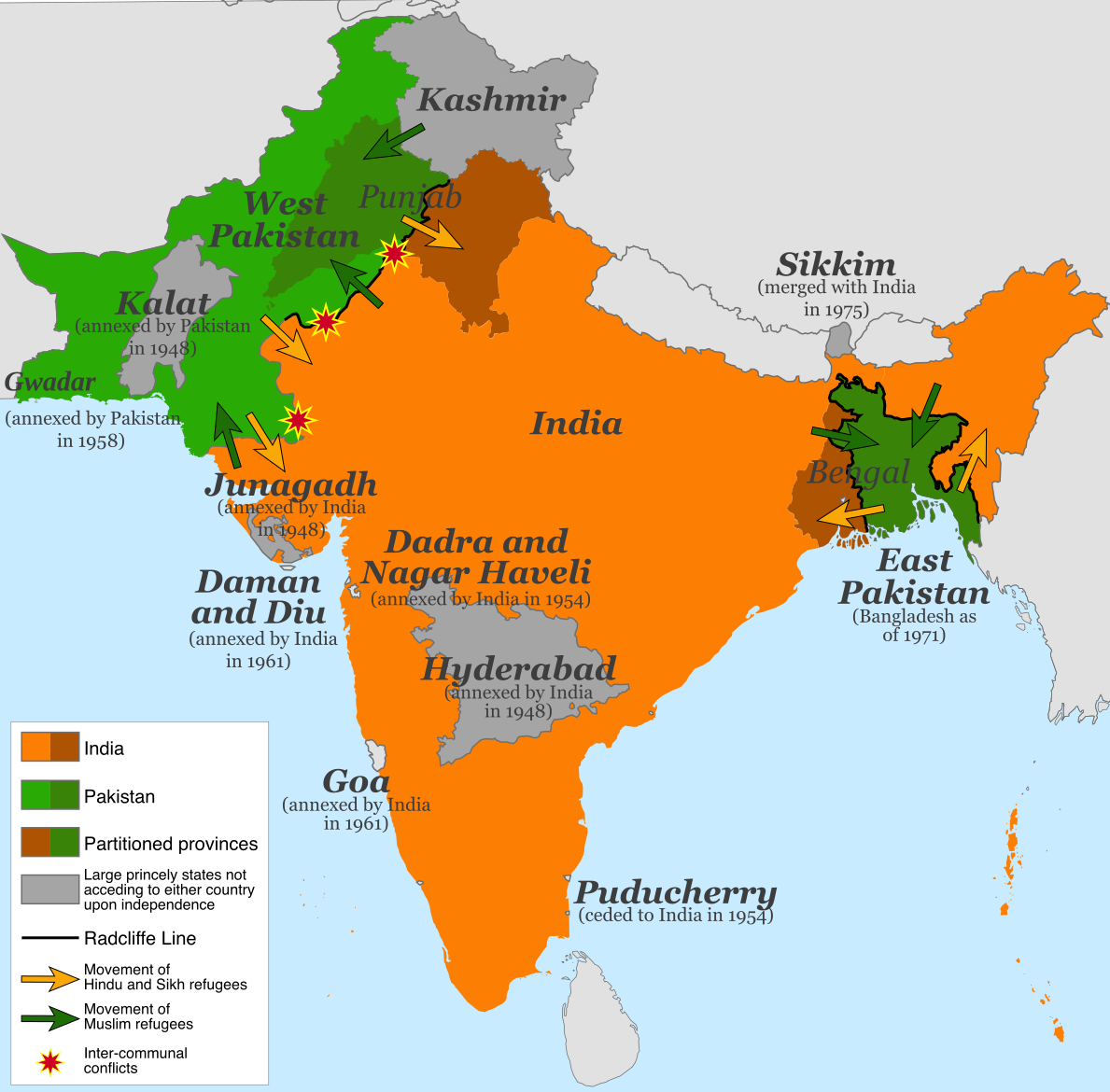
A subcontinent torn along lines drawn by a man who had never been there
Own work, CC BY-SA 4.0, via Wikimedia Commons
The question
What did the boundary commissions work from, why did Gurdaspur go to India, and what does the free record settle about the force, the dead and the displaced?
The statement read to the House of Commons when the plan was announced told the two provincial assemblies to meet in two parts, and it named the count they would be divided by: “For the purpose of determining the population of districts, the 1941 census figures will be taken as authoritative.” The Boundary Commissions were to be instructed “to demarcate the boundaries of the two parts of the Punjab on the basis of ascertaining the contiguous majority areas of Muslims and non-Muslims”, and to take into account other factors.12The Punjab commission sat in public at Lahore from 21 July to 31 July 1947, and was asked to decide before 15 August.34Its chairman signed the award at New Delhi on 12 August 1947.5
Notes 1 to 5
1Clement Attlee, Prime Minister, in the House of Commons, India (Transfer of Power) (1947)p. 36
2Clement Attlee, Prime Minister, in the House of Commons, India (Transfer of Power) (1947)p. 37
3Cyril Radcliffe, Chairman of the Punjab Boundary Commission, Report of the Punjab Boundary Commission (the Punjab... (1947)¶ 5
4Cyril Radcliffe, Chairman of the Punjab Boundary Commission, Report of the Punjab Boundary Commission (the Punjab... (1947)¶ 3
5Cyril Radcliffe, Chairman of the Punjab Boundary Commission, Report of the Punjab Boundary Commission (the Punjab... (1947)¶ 12
This thesis asks what the commissions worked from, why Gurdaspur went to India, and what the free record settles about the force that was to hold the Punjab, the dead and the displaced.It makes three claims.First, that the notional line and the terms of reference are in the record, that the census figures the commissions argued from are in it as the members reproduce them, and that every count of Gurdaspur's people in it puts the district within 2 points of half.Second, that the award placed 4 districts across the notional line, and that the only document tying Gurdaspur to Kashmir before the award is the Viceroy's own, with nothing to show it reached Radcliffe.Third, that the Boundary Force had, the police apart, one effective rifle for at least 1,600 people by its Governor's count, and that the dead and the displaced are unlike counts, which this thesis sets side by side and does not reduce to one number.
1The notional line and the terms of reference are in the record, the census figures the commissions argued from are in it as the members reproduce them, and every count of Gurdaspur's people in it puts the district within 2 points of half.
2The award placed 4 districts across the notional line, and the only document that ties Gurdaspur to Kashmir before the award is the Viceroy's own; nothing in the free record shows it reached Radcliffe.
3The force meant to hold the Punjab had, the police apart, 1 effective rifle for at least 1,600 people by its Governor's count, and the dead and the displaced are unlike counts that this thesis sets side by side and does not reduce to one number.
Shaded sentences are the reading of this thesis
The record
The primary documents this thesis holds were fetched from the UK legislation and Hansard services, from the digitised Constituent Assembly Debates, from the National Assembly of Pakistan, from the United Nations document system and from scans on the Internet Archive, and every passage below was sliced from that copy by a script rather than retyped. (the reading of this thesis)The two awards and the Sylhet report are held from the Government of India's own reprint, paragraph by paragraph and schedule paragraph by schedule paragraph. (the reading of this thesis)Three of the four reports of the Punjab commission's members, the Muslim League's memorandum, the Governor of the Punjab's note to the Viceroy of that March, the Viceroy's press conference and the liaison agency's recovery letter are held from Kirpal Singh's documentary collection, and the pages given are the collection's. The Transfer of Power volumes are Crown copyright, so they are held only as at most five passages each, and Mountbatten's own last report is among what the cap leaves out. (the reading of this thesis)The scholarship is held only as the passages cited, and one source is in Punjabi, with a rendering marked as this thesis's own. (the reading of this thesis)What the record does not hold is listed under the gaps below, by name, with what was tried. (the reading of this thesis)The largest are the Punjab volume of the census the commission argued from, which is known here only as the commission's members reproduce it; the report of the second League-nominated judge, which the collection carries and this pass did not slice; the two governments' submissions to the Security Council, which were fetched but whose text layers are unreadable; the one peer-reviewed demographic count of the Punjab's dead, which is paywalled; and every Urdu, Hindi and Bengali source that could be found, none of which could be read as text. (the reading of this thesis)The Indian fact-finding body's own statement of the limits of counting comes first. (the reading of this thesis)It wrote that the census returns of 1941 “were not accurate even at the time they were compiled”, that they became “hopelessly wrong, at the end of six years”, and that its own witnesses covered 2,094 of the 19,914 villages of West Punjab.6
Note 6
6Gopal Das Khosla, for the Fact Finding Organisation of the Government of India, Stern Reckoning (1949)p. 298
Primary documents held with extracts
31 of 31
Scholarship verified to exist as named
20 of 22
Of which read at a free copy and pinned
10
Positions, each with a source by a holder
7 of 7
Sources from the region or in its languages
29
Exhibits with full provenance
7
Findings of this thesis, with their working
4
Extracts stored verbatim
91
What the free record could not reach
Jalal's argument that Pakistan was a bargaining counter, and her reading of the League's demandthe Internet Archive item the event YAML names is a controlled lending copy that this container cannot open; no open chapter found. The position rests on the work as named and on Jinnah's own addressTriedarchive.org
Pandey's account of the violence and of the count of the deadpaywalled; no open chapter found. The event YAML attributes a figure of 2 million to Pandey and Butalia; neither passage could be read, so the figure is not published hereTrieddoi.org
Khan's narrative of the summer of 1947controlled lending copy, not openable from this containerTriedarchive.org
the demographic estimate of the Punjab's dead and missing from the 1931, 1941 and 1951 censusespaywalled (Taylor and Francis); OpenAlex lists no open copy. The one peer-reviewed count of the Punjab's dead could not be read, so the range below carries the fact-finding body, the Sikh account and the economists, not the demographersTrieddoi.org
the standard monograph on the Radcliffe Commission, including the chapter on water as 'the key' that Gilmartin citespaywalled; the author's 2002 article in American Diplomacy was fetched but that journal is editor-reviewed, not peer-reviewed, so it is not admitted as Tier B and is not citedTrieddoi.orgamericandiplomacy.web.unc.edu
Talbot's open-access survey of the legacies of Partitionthe journal's PDF endpoint answered HTTP 500 twice and 404 on the galley path; the article is open access and could not be read from this containerTriedjournals.akademicka.pljournals.akademicka.pl
Leake and Haines on border-making 1947 to 1965the open-access PDF answered a Cambridge Core page saying access was suspended under 'additional assurance measures'; not readable from this containerTriedwww.cambridge.org
Fitzpatrick on Spate and the maps of the partitionthe Edinburgh repository answered HTTP 403 with a JavaScript challengeTriedwww.research.ed.ac.uk
Rahman and van Schendel on migration across the Bengal border as the migrants describe itthe open-access PDF answered the same Cambridge Core suspension pageTriedwww.cambridge.org
Kaur on caste inside the rehabilitation of Punjabi migrants in Delhipaywalled; no open chapter foundTrieddoi.org
Butalia's interviews with abducted and recovered women, and the passage the event YAML quotesthe Internet Archive item the event YAML names is a controlled lending copy; not openable from this container. The YAML's quotation 'You think you are saving us? You are tearing us apart again' is attributed to Menon and Bhasin and could not be read in either book; it is not published hereTriedarchive.org
the count of about 75,000 abducted women and the recovery figures the event YAML attributes to this bookno Crossref record and no open copy; the figures are not published here as factTriedapi.crossref.org
the appendices of witness statements the SGPC compilation carriesreadable, but a Tier D compilation, so its statements are held only as the position's own count and not as testimonyTriedarchive.org
The Transfer of Power volumes beyond the five extracts the cap allows from each: Mountbatten's Personal Report No. 17 of 16 August 1947 (vol. XII, No. 489), which is his own account of withholding the awards until after 15 August, and the Punjab Boundary Force's establishment and reinforcementfetched whole, but Crown copyright, so held only as five passages; the volume's introduction says the awards were 'not published till 16 August' and this thesis states the publication date only as thatTriedarchive.org
The report of Mr. Justice Muhammad Munir of 6 August 1947, the second of the two League-nominated members of the Punjab Boundary Commissionthe collection carries it at pages 409 to 444 and it was fetched with the rest, but it was not sliced or read against the thesis in this pass; the League's case before the commission is therefore held from Din Mohammad alone, and under Rule B the Pakistani judges' reasoning rests on one of its two authorsTriedarchive.org
A Bengali survivor's testimony of the eastern partition, in any languagethe four testimonies held are all of the Punjab; no free, readable first-person account from Bengal was found, so the eastern partition is known here through scholarship and the awardTriedwww.1947partitionarchive.orgapi.openalex.org
A Dalit voice on the partition, or on caste inside the migration and the campsKaur's chapter on caste inside the rehabilitation of Punjabi migrants is paywalled, and no testimony in this record names caste; the record holds no Dalit voiceTrieddoi.org
Census of India 1941, Volume VI, Punjab, with the district and tehsil tables by community that the Boundary Commission's parties argued fromthe Internet Archive holds the Punjab age tables only (in.ernet.dli.2015.547583); the community tables by district are known here as the commission's own members reproduce themTriedarchive.orgarchive.org
Census of India 1941, Volume IV, Bengal Tables, Table XIII (community by district)fetched, but the OCR text layer of the community table is too damaged to read a district row with confidence; the Bengal comparison below therefore uses the 3 June appendix's list, not the census figuresTriedarchive.org
The complaint of India to the Security Council of 1 January 1948 (S/628) and Pakistan's reply of 15 January 1948 (S/646), which carry the two governments' accounts of the accession of Jammu and Kashmirboth PDFs were fetched from ODS, but their text layers are OCR garbage (every third word broken), so nothing can be pinned; the accession is cited here only as the Commons was told of it on 30 October 1947 and as resolution 47 frames itTrieddocuments.un.orgdocuments.un.org
The Instrument of Accession of Jammu and Kashmir, 26 October 1947HTTP 404 at the Ministry of External Affairs; no other free official copy foundTriedwww.mea.gov.in
Major-General Rees's report on the Punjab Boundary Force, and the Force's nominal strengthnot found in any open archive; the Force is known here only at the strengths the Governor of the Punjab reported on 8 and 13 August 1947, and the event YAML's 25,000 has no document behind it in this recordTriedarchive.org
The source of the estimate of 200,000 dead that the event record calls 'early British figures'Penderel Moon's Divide and Quit (1961), the usual source, is not in any open archive; the lowest figure this record holds is the Indian fact-finding body'sTriedarchive.org
Amrita Pritam's poem in a scholarly edition, and any Urdu, Hindi or Bengali source that could be read as textthe Tokyo University of Foreign Studies repository holds a 1947 Urdu pamphlet (Musalmanon ki duain) as an image scan with no text layer; the Al-Qalam journal's host does not resolve; Rekhta's search pages are rendered by script and the Faiz nazm could not be reached by URL; the Gandhi Heritage Portal is script-rendered; OpenAlex lists no open-access Bengali work on 1947. The archive.org item holding Gandhi's Calcutta prayer speeches carries the Hindi audio but no Hindi transcript. The one non-English source this record holds is the Punjabi poemTriedtufs.repo.nii.ac.jpwww.journal.alqalamjournalpu.comwww.rekhta.orgwww.gandhiheritageportal.orgapi.openalex.org
Testimony and scholarship that was found and refusedFerdous 2021 and Sharma and Mathur Velath 2021 (Journal of Migration Affairs) and Aslam 2020 (Pakistan Journal of Women's Studies) resolve to hijacked domains serving gambling pages; Jamil 2018 sits behind a JavaScript wall and its publisher is not admitted as peer-reviewed; Shonchoy and Tsubota 2016 is a discussion paper, not peer-reviewed; the Hindi article on Haryana's refugees (Zenodo, 2026) is self-deposited in a journal this record cannot verify as peer-reviewed; Bharadwaj, Khwaja and Mian 2008 on SSRN answered HTTP 403Triedmigrationaffairs.comdoi.orgrhpsnet.comir.ide.go.jpdoi.orgpapers.ssrn.com
The argument
1The date and the census
The Act set the appointed day as “the fifteenth day of August, nineteen hundred and forty-seven”, and set up two Dominions, India and Pakistan.7From that day the suzerainty of the Crown over the Indian States lapsed, and with it every treaty and agreement between the Crown and their rulers.8The Prime Minister told the Commons that the time given to the Bill was not commensurate with its importance and that the Government was constrained by the urgency of the matter.9In the Lords the Secretary of State said the House was being asked for a passage “so rapid as to be almost unprecedented” and that it might appear “a degree of haste that is almost unseemly”.10
Notes 7 to 10
7Parliament of the United Kingdom, Indian Independence Act 1947§ 1
8Parliament of the United Kingdom, Indian Independence Act 1947§ 7
9Clement Attlee, Prime Minister, in the House of Commons, Indian Independence Bill, second reading, 10 July 1947p. 2447
10The Earl of Listowel, Secretary of State for India and Burma, in the House of Lords, Indian Independence Bill, second reading in the Lords,... (1947)p. 802
The plan's own instrument was the notional division: the assemblies of Bengal and the Punjab would sit in two parts according to Muslim-majority and non-Muslim-majority districts, and until a commission's report was put into effect “the provisional boundaries indicated in the Appendix to the White Paper will be used”.11The appendix lists the Muslim-majority districts by the 1941 census: in Bengal the listed districts of the Chittagong, Dacca, Presidency and Rajshahi divisions; in the Punjab the listed districts of the Lahore, Rawalpindi and Multan divisions, Gurdaspur among them.12
Notes 11 to 12
11Clement Attlee, Prime Minister, in the House of Commons, India (Transfer of Power) (1947)p. 37
12Nicholas Mansergh and Penderel Moon (eds.), Constitutional Relations between Britain and India (1982)item 45Exhibit 1
Exhibit 1DocumentHis Majesty's Government, 3 June 1947
The Appendix to the Statement of 3 June 1947: the Muslim-majority districts by the 1941 census
APPENDIX
Muslim Majority Districts of Bengal and the Punjab
according
i. Bengal
Chittagong Division
Chittagong.
Noakhali.
Tippera.
Dacca Division
Bakarganj.
Dacca.
Faridpur.
Mymensingh.
Presidency Division
Jessore.
Murshidabad.
Nadia.
o the 1941 Census
2. The Punjab
Lahore Division
Gujranwala.
Gurdaspur.
Lahore.
Sheikhupura.
Sialkot.
Rawalpindi Division
Attock.
Gujrat.
Jhelum.
Mianwali.
Rawalpindi.
Shahpur.
Rajshahi Division
Bogra.
Dinajpur.
Malda.
Pabna.
Rajshahi.
Rangpur.
Multan Division
Dera Ghazi Khan.
Jhang.
Lyallpur.
Montgomery.
Multan.
Muzaffargarh.
Locator
item 45
Held by
Internet Archive (The Transfer of Power, vol. XI, No. 45), constitutionalre06nich
Rights
Crown copyright, held as the passage cited
The commissions did not work from surveys of their own. (the reading of this thesis)Answering the commission's secretaries on 23 July 1947, Sir George Abell “did not attach the map but suggested that any map if read with the population statistics in the 1941 census would suffice for the purpose”.13The parties argued from that census, and against it. (the reading of this thesis)The League-nominated judge wrote that the Muslims of Gurdaspur were 51.14 per cent of its people against 48.86 non-Muslim, and printed the four tehsils' communities from the 1941 census.1415The Congress-nominated judge took the same district total of 1,153,511, with 589,923 Muslims and 563,488 non-Muslims, and set against it an affidavit on an arithmetical error in the Shakargarh register that would reduce the Muslim majority from 26,000 to 20,000.16The event record's claim that the maps Radcliffe worked from had not been resurveyed since the census before last is carried by no document this record holds, and the episode's line that he worked from the last census is. (the reading of this thesis)
Notes 13 to 16
13Nicholas Mansergh and Penderel Moon (eds.), Constitutional Relations between Britain and India (1983)item 196
14Din Mohammad, member of the Punjab Boundary Commission (nominated by the Muslim League), Report of Mr. Justice Din Mohammad, 5 August 1947pp. 389 to 390
15Din Mohammad, member of the Punjab Boundary Commission (nominated by the Muslim League), Report of Mr. Justice Din Mohammad, 5 August 1947pp. 383 to 385
16Mehr Chand Mahajan, member of the Punjab Boundary Commission (nominated by the Congress), Report of Mr. Justice Meher Chand Mahajan, 3 August 1947pp. 327 to 328
2The commission and the line
The Punjab commission was constituted by the Governor-General's announcement of 30 June 1947, with Din Muhammad, Muhammad Munir, Mehr Chand Mahajan and Teja Singh as members and Radcliffe appointed chairman afterwards.17Radcliffe did not attend the public sittings in person, because the Bengal commission was sitting at the same time, and had the daily record sent to him.18After the sittings the commission adjourned to Simla, where the divergence between the members proved so wide that no agreed line was possible, and they assented to his giving his own decision.19The Prime Minister had told the Commons that Radcliffe “has accepted the request made to him by all parties in the Government of India to be chairman of both Commissions”.20
Notes 17 to 20
17Cyril Radcliffe, Chairman of the Punjab Boundary Commission, Report of the Punjab Boundary Commission (the Punjab... (1947)¶ 2
18Cyril Radcliffe, Chairman of the Punjab Boundary Commission, Report of the Punjab Boundary Commission (the Punjab... (1947)¶ 5
19Cyril Radcliffe, Chairman of the Punjab Boundary Commission, Report of the Punjab Boundary Commission (the Punjab... (1947)¶ 6
20Clement Attlee, Prime Minister, in the House of Commons, Indian Independence Bill, second reading, 10 July 1947p. 2448
Exhibit 2DocumentCyril Radcliffe, 12 August 1947
The Punjab award, paragraph 9: the debatable ground
9. The task of delimiting a boundary in the Punjab is a difficult one. The claims of the respective parties ranged over a wide field of territory, but in my judgment the truly debatable ground in the end proved to lie in and around the area between the Beas and Sutlej rivers on the one hand, and the River Ravi on the other. The fixing of a boundary in this area was further complicated by the existence of canal systems, so vital to the life of the Punjab but developed only under the conception of a single administration, and of systems of road and rail communication, which have been planned in the same way. There was also the stubborn geographical fact of the respective situations of Lahore and Amritsar, and the claims to each or both of those cities which each side vigorously maintained. After weighing to the best of my ability such other factors as appeared to me relevant as affecting the fundamental basis of contiguous majority areas, I have come to the decision set out in the Schedule which thus becomes the award of the Commission. I am conscious that there are legitimate criticisms to be made of it: as there are, I think, of any other line that might be chosen.
Locator
¶ 9
Held by
Internet Archive, Digital Library of India collection (Government of India Press reprint, 1958), dli.csl.1040
Rights
Government of India publication of 1958, public domain
The award names its own reasons. (the reading of this thesis)Radcliffe hesitated “long over those not inconsiderable areas east of the Sutlej River and in the angle of the Beas and Sutlej Rivers in which Muslim majorities are found”, and left them to the East Punjab, in the true interests of neither State and because of “the disruption of railway communications and water systems”.21He could not preserve the Upper Bari Doab Canal undivided, or the Mandi hydro-electric scheme, and hoped for joint control by agreement.22He wrote that the award could not satisfy “sentiments and aspirations deeply held on either side” and that the means to gratify them lay in political arrangements with which he was not concerned.23Gilmartin reads the same paragraphs as a chairman who saw water as the most important of the other factors.24
Notes 21 to 24
21Cyril Radcliffe, Chairman of the Punjab Boundary Commission, Report of the Punjab Boundary Commission (the Punjab... (1947)¶ 10
22Cyril Radcliffe, Chairman of the Punjab Boundary Commission, Report of the Punjab Boundary Commission (the Punjab... (1947)¶ 11
23Cyril Radcliffe, Chairman of the Punjab Boundary Commission, Report of the Punjab Boundary Commission (the Punjab... (1947)¶ 12
24David Gilmartin, Nation and Region in the Post-Partition Remaking of the... (2024)pp. 85 to 86
AnalysisThe finding of this thesis, from the rows below
The notional line against the award, district by district
Method Every district the award's schedules name or place, one row per district, read against the Appendix to the Statement of 3 June 1947 (src-top-xi.item45), which lists the Muslim-majority districts by the 1941 census. The listed column is read from the appendix; the award column from the schedule paragraph the row cites, the districts west of the Bengal line and the remainder rule for the rest; crossed is yes where the award put a listed district wholly or mostly on the non-Muslim side or an unlisted district on the Muslim side, part where the schedule divides the district along thana lines, and no otherwise; crossed_n is 1 for yes and 0 otherwise. The result is the sum of crossed_n, the number of districts the award put across the line. No share is given, because the schedules place every other district of both provinces by remainder and the two documents let this thesis name only the 40 rows below.
Rows the analysis is computed from, each traced to an extract
Computed over 40 rows, sum of crossed_n = 4; result 4
Of the 40 districts the appendix lists or the schedules name, the award put 4 across the notional line: Murshidabad, Khulna and the Chittagong Hill Tracts in Bengal, and Gurdaspur, three of whose four tehsils went east, in the Punjab; 5 more it divided along thana lines. The other 31 fell where the 3 June list had put them.
Confidence high for the whole districts, whose side the schedule states in words; moderate for the divided ones, where which part is larger is this thesis's reading of the thana list. Against it the Bengal report itself says the parties propounded the most diverse solutions and that the province offers few satisfactory natural boundaries, so a count of crossings measures the award against the notional list, not against any alternative line; the Sylhet transfer, decided by referendum and a separate report, is outside the count
partition-of-india
In Bengal the report says the province offers few satisfactory natural boundaries and that its development “has been on lines that do not well accord with a division by contiguous majority areas”.65Its questions were whether Calcutta could be divided, what territory the city needed, whether the river line could displace the Muslim majorities of Jessore and Nadia, whether Khulna could be held apart from Jessore, and to which State Darjeeling, Jalpaiguri and the Chittagong Hill Tracts should go, the last with a Muslim population of only 3 per cent.66The colleagues could not agree on any of these, and the chairman decided.67The schedule leaves Murshidabad west of the line and turns south along the Khulna and 24-Parganas boundary to the sea, so Khulna went east.6869Gandhi, at a prayer meeting in Calcutta after the award, deplored that “Khulna was to celebrate” its entry into Pakistan and said the award must be regarded as final “except to the extent that the ministers of the two Dominions agreed to vary it”.70In Sylhet, 8 of 55 thanas had non-Muslim majorities, and the chairman found that a division on majorities alone would leave the six non-Muslim thanas divorced from the rest of Assam and sever the railway, so he exchanged territory.717273
Notes 65 to 73
65Cyril Radcliffe, Chairman of the Bengal Boundary Commission, Report of the Bengal Boundary Commission (the Bengal... (1947)¶ 7
66Cyril Radcliffe, Chairman of the Bengal Boundary Commission, Report of the Bengal Boundary Commission (the Bengal... (1947)¶ 8
67Cyril Radcliffe, Chairman of the Bengal Boundary Commission, Report of the Bengal Boundary Commission (the Bengal... (1947)¶ 9
68Cyril Radcliffe, Chairman of the Bengal Boundary Commission, Report of the Bengal Boundary Commission (the Bengal... (1947)item 5
69Cyril Radcliffe, Chairman of the Bengal Boundary Commission, Report of the Bengal Boundary Commission (the Bengal... (1947)item 8
70M. K. Gandhi, speech at a prayer meeting, Calcutta, 24 August 1947, as reported in Harijan, Speech at prayer meeting, Calcutta, 24 August 1947¶ 6
71Cyril Radcliffe, Chairman of the Bengal Boundary Commission, Report of the Bengal Boundary Commission (Sylhet... (1947)¶ 10
72Cyril Radcliffe, Chairman of the Bengal Boundary Commission, Report of the Bengal Boundary Commission (Sylhet... (1947)¶ 12
73Cyril Radcliffe, Chairman of the Bengal Boundary Commission, Report of the Bengal Boundary Commission (Sylhet... (1947)¶ 13
3Gurdaspur
Every count of the district's people in the record puts the Muslim share a little over half, and the disagreement is over which count should rule. (the reading of this thesis)The Sikh committee's note to Cripps tabled the district at 50.8 per cent Muslim by the 1931 census and called the three central districts balanced.7475The Governor of the Punjab wrote, in the note he sent Lord Wavell, the Viceroy, that March, that Gurdaspur had 590,000 Muslims and 560,000 non-Muslims, that the Pathankot tehsil was predominantly non-Muslim, and that the other three tehsils had small Muslim majorities.76Asked on 4 June 1947 why the final boundaries would almost certainly differ from the provisional ones, the Viceroy answered that Gurdaspur's population was “50.4 per cent Muslims”, and that with a difference of 0.8 per cent it was unlikely the commission would throw the whole district into the Muslim majority areas.77The League's memorandum proposed a line on which every tehsil of Gurdaspur but Pathankot stayed in the West Punjab and the Ajnala tehsil of Amritsar joined it.78The League's judge put the Muslim share at 51.14 per cent and the tehsils at 52.1, 55.06, 51.3 and 38.8.7980The Congress's judge answered with the electoral rolls, 74,790 Muslim voters against 81,525 non-Muslim, and asked why the plebiscite test used in Sylhet and the Frontier should not apply to a district whose population majority was 1 per cent or a little more.81
Notes 74 to 81
74Sikh All Parties Committee, Amritsar, Note on the Sikhs' Position, appended to the memorandum... (1942)p. 7
75Sikh All Parties Committee, Amritsar, Note on the Sikhs' Position, appended to the memorandum... (1942)pp. 6 to 7
76Evan Jenkins, Governor of the Punjab, The Punjab Problem, enclosure to letter No. 653 to Lord... (1947)pp. 19 to 20
77Lord Mountbatten, Viceroy, at his press conference of 4 June 1947, Reproduction of some answers given at the press... (1947)pp. 99 to 100
78All-India Muslim League, Memorandum submitted to the Punjab Boundary Commission... (1947)pp. 184 to 185
79Din Mohammad, member of the Punjab Boundary Commission (nominated by the Muslim League), Report of Mr. Justice Din Mohammad, 5 August 1947pp. 389 to 390
80Din Mohammad, member of the Punjab Boundary Commission (nominated by the Muslim League), Report of Mr. Justice Din Mohammad, 5 August 1947pp. 383 to 385
81Mehr Chand Mahajan, member of the Punjab Boundary Commission (nominated by the Congress), Report of Mr. Justice Meher Chand Mahajan, 3 August 1947pp. 328 to 329
AnalysisThe finding of this thesis, from the rows below
Every count of Gurdaspur in the record
Method Every figure a fetched document gives for the Muslim share of Gurdaspur district's people, one row per figure, with the document, its census year and the side it was written from; where the document gives counts rather than a share (the Governor's 590,000 Muslims and 560,000 non-Muslims), the share is the Muslim count over the two, to one decimal. The result is the range of the column.
Rows the analysis is computed from, each traced to an extract
Computed over 5 rows, range of muslim_share = 50.4 to 51.3; result 50.4 to 51.3
Five documents from four sides put the Muslim share of Gurdaspur's people between 50.4 and 51.3 per cent, and no count of its people in the record puts it below half; the one count that runs the other way is of voters, 74,790 Muslim to 81,525 non-Muslim, which is 47.8 per cent.
Confidence high for the range, which is the extreme of five figures from five documents of four sides; the figures rest on two censuses, so the range spans 1931 and 1941 rather than one count. Against it the Congress-nominated judge's report carries an affidavit that reduces the 1941 majority from 26,435 to about 20,000 and electoral rolls with 81,525 non-Muslim voters to 74,790 Muslim; the Viceroy's 50.4 is described by the League's judge as an error, and the Viceroy himself said 'I think' when he gave it
partition-of-india
The schedule follows the Ujh river down the western boundary of the Pathankot tahsil to the point where the Pathankot, Shakargarh and Gurdaspur tahsils meet, and then the Ravi along the boundary between the Gurdaspur and Shakargarh tahsils and between Batala and Shakargarh, so Shakargarh went west and the other three tahsils east.8788Lord Ismay received a message from Liaquat Ali Khan whose gist, as he restated it, was that Gurdaspur or a large portion of it had been given to East Punjab, that the report was that this was “a political decision, and not a judicial one”, and that if so it was a grave injustice amounting to a breach of faith.89Ismay answered that the Viceroy had from the outset made it clear he must have nothing to do with the commissions and that the Indian leaders had themselves selected them, drafted their terms and undertaken to implement the award.90
Notes 87 to 90
87Cyril Radcliffe, Chairman of the Punjab Boundary Commission, Report of the Punjab Boundary Commission (the Punjab... (1947)item 1
88Cyril Radcliffe, Chairman of the Punjab Boundary Commission, Report of the Punjab Boundary Commission (the Punjab... (1947)item 2
89Nicholas Mansergh and Penderel Moon (eds.), Constitutional Relations between Britain and India (1983)item 428
90Nicholas Mansergh and Penderel Moon (eds.), Constitutional Relations between Britain and India (1983)item 428
The Viceroy's own record of an interview eight days before the award was signed has him telling the Nawab of Bhopal that Kashmir “was so placed geographically that it could join either Dominion, provided part of Gurdaspur were put into East Punjab by the Boundary Commission”.91That sentence is the only document in this record that ties Gurdaspur to Kashmir before the award, and it is the Viceroy's, not Radcliffe's. The award's reasons do not mention Kashmir, and the schedule names the State of Kashmir only as the place where the west branch of the Ujh enters the Punjab. (the reading of this thesis)929394The two stated grounds that name Gurdaspur or its tahsils are the Upper Bari Doab Canal from Madhopur in Pathankot, which the chairman could not preserve undivided, and the Mandi hydro-electric scheme, which supplies Gurdaspur among the districts it names and which he could not keep under one jurisdiction; the passage on the Sutlej and the Ferozepore headworks concerns Ferozepore, not Gurdaspur.9596Those grounds are what the Pakistani account's charge of a political decision is set against, and the award says no more of them than that. (the reading of this thesis)The record therefore shows a motive on the Viceroy's side and no document that carries it to the chairman, and this thesis says no more than that. (the reading of this thesis)At the end of October the Commons was told that some 2,000 armed raiders had entered Kashmir on or about 22 October, that the Maharaja had appealed to India on 26 October and asked leave to accede, and that on 27 October his accession was accepted “subject to a reference to the people of Kashmir”.97The Security Council's resolution 47 of 21 April 1948 noted that both governments desired the accession “decided through the democratic method of a free and impartial plebiscite” and recommended measures to bring it about, beginning with the withdrawal of tribesmen and Pakistani nationals.9899100Schofield's reading is that the plebiscite has never been held, the state remaining divided in fact between the two countries, and her paper examines why it was not held.101
Notes 91 to 101
91Nicholas Mansergh and Penderel Moon (eds.), Constitutional Relations between Britain and India (1983)item 335
92Cyril Radcliffe, Chairman of the Punjab Boundary Commission, Report of the Punjab Boundary Commission (the Punjab... (1947)¶ 9Exhibit 2
93Cyril Radcliffe, Chairman of the Punjab Boundary Commission, Report of the Punjab Boundary Commission (the Punjab... (1947)¶ 11
94Cyril Radcliffe, Chairman of the Punjab Boundary Commission, Report of the Punjab Boundary Commission (the Punjab... (1947)item 1
95Cyril Radcliffe, Chairman of the Punjab Boundary Commission, Report of the Punjab Boundary Commission (the Punjab... (1947)¶ 11
96Cyril Radcliffe, Chairman of the Punjab Boundary Commission, Report of the Punjab Boundary Commission (the Punjab... (1947)¶ 10
97Philip Noel-Baker, Secretary of State for Commonwealth Relations, in the House of Commons, Kashmir (Situation) (1947)p. 1086
98United Nations Security Council, Resolution 47 (1948) of 21 April 1948preambular para. 1
99United Nations Security Council, Resolution 47 (1948) of 21 April 1948preambular para. 3
100United Nations Security Council, Resolution 47 (1948) of 21 April 1948operative para. 1
101Victoria Schofield, Plebiscite Conundrum in Jammu and Kashmir (1947 to the... (2022)p. 17
4The force
In the first of two reports on the Force, the Governor of the Punjab told the Viceroy that its Commander put his 5 brigade groups at an average of 1500 effective rifles, “say 7500 effective rifles to control 12 districts with a population of no less than 12 million”, and that static troops and training centres would add another 1500.102In the second, a letter written the day after the award was signed, he wrote that the population of the districts was distributed over 17,932 inhabited towns and villages, that he had estimated the need at a minimum of about 20,000 effective fighting men, and gave the effective strength as about 7,500, or about 9,000 with static troops.103The episode's count of the Force is not one this record holds. (the reading of this thesis)
Notes 102 to 103
102Nicholas Mansergh and Penderel Moon (eds.), Constitutional Relations between Britain and India (1983)item 382
103Nicholas Mansergh and Penderel Moon (eds.), Constitutional Relations between Britain and India (1983)item 459Exhibit 3
Exhibit 3DocumentEvan Jenkins, 13 August 1947
The Governor of the Punjab on the Boundary Force, 13 August 1947
5. The Commander, Punjab Boundary Force, has a most difficult task. The population of the twelve districts in which he is operating is close on 14.5 million, and this population is distributed over 17,932 inhabited towns and villages. When the possibility of the enforcement of a Boundary award was first discussed, I estimated that we should need at least two Divisions of full strength and on a War footing — i.e. a minimum of about 20,000 effective fighting men. The effective strength of the P.B.F. is at present about 7,500, or including static troops and training centres about 9,000. Now that the Police are definitely unreliable in Lahore and Amritsar, the troops have a rapidly increasing responsibility. Neither the railways nor the main roads are safe, and the village raiding is quite impossible to control without a very great display of force. Fire power is really less important than numbers.
Locator
item 459
Held by
Internet Archive (The Transfer of Power, vol. XII, No. 459), indiatransferofp12nich
Rights
Crown copyright, held as the passage cited
AnalysisThe finding of this thesis, from the rows below
One rifle for at least 1,600 people
Method The Governor of the Punjab's telegram of 8 August 1947 gives the Boundary Force's strength as 5 brigade groups averaging 1,500 effective rifles, 7,500 in all, for 12 districts with a population of no less than 12 million. One row; the result is the population divided by the rifles.
Rows the analysis is computed from, each traced to an extract
document
population
rifles
Extract
Jenkins to Mountbatten, telegram No. 219-G, 8 August 1947, paragraph 4
Computed over 1 rows, sum population / sum rifles = 1.2e+07/7500; result 1600
By the Governor's telegram of 8 August 1947, the Boundary Force had, in addition to police, one effective rifle for at least 1,600 people in the 12 districts it was to hold: the telegram says 'no less than 12 million', so the ratio is a floor.
Confidence high: both figures sit in one sentence of one telegram, and the result is a division. Against it the strength is 'in addition to police', whose numbers the telegram does not give, so the ratio counts the Force alone; the same Governor's letter of 13 August gives 14.5 million people and about 9,000 including static troops and training centres, which is one rifle to about 1,611, and 17,932 inhabited towns and villages; and he had estimated the need at a minimum of about 20,000 effective fighting men, so the ratio measures the force he had, not the force the task needed
partition-of-india
The same telegram said that rural raiding in areas where the communities were inextricably mixed could not be checked except by a display and use of force on a massive scale, and said interception of raiders was vital.105What the Governor described is a force that had been asked for and counted before the line existed, and found short the day after the line was signed. (the reading of this thesis)
Note 105
105Nicholas Mansergh and Penderel Moon (eds.), Constitutional Relations between Britain and India (1983)item 382
5The count
The Indian fact-finding body examined “nearly fifteen thousand witnesses” who bore testimony to the murder of “fifty thousand non-Muslims”, and said the incidents deposed to represented only a fraction of the devastation.106Taking that into account it estimated the loss of non-Muslim life “at a figure between 200,000 and 250,000”, and believed “an equal number of Muslims perished in the course of the riots in India”.107The economists write of “nearly a million deaths due to the riots” and of “a mass migration and population transfer of nearly 17 million people”, and put the displaced at “14.5 million people” within four years of partition.108109The figures are set beside each other in the disagreements below, and this thesis states no single number. (the reading of this thesis)
Notes 106 to 109
106Gopal Das Khosla, for the Fact Finding Organisation of the Government of India, Stern Reckoning (1949)p. 298
107Gopal Das Khosla, for the Fact Finding Organisation of the Government of India, Stern Reckoning (1949)p. 299
108Prashant Bharadwaj and Rinchan Ali Mirza, Displacement and development (2019)p. 1
109Prashant Bharadwaj and Rinchan Ali Mirza, Displacement and development (2019)p. 5
AnalysisThe finding of this thesis, from the rows below
One migration, five counts
Method Every figure the fetched documents give for the number of people displaced by the partition, one row per figure, in millions as the document states it, with the border, the period and the direction each figure counts. The result is the number of rows. No range is taken across them, because they do not count the same thing.
Rows the analysis is computed from, each traced to an extract
The record holds five counts of five different things: one border by December 1947 (8.5 million), one direction by 1951 (7.3 million), both borders over four years (14.5 million), the whole transfer (nearly 17 million), and one province over twenty years (at least 6 million). The only two that count the whole transfer are the economists' own, 14.5 to 17 million, both from Bharadwaj and Mirza, the first citing Bharadwaj, Khwaja and Mian.
Confidence high for the count of rows; the 14.5 to 17 span is one producer's, and the other three are not comparable with it or with each other. Against it the SGPC compilation's 'over twelve millions' and the Indian fact-finding body's warning that refugee estimates 'do not give a true picture' are both in the record and neither is a digit this table can hold; the Hansard figure is 'or thereabouts' and covers the Punjab only
partition-of-india
The Commons was told in December that the number of refugees who had moved between East Punjab and West Punjab, both ways, “is 8,500,000 or thereabouts”, and the economists put the displaced at “14.5 million people” within four years.115116They cite the 1951 census of India, which enumerated “7.3 million displaced persons”, of whom “4.7 and 2.55 million had come from West and East Pakistan, respectively”.117In the east the count runs on: Chatterji writes that between 1947 and 1967 “at least 6 million Hindu refugees from East Bengal crossed into West Bengal”.118Mahbub and Saba, from Dhaka, write that the violence on the eastern side was more protracted and more episodic, beginning with the Kolkata and Noakhali riots of 1946, while the west saw massacres from 1947 to 1950.119
Notes 115 to 119
115Philip Noel-Baker, Secretary of State for Commonwealth Relations, in the House of Commons, India and Pakistan (Refugees, Relief) (1947)p. 1845
116Prashant Bharadwaj and Rinchan Ali Mirza, Displacement and development (2019)p. 5
117Prashant Bharadwaj and Rinchan Ali Mirza, Displacement and development (2019)p. 40
118Joya Chatterji, The Spoils of Partition (2007)pp. 1 to 2
119Rifat Mahbub and Anika Saba, Homed, Unhomed and Rehomed in Partition Stories of East... (2018)p. 109
6The women
Sarla Dutta was abducted on the road with two or three other girls, converted and renamed Anwar, and kept in the house of a man with three children.120When an army search came looking for abducted girls, her abductor put her inside the seed drum, and she slid her hand through an opening and screamed; she was 13.121The two governments had decided in December 1947, as the editor of the Punjab documents summarises it, that the conversion of persons abducted after 1 March 1947 was not to be recognised and that all such persons were to be restored to their Dominions “even against the wishes of persons concerned”.122
Notes 120 to 122
120Sarla Dutta, interviewed by Sruti Lodha for The 1947 Partition Archive, Sarla Dutta (oral history, first-person story page) (2024)¶ 5
121Sarla Dutta, interviewed by Sruti Lodha for The 1947 Partition Archive, Sarla Dutta (oral history, first-person story page) (2024)¶ 6Exhibit 4
122Kirpal Singh, Introduction, Recovery of Abducted Women (2005)§ xxxi
Exhibit 4DocumentSarla Dutta, interviewed by Sruti Lodha, story page of 20 June 2024
Sarla Dutta, abducted at 13 from Mirpur, on the search that found her
Soon after, there was a military inspection in the village I was in. A few army officials came looking for girls who had been abducted. They came to Kaalu’s house and asked about me. Having received news of this inspection, Kaalu put 13-year-old me inside a big drum, in which he normally stored seeds. Although Kaalu was strict in his instruction for me to be absolutely quiet when they came, upon hearing their questioning, I slid my hand through an opening in the drum and screamed to make myself noticed.
Locator
¶ 6
Held by
The 1947 Partition Archive, https://www.1947partitionarchive.org/sarla-dutta/
Rights
Copyright The 1947 Partition Archive, held as the passage cited
The Chief Liaison Officer wrote to the Chief Secretary of East Punjab at the end of April 1948 that in Sheikhupura about 100 abducted women were still to be recovered, that the District Liaison Officer had clues to 47 of them, and that from the start of April to 25 April only 16 women and 10 children had been recovered; in Sargodha about 100 women were still to be recovered, 28 of them reported to be with Pathans.123Dey reads Sidhwa's novel of abduction and recovery as showing a patriarchal ideology that turned women into mute signs, and language itself failing to articulate what was done to them.124Sherman, Gould and Ansari name refugee rehabilitation and the recovery of abducted women as the low-level state programmes through which recent work has bridged the study of high and low politics in the two new states.125
Notes 123 to 125
123Chief Liaison Officer (India), East Punjab Liaison Agency, Lahore, Demi-official letter No. 27581/CLO to the Chief... (1948)pp. 610 to 611
124Arunima Dey, The Female Body as the Site of Male Violence during the... (2018)p. 28
125Taylor C. Sherman, William Gould and Sarah Ansari, From Subjects to Citizens (2011)p. 2
7The villages
Khushi Muhammad Jut, born at Aloona Tola in the district of Ludhiana and seven years old when Pakistan was created, recalled his elders saying “For generations we have been living here, how can we leave our homes?”, and then Sikh migrants arriving to press their brethren to push the Muslims out.126127A friend of his father's from Jandali sent a horseman to warn them, and his father hid the family in a field near Nasrali on the land of Shadi Singh, before the attack they had been warned of.128Niamat Ali Malak, from a village in Patiala State, recalled the announcement that Pakistan had been made and people changing sides, with both communities attacking each other when they found the chance.129Bhagwant Singh Jawanda, born in 1924 in his father's village of Shanker in Ludhiana district, recalled Jinnah at Bradlaugh Hall in March 1947 telling the crowd “this is March, so march on, march on, march on!”, and Master Tara Singh advising the students at his hostel to walk in groups of 2 or 3.130131
Notes 126 to 131
126Khushi Muhammad Jut, interviewed for The 1947 Partition Archive, Khushi Muhammad Jut (oral history, story page) (2024)¶ 1
127Khushi Muhammad Jut, interviewed for The 1947 Partition Archive, Khushi Muhammad Jut (oral history, story page) (2024)¶ 8
128Khushi Muhammad Jut, interviewed for The 1947 Partition Archive, Khushi Muhammad Jut (oral history, story page) (2024)¶ 8
129Niamat Ali Malak, interviewed for The 1947 Partition Archive, Niamat Ali Malak (oral history, story page) (2024)¶ 8
130Bhagwant Singh Jawanda, interviewed for The 1947 Partition Archive, Bhagwant Singh Jawanda (oral history, story page) (2024)¶ 1
131Bhagwant Singh Jawanda, interviewed for The 1947 Partition Archive, Bhagwant Singh Jawanda (oral history, story page) (2024)¶ 5
Exhibit 5DocumentAmrita Pritam, 1947 to 1948, published 1949
Amrita Pritam, Ajj Aakhaan Waris Shah Nu, the first eight lines
Void translation, not a published quotationToday I call to Waris Shah: speak from somewhere within the graves,
and turn today some next page of the book of love.
One daughter of Punjab wept, and you wrote and wrote her laments;
today lakhs of daughters weep, and say to you, Waris Shah:
rise, you who felt for the grieving, rise and look at your own Punjab;
today the riverside groves lie strewn with corpses, and the Chenab is full of blood.
Someone has mixed poison into the five waters,
and those same waters have watered the land.
Copyright, held as the passage cited, with a Void translation beside it
The poem calls to Waris Shah to speak from the grave and turn a new page of the book of love, because one daughter of Punjab had wept and lakhs were weeping, and the Chenab was full of blood.132
Note 132
132Amrita Pritam, Ajj Aakhaan Waris Shah Nu (Today I call to Waris Shah),... (1949)§ 1Exhibit 5
Exhibit 6PhotographUnknown photographer, between 1947 and 1953, as the file page dates it
Public domain in India (the file page's tag), sourced by the uploader from a Columbia University teaching page and The Hindu
Shows
a train with passengers on its roof and in its doorways, which the file page captions as refugees; the file page gives no place, no date closer than 1947 to 1953 and no photographer
Does not show
which direction the train was going, which community its passengers belonged to, or that it is one of the trains attacked; the file page's caption is the uploader's
Exhibit 7MapWikimedia Commons contributor RaviC, derived from earlier Commons maps, with later translations by Jordi escarre, 11 February 2017, revised to 17 January 2025
a modern map of the two Dominions as its author drew them in 2017, with the princely states that did not accede drawn as parts of India and Pakistan, as its own note says
Does not show
the Radcliffe line as the award describes it thana by thana and village by village, nor the boundary of 1947 as surveyed; it is a contributor's drawing, not a document of 1947
The historiography
The British administrative account
Holders
Attlee (Commons, 3 June and 10 July 1947); Listowel (Lords, 16 July 1947); Mountbatten and his staff (Transfer of Power, vols. XI and XII); Jenkins, Governor of the Punjab; Talbot (2019)
Ian Talbot, Legacies of Partition for India and Pakistan (2019)Tier B, by a holder, not read free
Claims
Partition was the Indian parties' choice and the notional division, the commissions and their terms were theirs; the Viceroy kept out of the award; haste was the price of a divided government.
Omits
What the Viceroy's own staff wrote about Gurdaspur and Kashmir before the award, and the strength at which the Governor found the Boundary Force the day after the award was signed.
Tested against the primary record
SupportedThe 1941 census figures were to be taken as authoritative for the notional division, and the Boundary Commissions were to work from contiguous majority areas plus other factors.
Rests on documents from: Cyril Radcliffe, Chairman of the Boundary Commissions; Mehr Chand Mahajan, Punjab Boundary Commission (nominated by the Congress); Din Mohammad, Punjab Boundary Commission (nominated by the Muslim League); UK government.
The statement read to the Commons on 3 June 1947 says the 1941 figures would be authoritative; the award reproduces the terms of reference; and both the League-nominated and the Congress-nominated judges argue Gurdaspur from the 1941 census. Four producers carry the same basis.
The 5 extracts it rests on
Clement Attlee, Prime Minister, in the House of Commons, India (Transfer of Power) (1947)p. 36
The Provincial Legislative Assemblies of Bengal and the Punjab (excluding the European members) will therefore each be asked to meet in two parts, one representing the Muslim majority districts and the other the rest of the Province. For the purpose of determining the population of districts, the 1941 census figures will be taken as authoritative. The Muslim majority districts in these two Provinces are set out in the appendix to the White Paper of which copies will be available when I sit down.
Clement Attlee, Prime Minister, in the House of Commons, India (Transfer of Power) (1947)p. 37
For the immediate purpose of deciding on the issue of partition, the members of the Legislative Assemblies of Bengal and the Punjab will sit in two parts according to Muslim majority districts (as laid down in the Appendix to the White Paper) and non-Muslim majority districts. This is only a preliminary step of a purely temporary nature as it is evident that for the purposes of final partition of these Provinces a detailed investigation of boundary questions will be needed; and, as soon as a decision involving partition has been taken for either Province, a Boundary Commission will be set up by the Governor-General, the membership and terms of reference of which will be settled in consultation with those concerned. It will be instructed to demarcate the boundaries of the two parts of the Punjab on the basis of ascertaining the contiguous majority areas of Muslims and non-Muslims. It will also be instructed to take into account other factors. Similar instructions will be given to the Bengal Boundary Commission. Until the report of a Boundary Commission has been put into effect, the provisional boundaries indicated in the Appendix to the White Paper will be used.
Cyril Radcliffe, Chairman of the Punjab Boundary Commission, Report of the Punjab Boundary Commission (the Punjab... (1947)¶ 3
3. The terms of reference of the Commission, as set out in the announcement, were as follows:—
“The Boundary Commission is instructed to demarcate the boundaries of the two parts of the Punjab on the basis of ascertaining the contiguous majority areas of Muslims and non-Muslims. In doing so, it will also take into account other factors.”
We were desired to arrive at a decision as soon as possible before the 15th of August.
Din Mohammad, member of the Punjab Boundary Commission (nominated by the Muslim League), Report of Mr. Justice Din Mohammad, 5 August 1947pp. 383 to 385
Itremains now to examine the statistics of the district of Gurdaspur. It is not disputed
by the Indian National Congress that on the basis of 1941 census the percentage of the |
Muslims is 51,14 and that of the non-Muslims 48.86. The difference, therefore, is not .8 as
was stated by His Excellency the Viceroy in the Press Conference but 2,28 and this obviously
is not negligible:
This district is divided into four Tehsils, i.c., Gurdaspur, Batala, Shakargarh and
Pathankot, and the community wise population of the district is as follows:-
Community Gurdaspur Gurdaspur Batala . Shakagarh Pathankot
Tehsil Tehsil Tehsil Tehsil Tehsil
Hindus in- 283,192 59,970 33,433 116,553 376,227
cluding S.C. .
Sikhs 221,261 76,695 116,413 20,573 7,580
Christians 51,528 . 23,323 20,753. 4,779 2,673
Ad-Dharmis 7,582 302. 177 ---- 7,103
Jains 25 22 o- wooe 3
Muslims _ §89,923 171,498 =. 209,277 149,600 59,548
Total 1,153,511 328,819 380,053 291,505 153,134
(en on os 0 0 00 wa 0 OE SP Fe HY OO A Ak OF 8 8 > Om AH CR PU We DR OS HH
The percentage of Muslim population in the four tehsils is as stated below:-
Per cent
Gurdaspur Tehsil , 52.1
Batala Tehsil . 55.06
Shakargarh Tehsil 51.3
Pathankot Tehsil 38.8
The Muslims, therefore, though in majority in the district as a whole are in minority in the
tehsil of Pathankot.
Mehr Chand Mahajan, member of the Punjab Boundary Commission (nominated by the Congress), Report of Mr. Justice Meher Chand Mahajan, 3 August 1947pp. 327 to 328
Now I proceed to examine the case from the point of view of the administrative units situate in the tract between the Beas and Ravi, i.e., districts of Gurdaspur and Amritsar and the district of Lahore. The first district that I will consider is the district of Gurdaspur. This district is split up in two parts: (i) the part beyond the Ravi, and (ii) the part of the tract between the Ravi and Beas, The district measures 1,827 square miles. Its population according to the census of 1941 is 1,153,511, of this Muslims are 589,923 and non-Muslims 563,488, the difference being 26,435 in favour of the Muslims. The percentage works out to. 51.14 Muslims and 48.86 non-Muslims, These figures need amendment in view of an - arithmetical error that was discovered in original census register of the Shakargarh Tehsil - by the counsel for the Congress and an affidavit was produced before the Commission on this point. According to this affidavit instead of the Muslim majority of 7,695 in the . Shakargarh Tehsil the real majority of Muslims is only 1,627. This error will affect the total of the whole district and reduce the Muslim majority from 26,000 to 20,000 and thus affect the percentage calculation as well.
QualifiedThe Viceroy had nothing to do with the award and kept clear of the Boundary Commissions.
Rests on documents from: Viceroy and his staff. One producer, so the verdict is capped at qualified.
Ismay's letter says so, and Liaquat's message is what it answers; but the Viceroy's own interview record of 4 August has him saying Kashmir could join either Dominion 'provided part of Gurdaspur were put into East Punjab by the Boundary Commission', and on 4 June he had told the press it was unlikely the commission would place the whole district in the Muslim majority area. Every document here is the Viceroy's staff's own, so under Rule A the verdict is capped at qualified: the papers show a Viceroy who had a view of Gurdaspur's fate, not one who conveyed it to Radcliffe.
The 3 extracts it rests on
Nicholas Mansergh and Penderel Moon (eds.), Constitutional Relations between Britain and India (1983)item 428
(1) Gurdaspur or a large portion of it has been given to East Punjab by the award of the Boundary Commission. The report is that this is a political decision, and not a judicial one:
(2) If this is so, it is a grave injustice which will amount to a breach of faith on the part of the British.
Before giving you my comments on these points, let me state the background as I see it.
(1) The Viceroy has from the outset made it absolutely clear that he himself must have nothing to do either with arbitration of any kind or with the Boundary Commissions.
(2) The Indian leaders themselves selected all the Boundary Commissions, drafted their terms of reference and undertook to implement the award, whatever it might be.
Nicholas Mansergh and Penderel Moon (eds.), Constitutional Relations between Britain and India (1983)item 335
the viceroy went on to say that he fully realised the difficulties peculiar to Bhopal. They arose also in the cases of Kashmir and Hyderabad, though not so seriously with Kashmir, which was so placed geographically that it could join either Dominion, provided part of Gurdaspur were put into East Punjab by the Boundary Commission.
Lord Mountbatten, Viceroy, at his press conference of 4 June 1947, Reproduction of some answers given at the press... (1947)pp. 99 to 100
At his press conference of June 4, 1947, Mountbatten was asked why he had, in his broadcast of the previous evening on the June 3 Partition Plan, categorically sated that ‘‘the - ultimate boundaries will be settled by a Boundary Commission and will almost certainly not be identical with: those which have been provisionally adopted.’’ Mountbatten immediately replied, ‘‘I put that in for the simple reason that in the district of Gurdaspur in the Punjab the population is 50.4 per cent Muslims, | think, and 49.6 percent non- Muslims. With a difference of 0.8 per cent you will see at once that it is unlikely that the Boundary Commission will throw the whole of the district into the Muslim majority areas.”’
The Indian nationalist account
Holders
Nehru (Constituent Assembly, 14 August 1947); Mahajan (Boundary Commission report, 3 August 1947); Khosla, for the Fact Finding Organisation (1949); Gandhi (Calcutta, 24 August 1947)
Freedom came with a partition Congress accepted; the 1941 census on which Gurdaspur's majority rests was unreliable and the district's electors were non-Muslim in majority; the dead were counted by an official body at hundreds of thousands, not millions.
Omits
The Muslim victims of the eastern districts, whom the fact-finding body counts only as 'an equal number', and the League's case that a census cannot be replaced by a voters' roll.
Tested against the primary record
QualifiedOn the electoral rolls Gurdaspur's non-Muslim voters outnumbered its Muslim voters, 81,525 to 74,790.
Rests on documents from: Mehr Chand Mahajan, Punjab Boundary Commission (nominated by the Congress); Din Mohammad, Punjab Boundary Commission (nominated by the Muslim League).
The Congress-nominated judge's report carries the roll figures; the League-nominated judge's report, the only other producer on the point, argues from the 1941 population figures and does not mention the rolls in the passage held here. The rolls are one side's evidence, so the verdict is qualified.
The 2 extracts it rests on
Mehr Chand Mahajan, member of the Punjab Boundary Commission (nominated by the Congress), Report of Mr. Justice Meher Chand Mahajan, 3 August 1947pp. 328 to 329
There, however, a much stronger reason than this for saying that this district is anon- Muslim majority district. In order to determine the wishes of the people of the Frontier Province and of Sylhet a plebiscite was taken according to the statement of His Majesty of the 3rd of June and the persons who were entitled to vote in this were those whose names were bore on the electoral rolls prepared under the Act of 1935. If a plebiscite is taken on the lines on which it was taken in Sylhet or in the North-West Frontier Province, then it . would appear that plebiscite would go in favour of the non-Muslims, The electoral rolls disclose that in the Gurdaspur district there are 74,790 Muslims voters as against 81,525 non-Muslim voters. If for the purpose of exercise of political rights in the matter of partition the test laid down in other parts of India is the plebiscite test,then I do not see why that test should not be employed in this district when the population majority is one per cent or 1- 1/2 per cent.
Din Mohammad, member of the Punjab Boundary Commission (nominated by the Muslim League), Report of Mr. Justice Din Mohammad, 5 August 1947pp. 383 to 385
Itremains now to examine the statistics of the district of Gurdaspur. It is not disputed
by the Indian National Congress that on the basis of 1941 census the percentage of the |
Muslims is 51,14 and that of the non-Muslims 48.86. The difference, therefore, is not .8 as
was stated by His Excellency the Viceroy in the Press Conference but 2,28 and this obviously
is not negligible:
This district is divided into four Tehsils, i.c., Gurdaspur, Batala, Shakargarh and
Pathankot, and the community wise population of the district is as follows:-
Community Gurdaspur Gurdaspur Batala . Shakagarh Pathankot
Tehsil Tehsil Tehsil Tehsil Tehsil
Hindus in- 283,192 59,970 33,433 116,553 376,227
cluding S.C. .
Sikhs 221,261 76,695 116,413 20,573 7,580
Christians 51,528 . 23,323 20,753. 4,779 2,673
Ad-Dharmis 7,582 302. 177 ---- 7,103
Jains 25 22 o- wooe 3
Muslims _ §89,923 171,498 =. 209,277 149,600 59,548
Total 1,153,511 328,819 380,053 291,505 153,134
(en on os 0 0 00 wa 0 OE SP Fe HY OO A Ak OF 8 8 > Om AH CR PU We DR OS HH
The percentage of Muslim population in the four tehsils is as stated below:-
Per cent
Gurdaspur Tehsil , 52.1
Batala Tehsil . 55.06
Shakargarh Tehsil 51.3
Pathankot Tehsil 38.8
The Muslims, therefore, though in majority in the district as a whole are in minority in the
tehsil of Pathankot.
QualifiedThe fact-finding body's count is between 200,000 and 250,000 non-Muslims killed, with an equal number of Muslims believed killed in India.
Rests on documents from: Fact Finding Organisation of the Government of India. One producer, so the verdict is capped at qualified.
The count is the body's own, from nearly fifteen thousand witnesses and 2,094 of 19,914 villages in West Punjab by its own footnote, and the Muslim figure is a belief, not a count. One producer, and the producer says its own method is approximate: qualified.
The 2 extracts it rests on
Gopal Das Khosla, for the Fact Finding Organisation of the Government of India, Stern Reckoning (1949)p. 299
deposed to by eye-witnesses. Taking these factors into consideration the loss of non-Muslim life has been estimated at a figure between 200,000 and 250,000. It is believed that an equal number of Muslims perished in the course of the riots in India. The loss of non-Muslim property is estimated at about twenty thousand million rupees.
Gopal Das Khosla, for the Fact Finding Organisation of the Government of India, Stern Reckoning (1949)p. 298
It is not possible to make an accurate estimate of the total loss of life or the extent of damage to property caused by these riots. Figures computed on the population basis must, of necessity, prove extremely misleading. The census returns of 1941 were not accurate even at the time they were compiled. They became hopelessly wrong, at the end of six years, when a general increase in population and local movements made it impossible to determine, with any degree of accuracy, how many non-Muslims were living in West Punjab, the North-West Frontier Province and Sind. Nor is it possible to know the total number of Hindu and Sikh refugees who later arrived in India. Rough estimates of the total number of refugees, prepared for purposes of rehabilitation and allotment to the various provinces, do not give a true picture; and the total number of non-Muslims killed or a>n\erted cannot be calculated by substracting the number of refugees in India from the number of non-Muslims residing in the area which now comprises Pakistan, for the simple reason that both numbers will be grossly inaccurate. Figures based on ^he statements of refugee eye-witnesses are a surer guide though even these can, at best, be only approximate. The Fact? Finding Organization examined nearly fifteen thousand witnesses and they bear testimony to the murder of fifty thousand non-Muslims. The incidents deposed to by these witnesses, however, represent only a fraction of the total devastation caused. Thousands of villages where riots are known to have taken place do not figure in the material collected by the Organization.* and no account has been taken of incidents not
* Out of a total ol 19.914 villages in West Punjab only 2,094 are covered by the evidence collected by the Fact Finding Organization. The figures for the North-W^st Frontier Province arc 2,826 and 362 respectively, and for Bhawalpur 2.376 and 216 respectively.
The Pakistani nationalist account
Holders
Jinnah (Constituent Assembly of Pakistan, 11 August 1947); the Muslim League (memorandum to the Punjab Boundary Commission); Din Mohammad (Boundary Commission report, 5 August 1947); Liaquat Ali Khan (message of 11 August 1947); Hanif (2020); Jalal (1985)
Ayesha Jalal, The Sole Spokesman (1985)Tier B, by a holder, not read free
Claims
Division was the only solution; Gurdaspur was a Muslim-majority district by the census the plan itself made authoritative, and its award to India was a political decision; Kashmir's accession is to be decided by a plebiscite the Security Council called for.
Omits
The award's two stated grounds that name Gurdaspur or its tahsils, the Upper Bari Doab Canal from Madhopur in Pathankot and the Mandi hydro-electric scheme; and the 1942 Sikh note listing Gurdaspur at 50.8 per cent by the 1931 census.
Tested against the primary record
SupportedGurdaspur had a Muslim majority by the 1941 census: 51.14 per cent, with three of its four tehsils Muslim-majority.
Rests on documents from: Viceroy and his staff; Mehr Chand Mahajan, Punjab Boundary Commission (nominated by the Congress); Din Mohammad, Punjab Boundary Commission (nominated by the Muslim League).
The League-nominated judge prints the tehsil table; the Congress-nominated judge gives the same district figures, 589,923 Muslims of 1,153,511, and concedes the majority while disputing its size; the Viceroy's press conference and the 3 June appendix list the district as Muslim-majority. Three producers, on both sides, agree on the majority.
The 4 extracts it rests on
Din Mohammad, member of the Punjab Boundary Commission (nominated by the Muslim League), Report of Mr. Justice Din Mohammad, 5 August 1947pp. 383 to 385
Itremains now to examine the statistics of the district of Gurdaspur. It is not disputed
by the Indian National Congress that on the basis of 1941 census the percentage of the |
Muslims is 51,14 and that of the non-Muslims 48.86. The difference, therefore, is not .8 as
was stated by His Excellency the Viceroy in the Press Conference but 2,28 and this obviously
is not negligible:
This district is divided into four Tehsils, i.c., Gurdaspur, Batala, Shakargarh and
Pathankot, and the community wise population of the district is as follows:-
Community Gurdaspur Gurdaspur Batala . Shakagarh Pathankot
Tehsil Tehsil Tehsil Tehsil Tehsil
Hindus in- 283,192 59,970 33,433 116,553 376,227
cluding S.C. .
Sikhs 221,261 76,695 116,413 20,573 7,580
Christians 51,528 . 23,323 20,753. 4,779 2,673
Ad-Dharmis 7,582 302. 177 ---- 7,103
Jains 25 22 o- wooe 3
Muslims _ §89,923 171,498 =. 209,277 149,600 59,548
Total 1,153,511 328,819 380,053 291,505 153,134
(en on os 0 0 00 wa 0 OE SP Fe HY OO A Ak OF 8 8 > Om AH CR PU We DR OS HH
The percentage of Muslim population in the four tehsils is as stated below:-
Per cent
Gurdaspur Tehsil , 52.1
Batala Tehsil . 55.06
Shakargarh Tehsil 51.3
Pathankot Tehsil 38.8
The Muslims, therefore, though in majority in the district as a whole are in minority in the
tehsil of Pathankot.
Mehr Chand Mahajan, member of the Punjab Boundary Commission (nominated by the Congress), Report of Mr. Justice Meher Chand Mahajan, 3 August 1947pp. 327 to 328
Now I proceed to examine the case from the point of view of the administrative units situate in the tract between the Beas and Ravi, i.e., districts of Gurdaspur and Amritsar and the district of Lahore. The first district that I will consider is the district of Gurdaspur. This district is split up in two parts: (i) the part beyond the Ravi, and (ii) the part of the tract between the Ravi and Beas, The district measures 1,827 square miles. Its population according to the census of 1941 is 1,153,511, of this Muslims are 589,923 and non-Muslims 563,488, the difference being 26,435 in favour of the Muslims. The percentage works out to. 51.14 Muslims and 48.86 non-Muslims, These figures need amendment in view of an - arithmetical error that was discovered in original census register of the Shakargarh Tehsil - by the counsel for the Congress and an affidavit was produced before the Commission on this point. According to this affidavit instead of the Muslim majority of 7,695 in the . Shakargarh Tehsil the real majority of Muslims is only 1,627. This error will affect the total of the whole district and reduce the Muslim majority from 26,000 to 20,000 and thus affect the percentage calculation as well.
Lord Mountbatten, Viceroy, at his press conference of 4 June 1947, Reproduction of some answers given at the press... (1947)pp. 99 to 100
At his press conference of June 4, 1947, Mountbatten was asked why he had, in his broadcast of the previous evening on the June 3 Partition Plan, categorically sated that ‘‘the - ultimate boundaries will be settled by a Boundary Commission and will almost certainly not be identical with: those which have been provisionally adopted.’’ Mountbatten immediately replied, ‘‘I put that in for the simple reason that in the district of Gurdaspur in the Punjab the population is 50.4 per cent Muslims, | think, and 49.6 percent non- Muslims. With a difference of 0.8 per cent you will see at once that it is unlikely that the Boundary Commission will throw the whole of the district into the Muslim majority areas.”’
Nicholas Mansergh and Penderel Moon (eds.), Constitutional Relations between Britain and India (1982)item 45Exhibit 1
APPENDIX
Muslim Majority Districts of Bengal and the Punjab
according
i. Bengal
Chittagong Division
Chittagong.
Noakhali.
Tippera.
Dacca Division
Bakarganj.
Dacca.
Faridpur.
Mymensingh.
Presidency Division
Jessore.
Murshidabad.
Nadia.
o the 1941 Census
2. The Punjab
Lahore Division
Gujranwala.
Gurdaspur.
Lahore.
Sheikhupura.
Sialkot.
Rawalpindi Division
Attock.
Gujrat.
Jhelum.
Mianwali.
Rawalpindi.
Shahpur.
Rajshahi Division
Bogra.
Dinajpur.
Malda.
Pabna.
Rajshahi.
Rangpur.
Multan Division
Dera Ghazi Khan.
Jhang.
Lyallpur.
Montgomery.
Multan.
Muzaffargarh.
QualifiedThe allocation of Gurdaspur to East Punjab was a political decision, not a judicial one.
Rests on documents from: Cyril Radcliffe, Chairman of the Boundary Commissions; Viceroy and his staff.
The Viceroy's staff recorded him, on 4 August, treating part of Gurdaspur's transfer to East Punjab as the condition of Kashmir's freedom to join either Dominion, eight days before the award; Ismay's reply to Liaquat denies any influence. The award's reasons say nothing of Kashmir; the two stated grounds that name Gurdaspur or its tahsils are the Upper Bari Doab Canal from Madhopur in Pathankot and the Mandi hydro-electric scheme, and the schedule names the State of Kashmir only as where the Ujh enters the Punjab. The papers show the motive existed on the Viceroy's side; no document in this record shows it reached Radcliffe, so the claim is qualified, not supported.
The 5 extracts it rests on
Nicholas Mansergh and Penderel Moon (eds.), Constitutional Relations between Britain and India (1983)item 335
the viceroy went on to say that he fully realised the difficulties peculiar to Bhopal. They arose also in the cases of Kashmir and Hyderabad, though not so seriously with Kashmir, which was so placed geographically that it could join either Dominion, provided part of Gurdaspur were put into East Punjab by the Boundary Commission.
Nicholas Mansergh and Penderel Moon (eds.), Constitutional Relations between Britain and India (1983)item 428
(1) Gurdaspur or a large portion of it has been given to East Punjab by the award of the Boundary Commission. The report is that this is a political decision, and not a judicial one:
(2) If this is so, it is a grave injustice which will amount to a breach of faith on the part of the British.
Before giving you my comments on these points, let me state the background as I see it.
(1) The Viceroy has from the outset made it absolutely clear that he himself must have nothing to do either with arbitration of any kind or with the Boundary Commissions.
(2) The Indian leaders themselves selected all the Boundary Commissions, drafted their terms of reference and undertook to implement the award, whatever it might be.
Cyril Radcliffe, Chairman of the Punjab Boundary Commission, Report of the Punjab Boundary Commission (the Punjab... (1947)¶ 9Exhibit 2
9. The task of delimiting a boundary in the Punjab is a difficult one. The claims of the respective parties ranged over a wide field of territory, but in my judgment the truly debatable ground in the end proved to lie in and around the area between the Beas and Sutlej rivers on the one hand, and the River Ravi on the other. The fixing of a boundary in this area was further complicated by the existence of canal systems, so vital to the life of the Punjab but developed only under the conception of a single administration, and of systems of road and rail communication, which have been planned in the same way. There was also the stubborn geographical fact of the respective situations of Lahore and Amritsar, and the claims to each or both of those cities which each side vigorously maintained. After weighing to the best of my ability such other factors as appeared to me relevant as affecting the fundamental basis of contiguous majority areas, I have come to the decision set out in the Schedule which thus becomes the award of the Commission. I am conscious that there are legitimate criticisms to be made of it: as there are, I think, of any other line that might be chosen.
Cyril Radcliffe, Chairman of the Punjab Boundary Commission, Report of the Punjab Boundary Commission (the Punjab... (1947)¶ 11
11. I have not found it possible to preserve undivided the irrigation system of the Upper Bari Doab Canal, which extends from Madhopur in the Pathankot Tahsil to the western border of the district of Lahore, although I have made small adjustments of the I.ahorc-Amritsar district boundary to mitigate some of the consequences of this severance; nor can I see any means of preserving under one territorial jurisdiction the Mandi Hydro-electric Scheme which supplies power in the districts of Kangra, Gurdaspur, Amritsar, Lahore, Jullundur, Ludhiana, Ferozepore, Sheikhupura, and Lyallpur. I think it only right to express the hope that, where the drawing of a boundary line cannot avoid disrupting such unitary services as canal irrigation, railways, and electric power transmission, a solution may be found by agreement between the two States for some joint control of what has hitherto been a valuable common service.
Cyril Radcliffe, Chairman of the Punjab Boundary Commission, Report of the Punjab Boundary Commission (the Punjab... (1947)item 1
The boundary between the East and West Punjab shall commence on the north at the point where the west branch of the Ujh river enters the Punjab Province from the State of Kashmir. The boundary shall follow the line of that river down the western boundary of the Pathankot Tahsil to the point where the Pathankot, Shakargarh and Gurdaspur tahsils meet. The tahsil boundary and not the actual course of the Ujh river shall constitute the boundary between the East and West Punjab.
SupportedThe Security Council resolved that the accession of Jammu and Kashmir should be decided by a free and impartial plebiscite.
Rests on documents from: UK government; United Nations Security Council.
Resolution 47 notes that both governments desire the question decided by plebiscite and recommends measures to create the conditions for one; the Commons was told on 30 October 1947 that India accepted the accession 'subject to a reference to the people of Kashmir'. Two producers.
The 3 extracts it rests on
United Nations Security Council, Resolution 47 (1948) of 21 April 1948preambular para. 3
Being strongly of the opinion that the early restoration of peace and order in Jam.mu and Kashmir is essential and that India and Pakistan should do their utmost to bring about a cessation of aU fighting, Noting with satisfaction that both India and Pakistan desire that the question of the accession of Jam.mu and Kashmir to India or Pakistan should be decided through the democratic method of a free and impartial plebiscite, Considering that the continuation of the dispute is likely to endanger international peace and security,
United Nations Security Council, Resolution 47 (1948) of 21 April 1948operative para. 1
Recommends to the Governments of India and Pakistan the following measures as those which in the opinion of the Council are appropriate to bring about a cessation of the fighting and to create proper conditions for a free and impartial plebiscite to decide whether the State of Jam.mu and Kashmir is to accede to India or Pakistan : A. Restoration of peace and order 1. The Government of Pakistan should undertake to use its best endeavours : (a) To secure the withdrawal from the State of Jam.mu and Kashmir of tribesmen and Pakistani nationals not normally resident therein who have entered the State for the purpose of fighting, and to prevent any intrusion into the State of such elements and any furnishing of material aid to those fighting in the State;
Philip Noel-Baker, Secretary of State for Commonwealth Relations, in the House of Commons, Kashmir (Situation) (1947)p. 1086
According to the information I have received, some 2,000 armed raiders entered Kashmir, on or about the 22nd October; they took the Jhelum Valley road leading to Srinagar. It is alleged that they came in reprisal for attacks on Moslems in some parts of Kashmir reported by refugees. On 26th October, the Maharajah appealed to the Government of India for help, and asked for leave to accede to that Dominion. On 27th October His Highness was informed by the Governor General of India that his accession was accepted, subject to a reference to the people of Kashmir, when law and order had been restored. He was also informed that the Indian Government had decided to send Indian Army troops to assist in defence of the territory and people of Kashmir. I am not informed as to the exact strength or composition of the Indian forces which have in fact been sent to Kashmir.
The Sikh and Punjabi account
Holders
the Sikh All Parties Committee (1942 note); Teja Singh (Boundary Commission report, 4 August 1947); the Shiromani Gurdwara Parbandhak Committee (Talib, 1950); Amrita Pritam (Ajj Aakhaan Waris Shah Nu, 1949)
Any partition on Muslim-majority districts cuts the Sikhs in two and leaves their shrines and canal colonies in the west; the migration ran to more than twelve million and the dead to about a million; the Punjab's central districts were balanced, not Muslim; and the Punjab itself, in its poet's lament, had its five waters poisoned.
Omits
The Muslim majorities of the tehsils east of the Ravi that its own judge's report concedes, and the Muslim dead of the eastern districts after 15 August.
I found that it was mainly at the request of the Sikh community that Congress had put forward the Resolution on the partition of the Punjab,7 and you will remember that in the words of that Resolution they wished the Punjab to be divided between predominantly Muslim and non-Muslim areas. It was therefore on that Resolution, which the Sikhs themselves sponsored, that this division has been provided for. I was not aware of all the details when this suggestion was made but when I sent for the map and studied the distribution of the Sikh population under this proposal, I must say that I was astounded to find that the plan which they had produced divided their community into two almost equal parts.
The total population Of the Sikhs in the British Punjab according to the census figures of 1941 is 3,767,401. Out of this 1,683,855 live in the seventeen districts which according to the notional division from the western Punjab and 2,073,546 in the Eastern Punjab. This means thatif the notional division is adhered to, and the boundaries are demarcated according to it about 17 lacs i.e. a million and about seven hundred thousand of Sikhs would be left stranded in the Western Punjab, of these 1,368,962 belong to the districts of Gurdaspur, Lahore, Gujranwala, Sheikhupura, Lyallpur and Montgomery which will be the border districts just on the frontier of the two States that are to be sovereign States.
Tested against the primary record
QualifiedThe plan of 3 June divided the Sikh community into two almost equal parts.
Rests on documents from: Viceroy and his staff; Teja Singh, Punjab Boundary Commission (nominated by the Congress for the Sikhs).
The Viceroy said so at his press conference; the Sikh member's own report counts 3,767,401 Sikhs by the 1941 census, of whom 1,683,855 lived in the seventeen notional western districts and 2,073,546 in the east. Two producers agree on the division; the Sikh judge's own figures make it 45 to 55 rather than equal, so the claim is qualified by the position's own count.
The 2 extracts it rests on
Nicholas Mansergh and Penderel Moon (eds.), Constitutional Relations between Britain and India (1982)item 59
I found that it was mainly at the request of the Sikh community that Congress had put forward the Resolution on the partition of the Punjab,7 and you will remember that in the words of that Resolution they wished the Punjab to be divided between predominantly Muslim and non-Muslim areas. It was therefore on that Resolution, which the Sikhs themselves sponsored, that this division has been provided for. I was not aware of all the details when this suggestion was made but when I sent for the map and studied the distribution of the Sikh population under this proposal, I must say that I was astounded to find that the plan which they had produced divided their community into two almost equal parts.
Teja Singh, member of the Punjab Boundary Commission (nominated by the Congress for the Sikhs), Report of Mr. Justice Teja Singh, 4 August 1947pp. 353 to 354
The total population Of the Sikhs in the British Punjab according to the census figures of 1941 is 3,767,401. Out of this 1,683,855 live in the seventeen districts which according to the notional division from the western Punjab and 2,073,546 in the Eastern Punjab. This means thatif the notional division is adhered to, and the boundaries are demarcated according to it about 17 lacs i.e. a million and about seven hundred thousand of Sikhs would be left stranded in the Western Punjab, of these 1,368,962 belong to the districts of Gurdaspur, Lahore, Gujranwala, Sheikhupura, Lyallpur and Montgomery which will be the border districts just on the frontier of the two States that are to be sovereign States.
QualifiedGurdaspur, Amritsar and Lahore were districts of balanced population, not Muslim-majority districts.
Rests on documents from: Viceroy and his staff; Din Mohammad, Punjab Boundary Commission (nominated by the Muslim League); Sikh All Parties Committee, Amritsar.
The 1942 note's own 1931 table puts Gurdaspur at 50.8 and Amritsar at 47.0 per cent Muslim, and the 1941 table the League's judge prints puts Gurdaspur at 51.14; the 3 June appendix lists Gurdaspur and Lahore, not Amritsar, as Muslim-majority. Balanced is true of the margins and false of the label the plan used: qualified.
The 3 extracts it rests on
Sikh All Parties Committee, Amritsar, Note on the Sikhs' Position, appended to the memorandum... (1942)p. 7
Din Mohammad, member of the Punjab Boundary Commission (nominated by the Muslim League), Report of Mr. Justice Din Mohammad, 5 August 1947pp. 383 to 385
Itremains now to examine the statistics of the district of Gurdaspur. It is not disputed
by the Indian National Congress that on the basis of 1941 census the percentage of the |
Muslims is 51,14 and that of the non-Muslims 48.86. The difference, therefore, is not .8 as
was stated by His Excellency the Viceroy in the Press Conference but 2,28 and this obviously
is not negligible:
This district is divided into four Tehsils, i.c., Gurdaspur, Batala, Shakargarh and
Pathankot, and the community wise population of the district is as follows:-
Community Gurdaspur Gurdaspur Batala . Shakagarh Pathankot
Tehsil Tehsil Tehsil Tehsil Tehsil
Hindus in- 283,192 59,970 33,433 116,553 376,227
cluding S.C. .
Sikhs 221,261 76,695 116,413 20,573 7,580
Christians 51,528 . 23,323 20,753. 4,779 2,673
Ad-Dharmis 7,582 302. 177 ---- 7,103
Jains 25 22 o- wooe 3
Muslims _ §89,923 171,498 =. 209,277 149,600 59,548
Total 1,153,511 328,819 380,053 291,505 153,134
(en on os 0 0 00 wa 0 OE SP Fe HY OO A Ak OF 8 8 > Om AH CR PU We DR OS HH
The percentage of Muslim population in the four tehsils is as stated below:-
Per cent
Gurdaspur Tehsil , 52.1
Batala Tehsil . 55.06
Shakargarh Tehsil 51.3
Pathankot Tehsil 38.8
The Muslims, therefore, though in majority in the district as a whole are in minority in the
tehsil of Pathankot.
Nicholas Mansergh and Penderel Moon (eds.), Constitutional Relations between Britain and India (1982)item 45Exhibit 1
APPENDIX
Muslim Majority Districts of Bengal and the Punjab
according
i. Bengal
Chittagong Division
Chittagong.
Noakhali.
Tippera.
Dacca Division
Bakarganj.
Dacca.
Faridpur.
Mymensingh.
Presidency Division
Jessore.
Murshidabad.
Nadia.
o the 1941 Census
2. The Punjab
Lahore Division
Gujranwala.
Gurdaspur.
Lahore.
Sheikhupura.
Sialkot.
Rawalpindi Division
Attock.
Gujrat.
Jhelum.
Mianwali.
Rawalpindi.
Shahpur.
Rajshahi Division
Bogra.
Dinajpur.
Malda.
Pabna.
Rajshahi.
Rangpur.
Multan Division
Dera Ghazi Khan.
Jhang.
Lyallpur.
Montgomery.
Multan.
Muzaffargarh.
The Bengal and Bangladeshi account
Holders
Chatterji (2007); Mahbub and Saba (BRAC University, 2018); Rabbani (Asiatic Society of Bangladesh, 2024); Rahman and van Schendel (2003)
Md. Mahbubar Rahman and Willem van Schendel, 'I Am Not a Refugee' (2003)Tier B, by a holder, not read free
Claims
In the east the partition was not an event but a decades-long migration, at least 6 million Hindus leaving by 1967, and a boundary whose enclaves were not exchanged until 2015.
Omits
The award's own reasons for Calcutta, Khulna and Murshidabad, and the Muslim migration into East Bengal, which its stories carry and its counts do not.
Tested against the primary record
SupportedThe award placed Khulna, a district the 3 June plan did not list as Muslim-majority, in East Bengal, and Murshidabad, which it did list, in West Bengal.
Rests on documents from: Cyril Radcliffe, Chairman of the Boundary Commissions; Viceroy and his staff; M. K. Gandhi.
The schedule runs the line along the Malda-Murshidabad and Rajshahi-Murshidabad district boundaries, leaving Murshidabad west of it, and southwards along the Khulna and 24-Parganas boundary, leaving Khulna east of it; the appendix lists Murshidabad and not Khulna; Gandhi's speech of 24 August deplores Khulna celebrating its entry into Pakistan. Three producers.
The 4 extracts it rests on
Cyril Radcliffe, Chairman of the Bengal Boundary Commission, Report of the Bengal Boundary Commission (the Bengal... (1947)item 5
5. The line shall then turn south-east down the River Ganges along the boundary between the Districts of Malda and Murshidabad; Rajshahi and Murshidabad; Rajshahi and Nadia; to the point in the north-western corner of the District of Nadia where the channel of the River Mathabanga takes off from the River Ganges^ The district boundaries, and not the actual course of the River Ganges, shall constitute the boundary between East and West Bengal.
Cyril Radcliffe, Chairman of the Bengal Boundary Commission, Report of the Bengal Boundary Commission (the Bengal... (1947)item 8
8. The line shall then run southwards along the boundary between the Districts of Khulna and 24-Parganas, to the point where •that boundary meets the Bay of Bengal.
Nicholas Mansergh and Penderel Moon (eds.), Constitutional Relations between Britain and India (1982)item 45Exhibit 1
APPENDIX
Muslim Majority Districts of Bengal and the Punjab
according
i. Bengal
Chittagong Division
Chittagong.
Noakhali.
Tippera.
Dacca Division
Bakarganj.
Dacca.
Faridpur.
Mymensingh.
Presidency Division
Jessore.
Murshidabad.
Nadia.
o the 1941 Census
2. The Punjab
Lahore Division
Gujranwala.
Gurdaspur.
Lahore.
Sheikhupura.
Sialkot.
Rawalpindi Division
Attock.
Gujrat.
Jhelum.
Mianwali.
Rawalpindi.
Shahpur.
Rajshahi Division
Bogra.
Dinajpur.
Malda.
Pabna.
Rajshahi.
Rangpur.
Multan Division
Dera Ghazi Khan.
Jhang.
Lyallpur.
Montgomery.
Multan.
Muzaffargarh.
M. K. Gandhi, speech at a prayer meeting, Calcutta, 24 August 1947, as reported in Harijan, Speech at prayer meeting, Calcutta, 24 August 1947¶ 6
Lastly, he had heard that Khulna was to celebrate its entry into Pakis tan. He deplored such celebration after the Award. But he was consoled by Shaheed Saheb that the celebration would be joint and that the Hindus were associating with it. Nevertheless, he could not regard the example with happiness. The jubilant parties ought to restrain themselves, as the aggrieved ones should accept the Award with perfect resignation. It must be regarded as final except to the extent that the ministers of the two Dominions agreed to vary it for the mutual satisfaction of the parties concerned. There was no other worthy or gentlemanly way.
Cannot be tested from the free recordBetween 1947 and 1967 at least 6 million Hindu refugees crossed from East Bengal into West Bengal.
Rests on an absence in the free record.
No census or government count for Bengal is held in this record; the figure stands as the scholarship's.
The extract it rests on
Joya Chatterji, The Spoils of Partition (2007)pp. 1 to 2
Partition led to huge and unexpected migrations. In the past, Hindus and Muslims had lived cheek by jowl in Bengal, in the main quite amicably. Now they were forced to go their separate ways, with deeply destabilising consequences. Between 1947 and 1967, at least 6 million Hindu refugees from East Bengal crossed into West Bengal. This mass migration and the struggles of the refugees in the new province to find shelter, jobs and security are the subject of chapter 3.
The violence was done on women's bodies as a message between communities, and the two states' recovery of abducted women, decided on 6 December 1947 'even against the wishes of persons concerned', abducted them a second time.
Omits
The recovered women who wished to return, whom the liaison reports count without naming, and the men killed in the same columns.
Tested against the primary record
QualifiedRecovery was slow, contested by the courts, and done against the recovered women's stated wishes.
Rests on documents from: East Punjab Liaison Agency, Lahore; Kirpal Singh; Survivor testimony.
The two governments' decision of 6 December 1947, as the editor summarises it, was that all persons abducted after March 1947 were to be restored 'even against the wishes of persons concerned'. The Chief Liaison Officer's letter of April 1948 counts 16 women and 10 children recovered in Sheikhupura in a month against about 100 still to find, and 'clues' held for 47; Sarla Dutta's account has an army search reach her abductor's house and her own scream from inside a seed drum bring her out. An official record and a survivor agree that recovery was slow and contested; on consent they point opposite ways, so the verdict is qualified.
The 3 extracts it rests on
Chief Liaison Officer (India), East Punjab Liaison Agency, Lahore, Demi-official letter No. 27581/CLO to the Chief... (1948)pp. 610 to 611
(a) Seikhupura
The total number of persons still to be evacuated is about 1900, out of whom at least 1300 are baazigars. Almost all of them are converts. They are being collecied in the camp and sent to Lahore from where they will be evacuated to Amritsar. These people have no camels with them.
The number of abducted women still to be recovered is about 100 and the District Liaison Officer has clues of 47 out of them. The progress of recovery is very slow. From Istof April, 1948 to 25th April, 1948 only 16 women and 10 children were recovered. About 30-35 guides are always present in the camp. In these circumstances it is necessary that the District Liaison Officer must continue to work here.
(b) Sargodha
The total number of persons still to be evacuated is about 300. Most of them are converts, About 100 women have still to be recovered; 28 are reported to do with pathans and clues of another 70 are available with the District Liaison Officer and a list has been given to the Superintendent of Police. The progress of recovery is very slow as in other districts.
Sarla Dutta, interviewed by Sruti Lodha for The 1947 Partition Archive, Sarla Dutta (oral history, first-person story page) (2024)¶ 6Exhibit 4
Soon after, there was a military inspection in the village I was in. A few army officials came looking for girls who had been abducted. They came to Kaalu’s house and asked about me. Having received news of this inspection, Kaalu put 13-year-old me inside a big drum, in which he normally stored seeds. Although Kaalu was strict in his instruction for me to be absolutely quiet when they came, upon hearing their questioning, I slid my hand through an opening in the drum and screamed to make myself noticed.
Kirpal Singh, Introduction, Recovery of Abducted Women (2005)§ xxxi
The Governments of India and Pakistan in their meeting held on the 6th December, 1947 took the following decisions regarding the recovery of abducted women and children:
1. Conversion of persons abducted after the Ist March 1947 was not to be recognized and all such persons were to be restored to their respective Dominions even against the wishes of persons concerned.
2. The primary responsibility for the recovery of abducted persons was to rest with the local police. .
3. Social workers were to be associated actively with the scheme. The D.L.Os. were to supply information regarding abducted persons to be recovered.
Cannot be tested from the free recordAbout 75,000 women were abducted.
Rests on an absence in the free record.
No count of abductions is held in this record; the liaison letter counts districts, not the whole, and the books that carry the figure could not be read.
The extract it rests on
Chief Liaison Officer (India), East Punjab Liaison Agency, Lahore, Demi-official letter No. 27581/CLO to the Chief... (1948)pp. 610 to 611
(a) Seikhupura
The total number of persons still to be evacuated is about 1900, out of whom at least 1300 are baazigars. Almost all of them are converts. They are being collecied in the camp and sent to Lahore from where they will be evacuated to Amritsar. These people have no camels with them.
The number of abducted women still to be recovered is about 100 and the District Liaison Officer has clues of 47 out of them. The progress of recovery is very slow. From Istof April, 1948 to 25th April, 1948 only 16 women and 10 children were recovered. About 30-35 guides are always present in the camp. In these circumstances it is necessary that the District Liaison Officer must continue to work here.
(b) Sargodha
The total number of persons still to be evacuated is about 300. Most of them are converts, About 100 women have still to be recovered; 28 are reported to do with pathans and clues of another 70 are available with the District Liaison Officer and a list has been given to the Superintendent of Police. The progress of recovery is very slow as in other districts.
The demographers and economists
Holders
Bharadwaj and Mirza (2019); Hill, Seltzer, Leaning, Malik and Russell (2008)
Kenneth Hill, William Seltzer, J. Leaning, S. J. Malik and Selim Russell, The demographic impact of Partition in the Punjab in 1947 (2008)Tier B, by a holder, not read free
Claims
Nearly 17 million people were transferred and nearly a million died; 14.5 million were displaced within four years; India's 1951 census enumerated 7.3 million displaced persons.
Omits
The direction and timing of the counts it combines, which the British Government's own figure of December 1947 and the Bengal scholarship split apart.
Tested against the primary record
QualifiedAbout 8.5 million people had moved between the two Punjabs by December 1947.
Rests on documents from: Scholarship; UK government.
The Commons was told 8,500,000 'or thereabouts' had moved between East and West Punjab by 18 December 1947; the economists put 14.5 million displaced across both borders in four years. The two are not the same count, so they agree without confirming each other.
The 2 extracts it rests on
Philip Noel-Baker, Secretary of State for Commonwealth Relations, in the House of Commons, India and Pakistan (Refugees, Relief) (1947)p. 1845
No, Sir. The total number of refugees who have moved from the East Punjab to the West Punjab and vice versa is 8,500,000 or thereabouts. Large numbers of them have been resettled in towns, villages and farms in the new countries to which they have gone. The Governments have made a very great effort to deal with this matter, but I have no details.
Prashant Bharadwaj and Rinchan Ali Mirza, Displacement and development (2019)p. 5
Although the possibility that British India would be partitioned upon independence had been present for several years prior to the actual event, the partition when it finally came on August the 14th, 1947 was sudden, violent and chaotic for the millions who found themselves on the wrong side of the newly created India-Pakistan border. An estimated 14.5 million people were displaced within a short span of just four years after partition (Bharadwaj, Khwaja, and Mian, 2008, p. 39).
Jinnah's address to the Constituent Assembly, given three days before the transfer, is held here whole, and it is where the Pakistani position states itself. (the reading of this thesis)He told the Assembly that the division of India and the partition of the Punjab and Bengal had been accepted and that it was now the duty of everyone to abide by it, that in his judgment “there was no other solution”, and that “You are free; you are free to go to your temples, you are free to go to your mosques or to any other places of worship in this State of Pakistan”.133Nehru's motion of the same week is held in the same way. (the reading of this thesis)He said the pledge was being redeemed “not wholly or in full measure, but very substantially”, and, in the Hindustani speech the Debates translate, that “Not far from Delhi, big cities are ablaze and its heat is reaching us here”.134135The Sikh judge counted 3,767,401 Sikhs in the British Punjab by the 1941 census, 1,683,855 of them in the western districts of the notional division and 2,073,546 in the east, and 1,368,962 in the border districts.136The Sikh compilation writes of the uprooting “of over twelve millions, and the butchering of about a million”.137Hanif records that Gibbon was one of the three Punjab Assembly legislators who voted for Pakistan on 23 June 1947, and that he was summoned before the commission between 21 and 31 July.138Rabbani, from the Asiatic Society of Bangladesh, quotes the Protocol of 2011 under which “111 Indian enclaves in Bangladesh” and 51 Bangladeshi enclaves in India were exchanged.139140
Notes 133 to 140
133Muhammad Ali Jinnah, President of the Constituent Assembly of Pakistan, Address to the first Constituent Assembly of Pakistan,... (1947)whole document
134Constituent Assembly of India, Constitution of India (1947)§ 53612
135Constituent Assembly of India, Constitution of India (1947)§ 53610
136Teja Singh, member of the Punjab Boundary Commission (nominated by the Congress for the Sikhs), Report of Mr. Justice Teja Singh, 4 August 1947pp. 353 to 354
137Gurbachan Singh Talib, for the Shiromani Gurdwara Parbandhak Committee, Muslim League Attack on Sikhs and Hindus in the Punjab 1947 (1950)p. 43
138Kalsoom Hanif, State, Religion and Religious Minorities in Pakistan (2020)pp. 845 to 846
139M. G. Rabbani, Bangladesh-India Land Boundary Agreements, 1974-2015 (2024)pp. 101 to 102
140M. G. Rabbani, Bangladesh-India Land Boundary Agreements, 1974-2015 (2024)p. 102
The district's Muslim share was 50.4 per cent against 49.6, a difference of 0.8, so it was unlikely the commission would place the whole district in the Muslim majority area.
141Lord Mountbatten, Viceroy, at his press conference of 4 June 1947, Reproduction of some answers given at the press... (1947), pp. 99 to 100
51.14 per cent Muslim by the 1941 census, three tehsils of four Muslim-majority; the award of a large part of it to East Punjab was a political decision.
142Din Mohammad, member of the Punjab Boundary Commission (nominated by the Muslim League), Report of Mr. Justice Din Mohammad, 5 August 1947, pp. 383 to 385
A majority of 26,000 that an affidavit on an error in the Shakargarh register reduces to about 20,000, against electoral rolls of 81,525 non-Muslims to 74,790 Muslims.
143Mehr Chand Mahajan, member of the Punjab Boundary Commission (nominated by the Congress), Report of Mr. Justice Meher Chand Mahajan, 3 August 1947, pp. 328 to 329
It is not disputed by the Congress that on the basis of the 1941 census Gurdaspur is 51.14 per cent Muslim; the figures are the basis the plan itself laid down.
146Din Mohammad, member of the Punjab Boundary Commission (nominated by the Muslim League), Report of Mr. Justice Din Mohammad, 5 August 1947, pp. 383 to 385
Between 200,000 and 250,000 non-Muslims killed, with an equal number of Muslims believed killed in India, from the evidence of nearly fifteen thousand witnesses.
148Gopal Das Khosla, for the Fact Finding Organisation of the Government of India, Stern Reckoning (1949), p. 299
No source in this record is a Muslim woman's own account of abduction or recovery; the one first-person account of abduction is by a girl who was converted and renamed, and the Muslim survivors are known here through an archive's summaries.cuts against The feminist and subaltern account
No source in this record is a district file, a police diary or a railway log of the Punjab in August 1947; the killing is known here through a Governor's telegrams, a fact-finding body and survivors.cuts against The British administrative account
No source in this record is the Punjab census of 1941 itself; its figures are known here as the commission's members and the Governor reproduce them.cuts against The Indian nationalist account
No source in this record is a Sikh survivor's first-person testimony; the one Sikh voice in its own words is a poem, and the one Sikh testimony is an archive's summary.cuts against The Sikh and Punjabi account
No source in this record is a Bengali survivor's testimony; the four testimonies held are all of the Punjab, and the eastern partition is known here through scholarship and the award.cuts against The Bengal and Bangladeshi account
No source in this record is in Urdu, Hindi or Bengali, and the one Punjabi source is a poem; every argument here is made from documents written in English.cuts against The demographers and economists
Notes
1Clement Attlee, Prime Minister, in the House of Commons, India (Transfer of Power) (1947)p. 36
2Clement Attlee, Prime Minister, in the House of Commons, India (Transfer of Power) (1947)p. 37
3Cyril Radcliffe, Chairman of the Punjab Boundary Commission, Report of the Punjab Boundary Commission (the Punjab... (1947)¶ 5
4Cyril Radcliffe, Chairman of the Punjab Boundary Commission, Report of the Punjab Boundary Commission (the Punjab... (1947)¶ 3
5Cyril Radcliffe, Chairman of the Punjab Boundary Commission, Report of the Punjab Boundary Commission (the Punjab... (1947)¶ 12
6Gopal Das Khosla, for the Fact Finding Organisation of the Government of India, Stern Reckoning (1949)p. 298
7Parliament of the United Kingdom, Indian Independence Act 1947§ 1
8Parliament of the United Kingdom, Indian Independence Act 1947§ 7
9Clement Attlee, Prime Minister, in the House of Commons, Indian Independence Bill, second reading, 10 July 1947p. 2447
10The Earl of Listowel, Secretary of State for India and Burma, in the House of Lords, Indian Independence Bill, second reading in the Lords,... (1947)p. 802
11Clement Attlee, Prime Minister, in the House of Commons, India (Transfer of Power) (1947)p. 37
12Nicholas Mansergh and Penderel Moon (eds.), Constitutional Relations between Britain and India (1982)item 45Exhibit 1
13Nicholas Mansergh and Penderel Moon (eds.), Constitutional Relations between Britain and India (1983)item 196
14Din Mohammad, member of the Punjab Boundary Commission (nominated by the Muslim League), Report of Mr. Justice Din Mohammad, 5 August 1947pp. 389 to 390
15Din Mohammad, member of the Punjab Boundary Commission (nominated by the Muslim League), Report of Mr. Justice Din Mohammad, 5 August 1947pp. 383 to 385
16Mehr Chand Mahajan, member of the Punjab Boundary Commission (nominated by the Congress), Report of Mr. Justice Meher Chand Mahajan, 3 August 1947pp. 327 to 328
17Cyril Radcliffe, Chairman of the Punjab Boundary Commission, Report of the Punjab Boundary Commission (the Punjab... (1947)¶ 2
18Cyril Radcliffe, Chairman of the Punjab Boundary Commission, Report of the Punjab Boundary Commission (the Punjab... (1947)¶ 5
19Cyril Radcliffe, Chairman of the Punjab Boundary Commission, Report of the Punjab Boundary Commission (the Punjab... (1947)¶ 6
20Clement Attlee, Prime Minister, in the House of Commons, Indian Independence Bill, second reading, 10 July 1947p. 2448
21Cyril Radcliffe, Chairman of the Punjab Boundary Commission, Report of the Punjab Boundary Commission (the Punjab... (1947)¶ 10
22Cyril Radcliffe, Chairman of the Punjab Boundary Commission, Report of the Punjab Boundary Commission (the Punjab... (1947)¶ 11
23Cyril Radcliffe, Chairman of the Punjab Boundary Commission, Report of the Punjab Boundary Commission (the Punjab... (1947)¶ 12
24David Gilmartin, Nation and Region in the Post-Partition Remaking of the... (2024)pp. 85 to 86
25Cyril Radcliffe, Chairman of the Bengal Boundary Commission, Report of the Bengal Boundary Commission (the Bengal... (1947)item 2
26Cyril Radcliffe, Chairman of the Bengal Boundary Commission, Report of the Bengal Boundary Commission (the Bengal... (1947)item 2
27Cyril Radcliffe, Chairman of the Bengal Boundary Commission, Report of the Bengal Boundary Commission (the Bengal... (1947)item 2
28Cyril Radcliffe, Chairman of the Bengal Boundary Commission, Report of the Bengal Boundary Commission (the Bengal... (1947)item 2
29Cyril Radcliffe, Chairman of the Bengal Boundary Commission, Report of the Bengal Boundary Commission (the Bengal... (1947)item 2
30Cyril Radcliffe, Chairman of the Bengal Boundary Commission, Report of the Bengal Boundary Commission (the Bengal... (1947)item 2
31Cyril Radcliffe, Chairman of the Bengal Boundary Commission, Report of the Bengal Boundary Commission (the Bengal... (1947)item 2
32Cyril Radcliffe, Chairman of the Bengal Boundary Commission, Report of the Bengal Boundary Commission (the Bengal... (1947)item 2
33Cyril Radcliffe, Chairman of the Bengal Boundary Commission, Report of the Bengal Boundary Commission (the Bengal... (1947)item 2
34Cyril Radcliffe, Chairman of the Bengal Boundary Commission, Report of the Bengal Boundary Commission (the Bengal... (1947)item 5
35Cyril Radcliffe, Chairman of the Bengal Boundary Commission, Report of the Bengal Boundary Commission (the Bengal... (1947)item 2
36Cyril Radcliffe, Chairman of the Bengal Boundary Commission, Report of the Bengal Boundary Commission (the Bengal... (1947)item 3
37Cyril Radcliffe, Chairman of the Bengal Boundary Commission, Report of the Bengal Boundary Commission (the Bengal... (1947)item 4
38Cyril Radcliffe, Chairman of the Bengal Boundary Commission, Report of the Bengal Boundary Commission (the Bengal... (1947)item 5
39Cyril Radcliffe, Chairman of the Bengal Boundary Commission, Report of the Bengal Boundary Commission (the Bengal... (1947)item 7
40Cyril Radcliffe, Chairman of the Bengal Boundary Commission, Report of the Bengal Boundary Commission (the Bengal... (1947)item 7
41Cyril Radcliffe, Chairman of the Bengal Boundary Commission, Report of the Bengal Boundary Commission (the Bengal... (1947)item 8
42Cyril Radcliffe, Chairman of the Bengal Boundary Commission, Report of the Bengal Boundary Commission (the Bengal... (1947)item 8
43Cyril Radcliffe, Chairman of the Bengal Boundary Commission, Report of the Bengal Boundary Commission (the Bengal... (1947)item 1
44Cyril Radcliffe, Chairman of the Bengal Boundary Commission, Report of the Bengal Boundary Commission (the Bengal... (1947)item 1
45Cyril Radcliffe, Chairman of the Bengal Boundary Commission, Report of the Bengal Boundary Commission (the Bengal... (1947)item 2
46Cyril Radcliffe, Chairman of the Punjab Boundary Commission, Report of the Punjab Boundary Commission (the Punjab... (1947)item 2
47Cyril Radcliffe, Chairman of the Punjab Boundary Commission, Report of the Punjab Boundary Commission (the Punjab... (1947)item 2
48Cyril Radcliffe, Chairman of the Punjab Boundary Commission, Report of the Punjab Boundary Commission (the Punjab... (1947)item 2
49Cyril Radcliffe, Chairman of the Punjab Boundary Commission, Report of the Punjab Boundary Commission (the Punjab... (1947)item 6
50Cyril Radcliffe, Chairman of the Punjab Boundary Commission, Report of the Punjab Boundary Commission (the Punjab... (1947)item 6
51Cyril Radcliffe, Chairman of the Punjab Boundary Commission, Report of the Punjab Boundary Commission (the Punjab... (1947)item 6
52Cyril Radcliffe, Chairman of the Punjab Boundary Commission, Report of the Punjab Boundary Commission (the Punjab... (1947)item 6
53Cyril Radcliffe, Chairman of the Punjab Boundary Commission, Report of the Punjab Boundary Commission (the Punjab... (1947)item 6
54Cyril Radcliffe, Chairman of the Punjab Boundary Commission, Report of the Punjab Boundary Commission (the Punjab... (1947)item 6
55Cyril Radcliffe, Chairman of the Punjab Boundary Commission, Report of the Punjab Boundary Commission (the Punjab... (1947)item 6
56Cyril Radcliffe, Chairman of the Punjab Boundary Commission, Report of the Punjab Boundary Commission (the Punjab... (1947)item 6
57Cyril Radcliffe, Chairman of the Punjab Boundary Commission, Report of the Punjab Boundary Commission (the Punjab... (1947)item 6
58Cyril Radcliffe, Chairman of the Punjab Boundary Commission, Report of the Punjab Boundary Commission (the Punjab... (1947)item 6
59Cyril Radcliffe, Chairman of the Punjab Boundary Commission, Report of the Punjab Boundary Commission (the Punjab... (1947)item 6
60Cyril Radcliffe, Chairman of the Punjab Boundary Commission, Report of the Punjab Boundary Commission (the Punjab... (1947)item 4
61Cyril Radcliffe, Chairman of the Punjab Boundary Commission, Report of the Punjab Boundary Commission (the Punjab... (1947)item 6
62Cyril Radcliffe, Chairman of the Punjab Boundary Commission, Report of the Punjab Boundary Commission (the Punjab... (1947)item 6
63Cyril Radcliffe, Chairman of the Punjab Boundary Commission, Report of the Punjab Boundary Commission (the Punjab... (1947)item 2
64Cyril Radcliffe, Chairman of the Punjab Boundary Commission, Report of the Punjab Boundary Commission (the Punjab... (1947)item 4
65Cyril Radcliffe, Chairman of the Bengal Boundary Commission, Report of the Bengal Boundary Commission (the Bengal... (1947)¶ 7
66Cyril Radcliffe, Chairman of the Bengal Boundary Commission, Report of the Bengal Boundary Commission (the Bengal... (1947)¶ 8
67Cyril Radcliffe, Chairman of the Bengal Boundary Commission, Report of the Bengal Boundary Commission (the Bengal... (1947)¶ 9
68Cyril Radcliffe, Chairman of the Bengal Boundary Commission, Report of the Bengal Boundary Commission (the Bengal... (1947)item 5
69Cyril Radcliffe, Chairman of the Bengal Boundary Commission, Report of the Bengal Boundary Commission (the Bengal... (1947)item 8
70M. K. Gandhi, speech at a prayer meeting, Calcutta, 24 August 1947, as reported in Harijan, Speech at prayer meeting, Calcutta, 24 August 1947¶ 6
71Cyril Radcliffe, Chairman of the Bengal Boundary Commission, Report of the Bengal Boundary Commission (Sylhet... (1947)¶ 10
72Cyril Radcliffe, Chairman of the Bengal Boundary Commission, Report of the Bengal Boundary Commission (Sylhet... (1947)¶ 12
73Cyril Radcliffe, Chairman of the Bengal Boundary Commission, Report of the Bengal Boundary Commission (Sylhet... (1947)¶ 13
74Sikh All Parties Committee, Amritsar, Note on the Sikhs' Position, appended to the memorandum... (1942)p. 7
75Sikh All Parties Committee, Amritsar, Note on the Sikhs' Position, appended to the memorandum... (1942)pp. 6 to 7
76Evan Jenkins, Governor of the Punjab, The Punjab Problem, enclosure to letter No. 653 to Lord... (1947)pp. 19 to 20
77Lord Mountbatten, Viceroy, at his press conference of 4 June 1947, Reproduction of some answers given at the press... (1947)pp. 99 to 100
78All-India Muslim League, Memorandum submitted to the Punjab Boundary Commission... (1947)pp. 184 to 185
79Din Mohammad, member of the Punjab Boundary Commission (nominated by the Muslim League), Report of Mr. Justice Din Mohammad, 5 August 1947pp. 389 to 390
80Din Mohammad, member of the Punjab Boundary Commission (nominated by the Muslim League), Report of Mr. Justice Din Mohammad, 5 August 1947pp. 383 to 385
81Mehr Chand Mahajan, member of the Punjab Boundary Commission (nominated by the Congress), Report of Mr. Justice Meher Chand Mahajan, 3 August 1947pp. 328 to 329
82Sikh All Parties Committee, Amritsar, Note on the Sikhs' Position, appended to the memorandum... (1942)p. 7
83Evan Jenkins, Governor of the Punjab, The Punjab Problem, enclosure to letter No. 653 to Lord... (1947)pp. 19 to 20
84Lord Mountbatten, Viceroy, at his press conference of 4 June 1947, Reproduction of some answers given at the press... (1947)pp. 99 to 100
85Din Mohammad, member of the Punjab Boundary Commission (nominated by the Muslim League), Report of Mr. Justice Din Mohammad, 5 August 1947pp. 383 to 385
86Mehr Chand Mahajan, member of the Punjab Boundary Commission (nominated by the Congress), Report of Mr. Justice Meher Chand Mahajan, 3 August 1947pp. 327 to 328
87Cyril Radcliffe, Chairman of the Punjab Boundary Commission, Report of the Punjab Boundary Commission (the Punjab... (1947)item 1
88Cyril Radcliffe, Chairman of the Punjab Boundary Commission, Report of the Punjab Boundary Commission (the Punjab... (1947)item 2
89Nicholas Mansergh and Penderel Moon (eds.), Constitutional Relations between Britain and India (1983)item 428
90Nicholas Mansergh and Penderel Moon (eds.), Constitutional Relations between Britain and India (1983)item 428
91Nicholas Mansergh and Penderel Moon (eds.), Constitutional Relations between Britain and India (1983)item 335
92Cyril Radcliffe, Chairman of the Punjab Boundary Commission, Report of the Punjab Boundary Commission (the Punjab... (1947)¶ 9Exhibit 2
93Cyril Radcliffe, Chairman of the Punjab Boundary Commission, Report of the Punjab Boundary Commission (the Punjab... (1947)¶ 11
94Cyril Radcliffe, Chairman of the Punjab Boundary Commission, Report of the Punjab Boundary Commission (the Punjab... (1947)item 1
95Cyril Radcliffe, Chairman of the Punjab Boundary Commission, Report of the Punjab Boundary Commission (the Punjab... (1947)¶ 11
96Cyril Radcliffe, Chairman of the Punjab Boundary Commission, Report of the Punjab Boundary Commission (the Punjab... (1947)¶ 10
97Philip Noel-Baker, Secretary of State for Commonwealth Relations, in the House of Commons, Kashmir (Situation) (1947)p. 1086
98United Nations Security Council, Resolution 47 (1948) of 21 April 1948preambular para. 1
99United Nations Security Council, Resolution 47 (1948) of 21 April 1948preambular para. 3
100United Nations Security Council, Resolution 47 (1948) of 21 April 1948operative para. 1
101Victoria Schofield, Plebiscite Conundrum in Jammu and Kashmir (1947 to the... (2022)p. 17
102Nicholas Mansergh and Penderel Moon (eds.), Constitutional Relations between Britain and India (1983)item 382
103Nicholas Mansergh and Penderel Moon (eds.), Constitutional Relations between Britain and India (1983)item 459Exhibit 3
104Nicholas Mansergh and Penderel Moon (eds.), Constitutional Relations between Britain and India (1983)item 382
105Nicholas Mansergh and Penderel Moon (eds.), Constitutional Relations between Britain and India (1983)item 382
106Gopal Das Khosla, for the Fact Finding Organisation of the Government of India, Stern Reckoning (1949)p. 298
107Gopal Das Khosla, for the Fact Finding Organisation of the Government of India, Stern Reckoning (1949)p. 299
108Prashant Bharadwaj and Rinchan Ali Mirza, Displacement and development (2019)p. 1
109Prashant Bharadwaj and Rinchan Ali Mirza, Displacement and development (2019)p. 5
110Philip Noel-Baker, Secretary of State for Commonwealth Relations, in the House of Commons, India and Pakistan (Refugees, Relief) (1947)p. 1845
111Prashant Bharadwaj and Rinchan Ali Mirza, Displacement and development (2019)p. 40
112Prashant Bharadwaj and Rinchan Ali Mirza, Displacement and development (2019)p. 5
113Prashant Bharadwaj and Rinchan Ali Mirza, Displacement and development (2019)p. 1
114Joya Chatterji, The Spoils of Partition (2007)pp. 1 to 2
115Philip Noel-Baker, Secretary of State for Commonwealth Relations, in the House of Commons, India and Pakistan (Refugees, Relief) (1947)p. 1845
116Prashant Bharadwaj and Rinchan Ali Mirza, Displacement and development (2019)p. 5
117Prashant Bharadwaj and Rinchan Ali Mirza, Displacement and development (2019)p. 40
118Joya Chatterji, The Spoils of Partition (2007)pp. 1 to 2
119Rifat Mahbub and Anika Saba, Homed, Unhomed and Rehomed in Partition Stories of East... (2018)p. 109
120Sarla Dutta, interviewed by Sruti Lodha for The 1947 Partition Archive, Sarla Dutta (oral history, first-person story page) (2024)¶ 5
121Sarla Dutta, interviewed by Sruti Lodha for The 1947 Partition Archive, Sarla Dutta (oral history, first-person story page) (2024)¶ 6Exhibit 4
122Kirpal Singh, Introduction, Recovery of Abducted Women (2005)§ xxxi
123Chief Liaison Officer (India), East Punjab Liaison Agency, Lahore, Demi-official letter No. 27581/CLO to the Chief... (1948)pp. 610 to 611
124Arunima Dey, The Female Body as the Site of Male Violence during the... (2018)p. 28
125Taylor C. Sherman, William Gould and Sarah Ansari, From Subjects to Citizens (2011)p. 2
126Khushi Muhammad Jut, interviewed for The 1947 Partition Archive, Khushi Muhammad Jut (oral history, story page) (2024)¶ 1
127Khushi Muhammad Jut, interviewed for The 1947 Partition Archive, Khushi Muhammad Jut (oral history, story page) (2024)¶ 8
128Khushi Muhammad Jut, interviewed for The 1947 Partition Archive, Khushi Muhammad Jut (oral history, story page) (2024)¶ 8
129Niamat Ali Malak, interviewed for The 1947 Partition Archive, Niamat Ali Malak (oral history, story page) (2024)¶ 8
130Bhagwant Singh Jawanda, interviewed for The 1947 Partition Archive, Bhagwant Singh Jawanda (oral history, story page) (2024)¶ 1
131Bhagwant Singh Jawanda, interviewed for The 1947 Partition Archive, Bhagwant Singh Jawanda (oral history, story page) (2024)¶ 5
132Amrita Pritam, Ajj Aakhaan Waris Shah Nu (Today I call to Waris Shah),... (1949)§ 1Exhibit 5
133Muhammad Ali Jinnah, President of the Constituent Assembly of Pakistan, Address to the first Constituent Assembly of Pakistan,... (1947)whole document
134Constituent Assembly of India, Constitution of India (1947)§ 53612
135Constituent Assembly of India, Constitution of India (1947)§ 53610
136Teja Singh, member of the Punjab Boundary Commission (nominated by the Congress for the Sikhs), Report of Mr. Justice Teja Singh, 4 August 1947pp. 353 to 354
137Gurbachan Singh Talib, for the Shiromani Gurdwara Parbandhak Committee, Muslim League Attack on Sikhs and Hindus in the Punjab 1947 (1950)p. 43
138Kalsoom Hanif, State, Religion and Religious Minorities in Pakistan (2020)pp. 845 to 846
139M. G. Rabbani, Bangladesh-India Land Boundary Agreements, 1974-2015 (2024)pp. 101 to 102
140M. G. Rabbani, Bangladesh-India Land Boundary Agreements, 1974-2015 (2024)p. 102
141Lord Mountbatten, Viceroy, at his press conference of 4 June 1947, Reproduction of some answers given at the press... (1947)pp. 99 to 100
142Din Mohammad, member of the Punjab Boundary Commission (nominated by the Muslim League), Report of Mr. Justice Din Mohammad, 5 August 1947pp. 383 to 385
143Mehr Chand Mahajan, member of the Punjab Boundary Commission (nominated by the Congress), Report of Mr. Justice Meher Chand Mahajan, 3 August 1947pp. 328 to 329
144Sikh All Parties Committee, Amritsar, Note on the Sikhs' Position, appended to the memorandum... (1942)p. 7
145Clement Attlee, Prime Minister, in the House of Commons, India (Transfer of Power) (1947)p. 36
146Din Mohammad, member of the Punjab Boundary Commission (nominated by the Muslim League), Report of Mr. Justice Din Mohammad, 5 August 1947pp. 383 to 385
147Gopal Das Khosla, for the Fact Finding Organisation of the Government of India, Stern Reckoning (1949)p. 298
148Gopal Das Khosla, for the Fact Finding Organisation of the Government of India, Stern Reckoning (1949)p. 299
149Gurbachan Singh Talib, for the Shiromani Gurdwara Parbandhak Committee, Muslim League Attack on Sikhs and Hindus in the Punjab 1947 (1950)p. 43
150Prashant Bharadwaj and Rinchan Ali Mirza, Displacement and development (2019)p. 1
151Philip Noel-Baker, Secretary of State for Commonwealth Relations, in the House of Commons, India and Pakistan (Refugees, Relief) (1947)p. 1845
152Prashant Bharadwaj and Rinchan Ali Mirza, Displacement and development (2019)p. 5
153Gurbachan Singh Talib, for the Shiromani Gurdwara Parbandhak Committee, Muslim League Attack on Sikhs and Hindus in the Punjab 1947 (1950)p. 43
154Joya Chatterji, The Spoils of Partition (2007)pp. 1 to 2
Sources
Only entries verified to exist as named are printed. An entry with a free copy links to it; an entry read at that copy is marked as held.
opens the free copy in a new tab no free copy was found
A Primary record
All-India Muslim League. Memorandum submitted to the Punjab Boundary Commission on behalf of the Muslim League, July 1947. in Kirpal Singh (ed.), Select Documents on Partition of Punjab 1947: India and Pakistan, Document 102. 2nd edition of the collection, 2005, read from the Internet Archive scan; the editor's source is The Partition of the Punjab 1947, vol. I (Lahore, 1983), pp. 281-96. Delhi, National Book Shop. 1947. Kirpal Singh, Document 102.Held as extractsVerified 2026-09-25
Amrita Pritam. Ajj Aakhaan Waris Shah Nu (Today I call to Waris Shah), in Lammian Vaataan. in Lammian Vaataan (ਲੰਮੀਆਂ ਵਾਟਾਂ), as punjabi-kavita.com prints the collection; the page's heading is Lammian Vaataan : Amrita Pritam. the poem as the site prints it in Gurmukhi; the site dates the collection 1949 and the neighbouring poem 4 March to 15 August 1947. punjabi-kavita.com. 1949.In PAHeld as extractsVerified 2026-09-25
Bhagwant Singh Jawanda, interviewed for The 1947 Partition Archive. Bhagwant Singh Jawanda (oral history, story page). in The 1947 Partition Archive, story pages. story page published 11 June 2024. Berkeley, The 1947 Partition Archive. 2024. https://www.1947partitionarchive.org/bhagwant-singh-jawanda/.Held as extractsVerified 2026-09-25
Chief Liaison Officer (India), East Punjab Liaison Agency, Lahore. Demi-official letter No. 27581/CLO to the Chief Secretary, East Punjab, 29 April 1948, on evacuation and the recovery of abducted women. in Kirpal Singh (ed.), Select Documents on Partition of Punjab 1947: India and Pakistan, Document 219. 2nd edition of the collection, 2005, read from the Internet Archive scan; the editor's source is P.B.R.F. 218-ER-48C, pp. 1-10. Delhi, National Book Shop. 1948. Kirpal Singh, Document 219.Held as extractsVerified 2026-09-25
Clement Attlee, Prime Minister, in the House of Commons. India (Transfer of Power): statement of 3 June 1947. in Hansard, HC Deb 03 June 1947 vol 438 cc35-46. vol. 438. London, UK Parliament (Historic Hansard). 1947. HC Deb 03 June 1947 vol 438 cc35-46.Held as extractsVerified 2026-09-25
Clement Attlee, Prime Minister, in the House of Commons. Indian Independence Bill, second reading, 10 July 1947. in Hansard, HC Deb 10 July 1947 vol 439 cc2441-550. vol. 439. London, UK Parliament (Historic Hansard). 1947. HC Deb 10 July 1947 vol 439 cc2441-550.Held as extractsVerified 2026-09-25
Constituent Assembly of India. Constitution of India: Constituent Assembly Debates, 14 Aug 1947 (the midnight session). in Constituent Assembly Debates, Volume V. vol. V. site edition, paragraph-numbered 5.36.x. New Delhi, Constitution of India (Centre for Law and Policy Research), digitised and paragraph-numbered edition. 1947. sitting of 14 August 1947.Held as extractsVerified 2026-09-25
Cyril Radcliffe, Chairman of the Bengal Boundary Commission. Report of the Bengal Boundary Commission (the Bengal award), 12 August 1947. in Reports of the Bengal Boundary Commission and Punjab Boundary Commission (Radcliffe Awards). Government of India reprint of 1958, read from the Digital Library of India scan on the Internet Archive. New Delhi, Government of India Press. 1947. D.S. 419, P III/54; dated New Delhi, 12 August 1947.Held as extractsVerified 2026-09-25
Cyril Radcliffe, Chairman of the Bengal Boundary Commission. Report of the Bengal Boundary Commission (Sylhet District), 13 August 1947. in Reports of the Bengal Boundary Commission and Punjab Boundary Commission (Radcliffe Awards). Government of India reprint of 1958, read from the Digital Library of India scan on the Internet Archive. New Delhi, Government of India Press. 1947. D.S. 419, P III/54; dated New Delhi, 13 August 1947.Held as extractsVerified 2026-09-25
Cyril Radcliffe, Chairman of the Punjab Boundary Commission. Report of the Punjab Boundary Commission (the Punjab award), 12 August 1947. in Reports of the Bengal Boundary Commission and Punjab Boundary Commission (Radcliffe Awards). Government of India reprint of 1958, read from the Digital Library of India scan on the Internet Archive. New Delhi, Government of India Press. 1947. D.S. 419, P III/54; dated New Delhi, 12 August 1947.Held as extractsVerified 2026-09-25
Din Mohammad, member of the Punjab Boundary Commission (nominated by the Muslim League). Report of Mr. Justice Din Mohammad, 5 August 1947. in Kirpal Singh (ed.), Select Documents on Partition of Punjab 1947: India and Pakistan, Document 133. 2nd edition of the collection, 2005, read from the Internet Archive scan; the editor's source is Partition Proceedings, vol. VI, pp. 235-263. Delhi, National Book Shop. 1947. Kirpal Singh, Document 133.Held as extractsVerified 2026-09-25
Evan Jenkins, Governor of the Punjab. The Punjab Problem, enclosure to letter No. 653 to Lord Wavell, 7 March 1947. in Kirpal Singh (ed.), Select Documents on Partition of Punjab 1947: India and Pakistan, Document 12 and enclosure. 2nd edition of the collection, 2005 (1st 1991), read from the Internet Archive scan. Delhi, National Book Shop. 1947. Kirpal Singh, Document 12, enclosure, from IOR R/3/1/89.Held as extractsVerified 2026-09-25
Gopal Das Khosla, for the Fact Finding Organisation of the Government of India. Stern Reckoning: A Survey of the Events Leading up to and Following the Partition of India. read from the Internet Archive scan. New Delhi, Bhawnani and Sons. 1949.Held as extractsVerified 2026-09-25
Khushi Muhammad Jut, interviewed for The 1947 Partition Archive. Khushi Muhammad Jut (oral history, story page). in The 1947 Partition Archive, story pages. story page published 11 June 2024. Berkeley, The 1947 Partition Archive. 2024. https://www.1947partitionarchive.org/khushi-muhammad-jut/.Held as extractsVerified 2026-09-25
Lord Mountbatten, Viceroy, at his press conference of 4 June 1947. Reproduction of some answers given at the press conference held by Lord Mountbatten on June 4, 1947. in Kirpal Singh (ed.), Select Documents on Partition of Punjab 1947: India and Pakistan, Document 55. 2nd edition of the collection, 2005, read from the Internet Archive scan; the editor's source is The Partition of the Punjab 1947, vol. I (Lahore, 1983), pp. 17-25. Delhi, National Book Shop. 1947. Kirpal Singh, Document 55.Held as extractsVerified 2026-09-25
M. K. Gandhi, speech at a prayer meeting, Calcutta, 24 August 1947, as reported in Harijan. Speech at prayer meeting, Calcutta, 24 August 1947. in The Collected Works of Mahatma Gandhi, vol. 89, No. 103, p. 84 (from Harijan, 7 September 1947), as reproduced in the archive.org item's annotation. vol. 89. the archive.org item Swaraj-Gandhi-1947-08-24, which holds the Hindi audio and reproduces the Collected Works' English report in its description. New Delhi, Publications Division, Government of India. 1947. CWMG vol. 89, No. 103.Held as extractsVerified 2026-09-25
M. W. M. Yeatts, Census Commissioner for India. Census of India 1941, Volume I, India, Part I, Tables. vol. I. read from the Internet Archive scan. Delhi, Manager of Publications. 1943. Table I, Area, Houses and Population.Held as extractsVerified 2026-09-25
Mehr Chand Mahajan, member of the Punjab Boundary Commission (nominated by the Congress). Report of Mr. Justice Meher Chand Mahajan, 3 August 1947. in Kirpal Singh (ed.), Select Documents on Partition of Punjab 1947: India and Pakistan, Document 128. 2nd edition of the collection, 2005, read from the Internet Archive scan; the editor's source is Partition Proceedings, vol. VI, pp. 162-192. Delhi, National Book Shop. 1947. Kirpal Singh, Document 128.Held as extractsVerified 2026-09-25
Muhammad Ali Jinnah, President of the Constituent Assembly of Pakistan. Address to the first Constituent Assembly of Pakistan, 11 August 1947. the text as the National Assembly's website publishes it. Islamabad, National Assembly of Pakistan. 1947. Address of the Founder of Pakistan Quaid-e-Azam Muhammad Ali Jinnah on 11th August, 1947 to 1st Constituent Assembly.Held as extractsVerified 2026-09-25
Niamat Ali Malak, interviewed for The 1947 Partition Archive. Niamat Ali Malak (oral history, story page). in The 1947 Partition Archive, story pages. story page published 11 June 2024. Berkeley, The 1947 Partition Archive. 2024. https://www.1947partitionarchive.org/niamat-ali-malak/.Held as extractsVerified 2026-09-25
Nicholas Mansergh and Penderel Moon (eds.). Constitutional Relations between Britain and India: The Transfer of Power 1942-7, Volume XI, The Mountbatten Viceroyalty, Announcement and Reception of the 3 June Plan, 31 May-7 July 1947. vol. XI. London, Her Majesty's Stationery Office. 1982. cited by document number: No. 45 (the Statement of 3 June 1947 and its Appendix), No. 59 (the Viceroy's press conference of 4 June 1947), No. 155 (R. A. Butler to Mountbatten, with the editors' note quoting the reply of 17 June).Held as extractsVerified 2026-09-25
Nicholas Mansergh and Penderel Moon (eds.). Constitutional Relations between Britain and India: The Transfer of Power 1942-7, Volume XII, The Mountbatten Viceroyalty, Princes, Partition and Independence, 8 July-15 August 1947. vol. XII. London, Her Majesty's Stationery Office. 1983. cited by document number: No. 196 note 2 (Abell's reply of 23 July), No. 335 (Viceroy's interview of 4 August), No. 382 (Jenkins' telegram of 8 August), No. 428 (Ismay to Liaquat Ali Khan, 11 August), No. 459 (Jenkins' letter of 13 August).Held as extractsVerified 2026-09-25
Parliament of the United Kingdom. Indian Independence Act 1947. enacted text, with the repeals of 1957, 1976 and 1993 marked. London, legislation.gov.uk (The National Archives). 1947. 1947 c. 30 (10 and 11 Geo. 6), Royal Assent 18 July 1947.Held as extractsVerified 2026-09-25
Philip Noel-Baker, Secretary of State for Commonwealth Relations, in the House of Commons. India and Pakistan (Refugees, Relief): oral answer of 18 December 1947. in Hansard, HC Deb 18 December 1947 vol 445 cc1844-5. vol. 445. London, UK Parliament (Historic Hansard). 1947. HC Deb 18 December 1947 vol 445 cc1844-5.Held as extractsVerified 2026-09-25
Philip Noel-Baker, Secretary of State for Commonwealth Relations, in the House of Commons. Kashmir (Situation): statement of 30 October 1947. in Hansard, HC Deb 30 October 1947 vol 443 cc1086-7. vol. 443. London, UK Parliament (Historic Hansard). 1947. HC Deb 30 October 1947 vol 443 cc1086-7.Held as extractsVerified 2026-09-25
Sarla Dutta, interviewed by Sruti Lodha for The 1947 Partition Archive. Sarla Dutta (oral history, first-person story page). in The 1947 Partition Archive, story pages. story page published 20 June 2024. Berkeley, The 1947 Partition Archive. 2024. https://www.1947partitionarchive.org/sarla-dutta/.Held as extractsVerified 2026-09-25
Sikh All Parties Committee, Amritsar. Note on the Sikhs' Position, appended to the memorandum handed to Sir Stafford Cripps on 31 March 1942. in Kirpal Singh (ed.), Select Documents on Partition of Punjab 1947: India and Pakistan, Document 3 and note. 2nd edition of the collection, 2005, read from the Internet Archive scan; the editor's source is the records of the S.G.P.C., Amritsar. Delhi, National Book Shop. 1942. Kirpal Singh, Document 3, Note on the Sikhs' Position.Held as extractsVerified 2026-09-25
Teja Singh, member of the Punjab Boundary Commission (nominated by the Congress for the Sikhs). Report of Mr. Justice Teja Singh, 4 August 1947. in Kirpal Singh (ed.), Select Documents on Partition of Punjab 1947: India and Pakistan, Document 130. 2nd edition of the collection, 2005, read from the Internet Archive scan; the editor's source is Partition Proceedings, vol. VI, pp. 193-216. Delhi, National Book Shop. 1947. Kirpal Singh, Document 130.Held as extractsVerified 2026-09-25
The Earl of Listowel, Secretary of State for India and Burma, in the House of Lords. Indian Independence Bill, second reading in the Lords, 16 July 1947. in Hansard, HL Deb 16 July 1947 vol 150 cc802-74. vol. 150. London, UK Parliament (Historic Hansard). 1947. HL Deb 16 July 1947 vol 150 cc802-74.Held as extractsVerified 2026-09-25
United Nations Security Council. Resolution 47 (1948) of 21 April 1948. New York, United Nations. 1948. S/726, adopted at the 286th meeting.Held as extractsVerified 2026-09-25
United Nations Security Council. Resolution 39 (1948) of 20 January 1948. New York, United Nations. 1948. S/654, adopted at the 230th meeting.Held as extractsVerified 2026-09-25
B Peer-reviewed scholarship
Arunima Dey. The Female Body as the Site of Male Violence during the Partition of India in Bapsi Sidhwa's Ice-Candy-Man. in Complutense Journal of English Studies. vol. 26, 27-45. Madrid, Universidad Complutense de Madrid. 2018.Held as extractsVerified 2026-09-25
Ayesha Jalal. The Sole Spokesman: Jinnah, the Muslim League and the Demand for Pakistan. Cambridge, Cambridge University Press. 1985.Verified 2026-09-25
David Gilmartin. Nation and Region in the Post-Partition Remaking of the Indus River Basin. in Critical Pakistan Studies. vol. 2(1), 85-110. Cambridge University Press. 2024.Held as extractsVerified 2026-09-25
Elisabeth Leake and Daniel Haines. Lines of (In)Convenience: Sovereignty and Border-Making in Postcolonial South Asia, 1947-1965. in The Journal of Asian Studies. vol. 76(4), 963-985. Cambridge University Press. 2017.Verified 2026-09-25
Gyanendra Pandey. Remembering Partition: Violence, Nationalism and History in India. Cambridge, Cambridge University Press. 2001.Verified 2026-09-25
Hannah Fitzpatrick. Imagining and mapping the end of an empire: Oskar Spate and the partition of India and Pakistan. in Journal of Historical Geography. vol. 66, 43-54. Elsevier. 2019.Verified 2026-09-25
Ian Talbot. Legacies of Partition for India and Pakistan. in Politeja. vol. 16(2), 7-25. Krakow, Ksiegarnia Akademicka. 2019.Verified 2026-09-25
Joya Chatterji. The Spoils of Partition: Bengal and India, 1947-1967. the introduction, which the publisher serves free. Cambridge, Cambridge University Press. 2007.Held as extractsVerified 2026-09-25
Kalsoom Hanif. State, Religion and Religious Minorities in Pakistan: Remembering the Participation of Christians in Punjab Legislative Assembly 1947-55. in Pakistan Social Sciences Review. vol. 4(2), 842-851. Lahore, Fatima Gohar Educational and Welfare Society. 2020.Held as extractsVerified 2026-09-25
Kenneth Hill, William Seltzer, J. Leaning, S. J. Malik and Selim Russell. The demographic impact of Partition in the Punjab in 1947. in Population Studies. vol. 62(2), 155-170. Taylor and Francis. 2008.Verified 2026-09-25
Kirpal Singh. Introduction, Recovery of Abducted Women: the decisions of the Governments of India and Pakistan of 6 December 1947. in Kirpal Singh (ed.), Select Documents on Partition of Punjab 1947: India and Pakistan, editor's introduction. 2nd edition of the collection, 2005 (1st 1991), read from the Internet Archive scan. Delhi, National Book Shop. 2005.Held as extractsVerified 2026-09-25
Lucy P. Chester. Borders and Conflict in South Asia: The Radcliffe Boundary Commission and the Partition of Punjab. the Crossref record is the 2017 online edition. Manchester, Manchester University Press. 2009.Verified 2026-09-25
M. G. Rabbani. Bangladesh-India Land Boundary Agreements, 1974-2015: Context, Correlations and Compromises. in Journal of the Asiatic Society of Bangladesh (Humanities). vol. 69(1), 89-106. Dhaka, Asiatic Society of Bangladesh. 2024.Held as extractsVerified 2026-09-25
Md. Mahbubar Rahman and Willem van Schendel. 'I Am Not a Refugee': Rethinking Partition Migration. in Modern Asian Studies. vol. 37(3), 551-584. Cambridge University Press. 2003.Verified 2026-09-25
Prashant Bharadwaj and Rinchan Ali Mirza. Displacement and development: Long term impacts of population transfer in India. in Explorations in Economic History. vol. 73, 101273. author accepted manuscript, Kent Academic Repository. Elsevier. 2019.Held as extractsVerified 2026-09-25
Ravinder Kaur. Since 1947: Partition Narratives among Punjabi Migrants of Delhi. New Delhi, Oxford University Press. 2007.Verified 2026-09-25
Rifat Mahbub and Anika Saba. Homed, Unhomed and Rehomed in Partition Stories of East Bengal/East Pakistan. in Asiatic: IIUM Journal of English Language and Literature. vol. 12(1), 108-125. Kuala Lumpur, IIUM Press. 2018.Held as extractsVerified 2026-09-25
Taylor C. Sherman, William Gould and Sarah Ansari. From Subjects to Citizens: Society and the Everyday State in India and Pakistan, 1947-1970. in Modern Asian Studies. vol. 45(1), 1-6. published version, LSE Research Online. Cambridge University Press. 2011.Held as extractsVerified 2026-09-25
Victoria Schofield. Plebiscite Conundrum in Jammu and Kashmir (1947 to the Present Day). in Strategic Studies. vol. 42(1), 17-39. Islamabad, Institute of Strategic Studies Islamabad. 2022.Held as extractsVerified 2026-09-25
Yasmin Khan. The Great Partition: The Making of India and Pakistan. the Crossref record is the 2017 edition. New Haven, Yale University Press. 2007.Verified 2026-09-25
D Positional
Gurbachan Singh Talib, for the Shiromani Gurdwara Parbandhak Committee. Muslim League Attack on Sikhs and Hindus in the Punjab 1947. read from the Internet Archive scan. Amritsar, Shiromani Gurdwara Parbandhak Committee. 1950.Held as extractsVerified 2026-09-25
The event
Key figures
Lord Louis MountbattenLast Viceroy of India, oversaw transfer of power1900 to 1979
Jawaharlal NehruFirst Prime Minister of India1889 to 1964
Muhammad Ali JinnahFounder and first Governor-General of Pakistan1876 to 1948
Sir Cyril RadcliffeChairman of the Boundary Commissions, drew the Radcliffe Line
Mahatma GandhiOpposed partition, assassinated January 30, 19481869 to 1948
Master Tara SinghAkali Dal leader, rallied Sikhs against partition of Punjab1885 to 1967
Amrita PritamPunjabi poet whose 'Ajj Aakhaan Waris Shah Nu' became the literary voice of Partition's anguish1919 to 2005