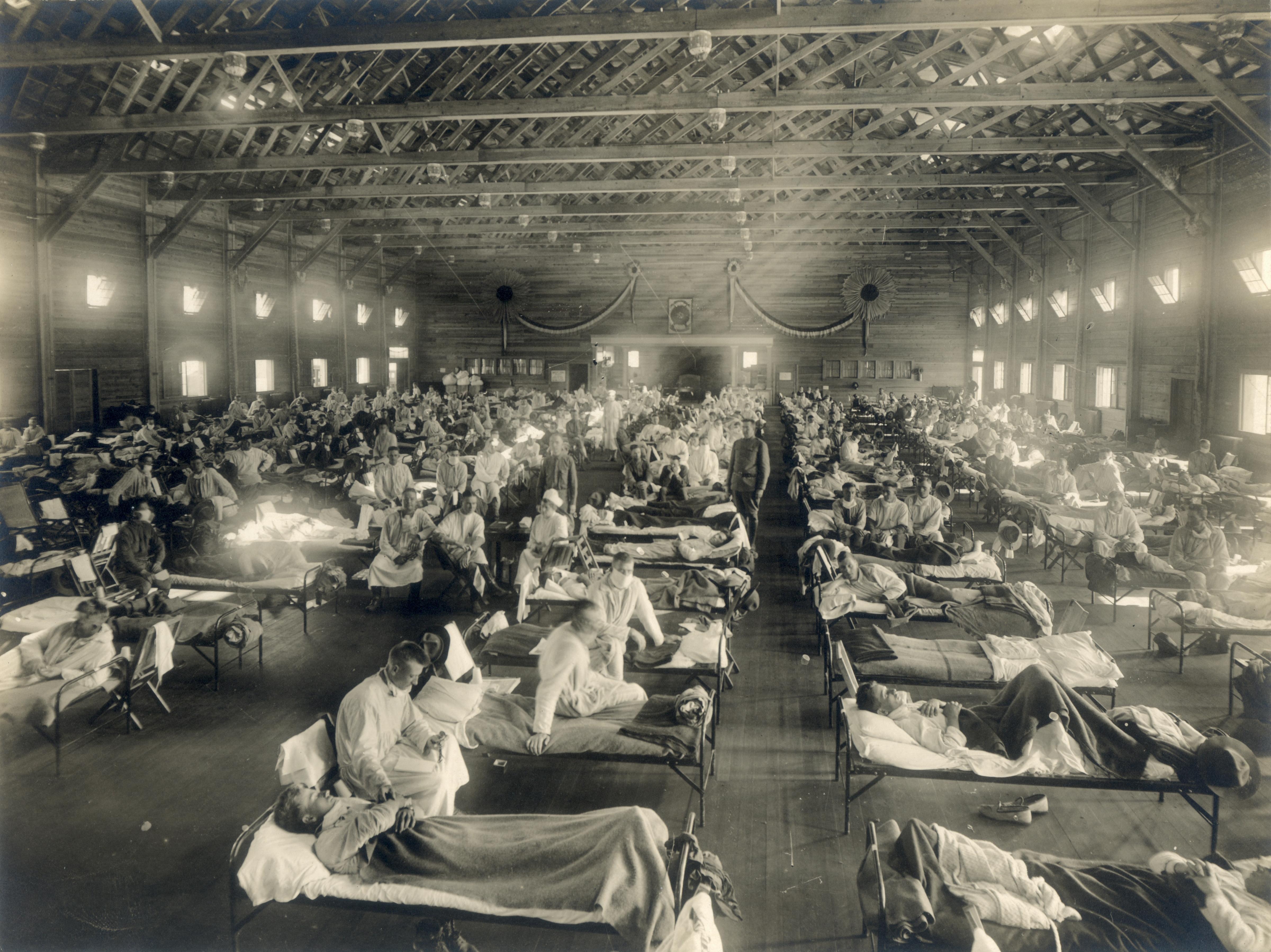
It killed more people than the war it traveled on, and it was never Spanish
Otis Historical Archives, National Museum of Health and Medicine, Public domain, via Wikimedia Commons
The question
How many people the pandemic of 1918 killed, why every count of them is an estimate, and what the free record settles about the name, the waves and the unequal dying.
The Ministry of Health opened its report with a pestilence that “destroyed more human lives in a few months than did the European war in five years, carrying off upwards of 150,000 persons in England and Wales alone”.1The Sanitary Commissioner with the Government of India wrote in his report for 1918 that “There is no method by which the deaths actually due to influenza can be calculated”, and then estimated anyway.2The Public Health Service's statistician wrote, with the epidemic of 1918 still running, that “a true prevalence rate can not be computed”.3Every count of the dead that follows was made by people who said so first. (the reading of this thesis)
Notes 1 to 3
1Great Britain, Ministry of Health (Major Greenwood, Thomas Carnwath, R. Bruce Low, S. P. James and others), Reports on Public Health and Medical Subjects, No. 4 (1920)¶ 2
2Sanitary Commissioner with the Government of India, Annual Report of the Sanitary Commissioner with the... (1920)p. 56Exhibit 2
3Edgar Sydenstricker, Public Health Statistician, United States Public Health Service, Preliminary Statistics of the Influenza Epidemic (1918)p. 2306
This thesis asks how many the pandemic killed, why every figure for it is an estimate, and what the free record settles about the name, the waves and the unequal dying.It makes 3 claims.First, that no official body counted the dead directly, that the Indian and English registrars stated an excess over normal mortality with its method and its doubt, that the Public Health Service could not count cases and turned to the death registers, and that every later global figure rests on such approximations.Second, that the disease was named for Spain because its source was attributed to Spain when the spread was first recognised, that the Ministry of Health denied in 1920 that it began there, and that the record holds concealment on the neutral side and censorship on the belligerent side without an order for either.Third, that the official rates themselves state how unequally people died, and that the thesis prints those rates side by side rather than one figure for the world.
1No official body that counted the dead of 1918 counted them directly; the Government of India and the Registrar-General each state an excess over normal mortality and say in their own words that it is an approximation, the Public Health Service could not count cases and turned to the death registers, and every later global figure is built on such approximations.
2The disease was called Spanish because its source was attributed to Spain when its spread over Europe was first recognised, and the Ministry of Health wrote in 1920 that it could not be admitted that the European epidemic began there; the record holds concealment on the neutral side and censorship on the belligerent side, and no order for either.
3The dying was unequal by a factor the official rates themselves state, from 3.129 per 1,000 among civilians in England and Wales to 66.4 in the Central Provinces, 22.6 among Māori against about 5 among Europeans in New Zealand, and in Western Samoa 7,542 dead of the 38,178 the Apia department counted before the epidemic, where the Ministry of Health gives the population as 30,738.
Shaded sentences are the reading of this thesis
The record
Every primary document this thesis holds was fetched from the Internet Archive, where the Ministry of Health's report, the Registrar-General's supplement, the Government of India's report, the Census of India, the Senate hearings on Alaska, the South African Railways' report and a wartime number of the American Journal of Nursing are digitised, and where JSTOR's Early Journal Content holds the Public Health Reports of the epidemic years as separate articles; every passage below was sliced from that copy by a script rather than retyped, and where a text layer garbled a figure the page scan was read and the header says so. (the reading of this thesis)The scholarship is held only as the passages cited, most of it read through Europe PMC, and abstracts and one set of footnotes stand for works whose full text is paywalled. (the reading of this thesis)Two memoirs are held as positions and not as facts: a physician's and a poet's, the poet's in Hindi with a rendering marked as this thesis's own. (the reading of this thesis)What the record does not hold is listed under the gaps in the ledger, by name, with what was tried: the New Zealand commission's own report on Samoa behind a challenge page, the Spanish statistical series behind two refusals, the French and Japanese official records behind a security page and a script shell, and the Chinese record not reached at all. (the reading of this thesis)The Government of India's own statement of what it could not count comes first. (the reading of this thesis)It gives four estimates, sets aside the first, 7,718,307, as an overestimate, and takes the mean of the other 3, 7,089,694, “Without any claim to accuracy”.45
Notes 4 to 5
4Sanitary Commissioner with the Government of India, Annual Report of the Sanitary Commissioner with the... (1920)p. 56Exhibit 2
5Sanitary Commissioner with the Government of India, Annual Report of the Sanitary Commissioner with the... (1920)p. 57
Primary documents held with extracts
16 of 16
Scholarship verified to exist as named
26 of 26
Of which read at a free copy and pinned
22
Positions, each with a source by a holder
13 of 13
Sources from the region or in its languages
3
Exhibits with full provenance
6
Findings of this thesis, with their working
5
Extracts stored verbatim
105
What the free record could not reach
Mills's demographic study of India, the position's own best countpaywalled at SAGE; the Europe PMC record carries no abstract; the work is known here through Arnold's citation of itTrieddoi.orgwww.ebi.ac.uk
Tomkins on Western Samoa, the source behind the event record's SS Talune, Logan and Poyer narrativepaywalled at Taylor and Francis; the Samoan Epidemic Commission's report itself sits on Papers Past and AtoJs, both of which answered this container with an Incapsula challenge page; the commission is known here as the Ministry of Health summarised it in 1920Trieddoi.orgpaperspast.natlib.govt.nzatojs.natlib.govt.nz
The Pacific mortality survey the event record citespaywalled at Elsevier; Crossref resolves the title; the same authors' open article of 2012 in Emerging Infectious Diseases is held insteadTrieddoi.org
Patterson and Pyle's 1991 estimate of 24.7 to 39.3 millionthe DOI the literature gives answers 404 at Crossref and the Europe PMC record carries no abstract; the figure is held here only as Johnson and Mueller's abstract and Spreeuwenberg and colleagues recite itTriedapi.crossref.orgeuropepmc.org
Jordan, Epidemic Influenza: A Survey (Chicago, 1927), the 21.6 million estimateno copy on the Internet Archive; the figure is held as Spreeuwenberg and colleagues and Johnson and Mueller recite it (21.6 and 21.5 million respectively)Triedarchive.org
The full texts of Johnson and Mueller (2002), Afkhami (2003), Chandra, Kuljanin and Wray (2012), Markel and colleagues (2007), Trilla and colleagues (2008), Hardiman (2012), Oxford (2001) and Arnold (2019)Project MUSE answered a verification page, Springer and Cambridge serve the abstract and footnotes only, Oxford University Press answered 403, and the PubMed Central pages for Hardiman and Oxford came back as page shells; each is pinned here only on its abstract, and Arnold also on the footnotes Cambridge serves freeTriedmuse.jhu.edulink.springer.comacademic.oup.compmc.ncbi.nlm.nih.govpmc.ncbi.nlm.nih.govwww.cambridge.org
Cheng and Leung, What happened in China during the 1918 influenza pandemic? (2007)the publisher answered 403; its abstract, which asserts 100 million deaths worldwide and a mild course in China, was read at Europe PMC but the paper is not entered because nothing in it could be pinned beyond that sentenceTriedwww.ijidonline.com
The Public Health Reports issues of 1918 as PubMed Central serves them, including the 5 April 1918 issue that carries the Haskell County note Barry describesevery PubMed Central page for the scanned 1918 issues answered a reCAPTCHA page; the issues held here were read instead from JSTOR's Early Journal Content on the Internet Archive, which holds the articles as separate items and does not hold the Haskell noteTriedpmc.ncbi.nlm.nih.govpmc.ncbi.nlm.nih.govpmc.ncbi.nlm.nih.gov
The Spanish official statistics of 1918 (Movimiento natural de la población) and the Madrid press of May 1918 (ABC of 22 May 1918)the Boletín Oficial del Estado's historical archive and the Biblioteca Nacional's Hemeroteca Digital both answered 403; Spain's counts are held as Trilla and colleagues and Almudéver Campo and Camaño Puig recite themTriedwww.boe.eshemerotecadigital.bne.es
A French contemporary source: the Gallica copy of Considérations cliniques sur l'épidémie de grippe (1918), ark bpt6k9799472nthe SRU search answered and listed the item, but every text and record request answered a security-verification page; the French side of the naming dispute is held only as the Ministry of Health reports itTriedgallica.bnf.frgallica.bnf.fr
The Japanese Home Ministry's report Ryūkōsei kanbō (内務省衛生局『流行性感冒』, 1922), NDL Digital Collections pid 985202the catalogue record answered and names the item, but the viewer page is a script shell with no text layer reachable from this container; Japan is not argued hereTriedndlsearch.ndl.go.jpdl.ndl.go.jp
Brazilian scholarship on SciELO (Goulart 2005, Bertucci) and the Diamantina parish register Souza citesscielo.br answered 403, as the proposal's catalogue records; Souza's article was read through Europe PMC instead, and no Brazilian register is heldTriedwww.scielo.br
Crosby, Epidemic and Peace, 1918 (1976) and its 2003 reissue, and Rice, Black November (1988)both Crosby items are lending copies marked access-restricted and could not be read from this container; Rice's book has no open copy; Crosby's title is known here as Honigsbaum quotes it and Rice's Māori rate as Wilson and colleagues recite itTriedarchive.orgarchive.org
Phillips, Black October (1984 thesis, 1990 book) on South Africathe University of Cape Town repository did not answer; South Africa is held here through the Union commission's figures as the Public Health Service and the Ministry of Health reproduce them and through the Railways' own reportTriedopen.uct.ac.za
The Camp Devens letter of 29 September 1918 as printed (Grist, BMJ, 22-29 December 1979)not indexed under that title; the letter is held here as Wever and van Bergen reproduce it, and is cited as their reproductionTriedwww.ebi.ac.uk
The Sanitary Commissioner's provincial reports for 1918 (Punjab, United Provinces, Bombay) and the passage the event record attributes to the Sanitary Commissioner (hospitals so choked, burning ghats swamped with corpses)no provincial report is on the Internet Archive; the Government of India's report for 1918 is held whole and the passage is not in itTriedarchive.org
Nirala's memoir in English (A Life Misspent, 2016) and a dated first edition of Kulli Bhatthe translation is in copyright and has no open copy; the two Digital Library of India scans are undated and dated 1958, and the undated scan, which has the better text layer, is the one readTriedarchive.orgarchive.org
The argument
1The count that counted itself
The Registrar-General's method is on his first page.6“The deaths allocated to influenza during 1918 numbered 112,329”, and over the 46 weeks from 23 June to 10 May “the total deaths allocated to the disease were 151,446, including 140,989 of civilians”.7He then wrote that “the mortality attributed to the disease does not represent the whole of that caused by it”, added the excess under other headings, and reached 198,000, which “in view of the uncertainties of the estimation” he rounded to “the round figure of 200,000 deaths attributable to the epidemic”.89The Ministry of Health, writing in the same year from the same returns, put the loss at “upwards of 150,000”, which is the allocated count and not the estimate.10The same country, the same year, and two official figures apart by the excess one of them estimated, because one counts what the certificates say and the other what the certificates missed. (the reading of this thesis)
Notes 6 to 10
6Registrar-General for England and Wales, Supplement to the Eighty-First Annual Report of the... (1920)§ estimate
7Registrar-General for England and Wales, Supplement to the Eighty-First Annual Report of the... (1920)§ estimate
8Registrar-General for England and Wales, Supplement to the Eighty-First Annual Report of the... (1920)§ estimate
9Registrar-General for England and Wales, Supplement to the Eighty-First Annual Report of the... (1920)§ totalExhibit 1
10Great Britain, Ministry of Health (Major Greenwood, Thomas Carnwath, R. Bruce Low, S. P. James and others), Reports on Public Health and Medical Subjects, No. 4 (1920)¶ 2
Exhibit 1DocumentRegistrar-General for England and Wales, 1920
The Registrar-General's round figure for England and Wales
In addition to the above there were 7,591 deaths of non-civilian males in this country allocated to influenza in 1918 and 2,899 in 1919 during the epidemic period, or 10,490 in all. This number has to be increased to an uncertain extent, say to 14,000 to allow for deaths really due to influenza but allocated to other causes. The non-civilian mortality of the preceeding years was so small that it may be left out of account. This addition to the civilian deaths brings the total toe 198,000, and in view of the uncertainties of the estimation the round figure of 200,000 deaths attributable to the epidemic (in addition to about 7,000 which the average rate of recent mortality would have accounted for) may be accepted as adequately summing up its results
Locator
§ total
Held by
Internet Archive, sid14156800, page 7
Rights
Crown copyright expired, public domain
In India there were no certificates to miss. (the reading of this thesis)The Sanitary Commissioner took the excess of all deaths in 1918 over the mean of the previous 5 years and got 7,718,307, called it an overestimate because plague, cholera, malaria and relapsing fever had raised the mortality in the first half of the year, took the excess from June 1st to December 31st and got 6,812,633, took all-cause deaths less plague, cholera and smallpox against the previous quinquennium and got 7,304,478, took the excess in fevers and respiratory diseases and got 7,151,971, and took the mean of the last 3, 7,089,694, as the figure of his report, “Without any claim to accuracy”.1112The Ministry of Health's summary carries the second of those figures in words, the June to December excess of 6,812,633 rounded to “approximately seven millions”, and adds that “anything other than approximations of this nature is impossible to obtain”.1314
Notes 11 to 14
11Sanitary Commissioner with the Government of India, Annual Report of the Sanitary Commissioner with the... (1920)p. 56Exhibit 2
12Sanitary Commissioner with the Government of India, Annual Report of the Sanitary Commissioner with the... (1920)p. 57
13Great Britain, Ministry of Health (Major Greenwood, Thomas Carnwath, R. Bruce Low, S. P. James and others), Reports on Public Health and Medical Subjects, No. 4 (1920)§ india
14Sanitary Commissioner with the Government of India, Annual Report of the Sanitary Commissioner with the... (1920)p. 56Exhibit 2
Exhibit 2DocumentSanitary Commissioner with the Government of India, 1920
The Sanitary Commissioner's four figures for India, 1918
Influenza . — There is no method by which the deaths actually due to influenza can be calculated. If it be assumed that the excess Mortality. jn the deaths in 1918 over the mean of the previous 5 years was the result — direct or indirect — of influenza, the figure would come to 7,718,307. This is an overestimate owing to the disturbing factor of other epidemic diseases, such as plague, cholera, malaria and relapsing fever, which raised the mortality in various parts of India during the first half of the year. There is no certain evidence that influenza was present in India before June 1st : it is, however, probable that if it were, it had no appreciable influence on the death rate for India as a whole. This suggests that the excess in the mortality from all causes between June 1st and December 31st over the 5 years mean — 6,812,633 — may be a more reliable index. This may, however, be a slight underestimate, for, in the last half of 1918 the mortality from plague was exceptionally low as compared with the quinquennial mean. Another estimate may be obtained by "subtracting from the total mortality from all causes the deaths registered as due to the chief epidemic diseases — - plague, cholera and small-pox, and comparing this figure with one similarly obtained for the previous quinquennium. On this basis the estimate would be 7,304,478. A fourth figure may be estimated by taking the excess in the mortality from “ fevers ” and respiratory diseases over the average for 5 years. In 1918 this excess came to 7,151,971.
Locator
p. 56
Held by
Wellcome Collection, digitised on the Internet Archive, b31492551, page 56
Rights
Public Domain Mark
AnalysisThe finding of this thesis, from the rows below
The Sanitary Commissioner's mean, recomputed
Method The Government of India's report for 1918 gives four estimates of the deaths directly and indirectly due to influenza, sets the first aside as an overestimate, and takes the mean of the other three as its figure. One row per figure the mean is taken over, each with a weight of 1; the result is the sum of the figures over the sum of the weights, which is the mean the report prints.
Rows the analysis is computed from, each traced to an extract
method
figure
weight
Extract
excess of all-cause deaths, 1 June to 31 December 1918, over the five-year mean
Computed over 3 rows, sum figure / sum weight = 2.12691e+07/3; result 7089694
The report's 7,089,694 is the mean of its own three figures, 6,812,633, 7,304,478 and 7,151,971, and it recomputes exactly; the fourth figure, 7,718,307, is the one the report calls an overestimate and leaves out.
Confidence high: arithmetic on four numbers printed in one paragraph of a document held whole, the third of them checked against the page scan because the text layer garbled a digit. Against it none found in the Government of India's report or the Ministry of Health's summary of it; the mean is of three estimates the report itself makes without any claim to accuracy, so the arithmetic is exact and the quantity is not
spanish-flu-1918
The Public Health Service could not count cases at all. (the reading of this thesis)“As influenza is not a reportable disease in most of the States, it is impossible to secure complete reports of its prevalence among civilians”, its bulletin of 27 September 1918 begins, and the state returns that follow are telegrams.18By December its statistician had given up on morbidity and turned to the death registers: “we must look to mortality reports for our main statistics of the epidemic”.19Three producers, on three continents, and each says the same thing of its own figure. (the reading of this thesis)
Notes 18 to 19
18United States Public Health Service, Epidemic Influenza ("Spanish Influenza") (1918)p. 1625
19Edgar Sydenstricker, Public Health Statistician, United States Public Health Service, Preliminary Statistics of the Influenza Epidemic (1918)p. 2306
2The world's dead
No document in this record counts the world. (the reading of this thesis)The Ministry of Health wrote that “the epidemic destroyed more lives in the whole world than did the European war in five years”, and gave no number for either.20The numbers came later, and each of them recites the ones before. (the reading of this thesis)Johnson and Mueller's abstract puts the earliest at “a 1920s calculation” of “21.5 million”, a 1991 paper at “24.7-39.3 million”, and their own at “of the order of 50 million”, before calling even that “a significant understatement”.21Spreeuwenberg, Kroneman and Paget, working from the vital records of 13 countries and British India, put the world's dead at “15 million deaths in 1918” and at “17.4 million deaths (1918 and 1919 combined)”, and wrote that the true total is “very unlikely to be higher than 25 million”.2223Taubenberger and Morens carry the largest, “Total deaths were estimated at ≈50 million” and “arguably as high as 100 million”, with “≈500 million persons” infected.24The record holds these as counts of unlike periods by unlike methods, and this thesis lists them and does not average them. (the reading of this thesis)
Notes 20 to 24
20Great Britain, Ministry of Health (Major Greenwood, Thomas Carnwath, R. Bruce Low, S. P. James and others), Reports on Public Health and Medical Subjects, No. 4 (1920)¶ 17
21Niall P. A. S. Johnson and Juergen Mueller, Updating the Accounts (2002)abstract
22Peter Spreeuwenberg, Madelon Kroneman and John Paget, Reassessing the Global Mortality Burden of the 1918... (2018)abstract
23Peter Spreeuwenberg, Madelon Kroneman and John Paget, Reassessing the Global Mortality Burden of the 1918... (2018)¶ 22
24Jeffery K. Taubenberger and David M. Morens, 1918 Influenza (2006)¶ 2
AnalysisThe finding of this thesis, from the rows below
Every figure for the world's dead that this record holds
Method One row per figure for the pandemic's worldwide dead that a fetched document states or recites, with the producer of the figure, the document it is read in, and the period the figure covers where the document says; each end of a stated range is its own row, and a figure recited by a second document is a second row, marked as a recital. Jordan's estimate is entered once, as Spreeuwenberg and colleagues recite it (Johnson and Mueller recite the same 1920s calculation as 21.5). The result is the count of rows.
Rows the analysis is computed from, each traced to an extract
Computed over 16 rows, count of rows = 16; result 16
The record holds 16 figures for the world's dead in 6 sources, 8 of them originating estimates and 8 recitals of those; the originating estimates are Jordan's 21.6, Patterson and Pyle's 24.7 to 39.3, Johnson and Mueller's 50, Taubenberger and Morens's 50 to 100, and Spreeuwenberg, Kroneman and Paget's 15 for 1918 alone and 17.4 for 1918 and 1919; like for like, whole pandemic against whole pandemic, the low end is 17.4 and not 15, and this thesis does not average the column or run it together as one range.
Confidence high for the count, which is of rows in documents held; the figures themselves are each their producer's and are not tested here. Against it none found beyond the figures themselves: every document that gives a figure also says the true number is uncertain, Johnson and Mueller calling theirs an understatement and Spreeuwenberg and colleagues calling totals above 25 million unrealistic, so the list is a list of disagreements and not of measurements; Spreeuwenberg and colleagues recite Patterson and Pyle as 30 with a range, where Johnson and Mueller recite only the range
spanish-flu-1918
What can be tested is the one claim they share, that the returns understate the dead. (the reading of this thesis)That claim is supported, and by the returns' own authors: the Sanitary Commissioner that there was no method, the Registrar-General that the allocated deaths were not the whole, the Public Health Service that in practically no locality could complete reports of cases be assumed.414243In Java the quinquennial population counts and the two censuses give Chandra a loss “in the range of 4.26” to “4.37 million”, against a standing estimate for all of Indonesia of “1.5 million”, whose source, he writes, “was not provided”.4445In India the same method, applied to census districts, runs the other way: Chandra, Kuljanin and Wray find “at most 13.88 million, compared with 17.21 million” on Davis's assumptions, and call Davis's figure “overstated by at least 24%”.46Arnold's abstract keeps “at least twelve million lives, more than in any other country”.47The contemporary figure, 7,089,694 for British India in 1918, and the later reconstructions, from Arnold's “at least twelve million” to the 13.88 and 17.21 of Chandra, Kuljanin and Wray, are set beside each other in the disagreements below; they are not the same quantity, and neither disproves the other.484950
Notes 41 to 50
41Sanitary Commissioner with the Government of India, Annual Report of the Sanitary Commissioner with the... (1920)p. 56Exhibit 2
42Registrar-General for England and Wales, Supplement to the Eighty-First Annual Report of the... (1920)§ estimate
43Edgar Sydenstricker, Public Health Statistician, United States Public Health Service, Preliminary Statistics of the Influenza Epidemic (1918)p. 2306
44Siddharth Chandra, Mortality from the influenza pandemic of 1918-19 in... (2013)abstract
45Siddharth Chandra, Mortality from the influenza pandemic of 1918-19 in... (2013)¶ 14
46Siddharth Chandra, Goran Kuljanin and Jennifer Wray, Mortality From the Influenza Pandemic of 1918-1919 (2012)abstract
47David Arnold, Death and the Modern Empire (2019)abstract
48Sanitary Commissioner with the Government of India, Annual Report of the Sanitary Commissioner with the... (1920)p. 57
49Siddharth Chandra, Goran Kuljanin and Jennifer Wray, Mortality From the Influenza Pandemic of 1918-1919 (2012)abstract
50David Arnold, Death and the Modern Empire (2019)abstract
3The name
Part II of the Ministry's report, the account of the epidemic abroad, was compiled by “Dr. Robert Bruce Low, C.B., and Dr. S. P. James”.51Its introduction opens: “When it was first recognised that influenza was spreading over Europe in 1918, the source of the epidemic was attributed to Spain, and the disease was, on this account, termed” the Spanish influenza; and then: “It cannot, therefore, be admitted that the European epidemic began in Spain”.52The introduction listed outbreaks at the same time in France, Germany and the Russian war zones, and recalled that the pandemic of 1889 had been called Chinese in Russia, Russian in Europe, European in North America and American in Japan.53The Public Health Service's circular of 13 September 1918 already wrote “so-called Spanish influenza”, and confessed that “Owing to disordered conditions in European countries, the bureau has no authoritative information as to the nature of the disease or its prevalence”; what it had was press dispatches that “8,000,000 persons have suffered from the disease in that country”.54
Notes 51 to 54
51Great Britain, Ministry of Health (Major Greenwood, Thomas Carnwath, R. Bruce Low, S. P. James and others), Reports on Public Health and Medical Subjects, No. 4 (1920)§ parts
52Great Britain, Ministry of Health (Major Greenwood, Thomas Carnwath, R. Bruce Low, S. P. James and others), Reports on Public Health and Medical Subjects, No. 4 (1920)§ namingExhibit 3
53Great Britain, Ministry of Health (Major Greenwood, Thomas Carnwath, R. Bruce Low, S. P. James and others), Reports on Public Health and Medical Subjects, No. 4 (1920)§ namingExhibit 3
54United States Public Health Service (circular signed Rupert Blue, Surgeon General), Measures for the Prevention of the Introduction of... (1918)p. 1540
Exhibit 3DocumentGreat Britain, Ministry of Health, 1920
R. Bruce Low on the name, 1920
When it was first recognised that influenza was spreading over Europe in 1918, the source of the epidemic was attributed to Spain, and the disease was, on this account, termed " the Spanish Influenza." Although the presence of epidemic influenza in Spain was recognised in the early months of 1918, it is beyond doubt that at the same time outbreaks were occurring in other European countries, including France and Germany and in the Russian war zones. It cannot, therefore, be admitted that the European epidemic began in Spain. A recent American report contains the statement that: "It seems " probable that the earliest appearance of the 1918 influenza " pandemic was in Eastern Europe, and that by April it was " spreading in the war zones of Western Europe." It may be remembered that the 1889 epidemic was believed to have originated in China, and spread thence to Russia, where it was spoken of as the "Chinese" influenza. From Russia the disease spread westward into Europe, where it was named the " Russian" influenza. From Europe the infection was carried to North America by shipping, and there it was called the "European" influenza; and when it spread from North America across the Pacific to Japan it was known there as the "American" influenza.
Locator
§ naming
Held by
FluWeb Historical Influenza Database copy on the Internet Archive, pandemic-of-influenza-1918-1919_UK-MinistryofHealth_HMSO-1920, Part II, introduction
Rights
Public Domain Mark
The record holds the attribution and the dispute under it, and it does not say who made the attribution or why. (the reading of this thesis)“The Spanish authorities strongly maintain” that the first wave of May and June 1918 “was due to infection introduced from France”, and “The French authorities on the other hand as stoutly contend that France received its infection from Spain”; a Spanish medical commission sent to Paris concluded that the two epidemics “were identical”.5556Madrid's epidemic reached “King Alfonso and a number of his Cabinet Ministers”.57And the same section carries the one act of concealment this record documents, on the neutral side: the “allegation is made that the municipal authorities of San Sebastian purposely concealed the prevalence of influenza as far as they were able, so as not to prejudice the summer season of this health resort”.58
Notes 55 to 58
55Great Britain, Ministry of Health (Major Greenwood, Thomas Carnwath, R. Bruce Low, S. P. James and others), Reports on Public Health and Medical Subjects, No. 4 (1920)§ spain
56Great Britain, Ministry of Health (Major Greenwood, Thomas Carnwath, R. Bruce Low, S. P. James and others), Reports on Public Health and Medical Subjects, No. 4 (1920)§ spaincommission
57Great Britain, Ministry of Health (Major Greenwood, Thomas Carnwath, R. Bruce Low, S. P. James and others), Reports on Public Health and Medical Subjects, No. 4 (1920)§ spain
58Great Britain, Ministry of Health (Major Greenwood, Thomas Carnwath, R. Bruce Low, S. P. James and others), Reports on Public Health and Medical Subjects, No. 4 (1920)§ spain
The censorship the name is usually laid to is in the scholarship, not in a Tier A document here. (the reading of this thesis)Honigsbaum finds that “The first Britons knew of the flu was in late May when the Daily Express and the Daily Mail ran brief reports about a ‘mysterious epidemic’ in Spain”, that in September “The Times censored several of Milligan’s medical bulletins” on the Prime Minister's illness, and that army sickness rates “failed to make it past the military censors”.596061Trilla, Trilla and Daer date the Madrid headline: “On 22 May 1918, the epidemic was a headline in Madrid's ABC newspaper”.62No order to suppress reporting is held on either side, and the verdict on the position is capped where the record stops. (the reading of this thesis)
Notes 59 to 62
59Mark Honigsbaum, Regulating the 1918-19 Pandemic (2013)¶ 12
60Mark Honigsbaum, Regulating the 1918-19 Pandemic (2013)¶ 14b
61Mark Honigsbaum, Regulating the 1918-19 Pandemic (2013)¶ 15
62Antoni Trilla, Guillem Trilla and Carolyn Daer, The 1918 "Spanish Flu" in Spain (2008)abstract
4The waves
The Ministry's chronology is one sentence: “In Paris the epidemic broke out in July; in Spain at the end of May; in Italy in April; in Greece in May; in Persia and Mesopotamia in June ; in India in June ; in Australia and New Zealand in July”.63In America influenza “became epidemic in mild form in April and May, 1918, and in September developed more virulent characters and swept over the country, mainly from east to west”.64The Registrar-General saw the same turn in the ages of the dead: the age distribution of influenza mortality “suddenly and completely changed with the onset of the summer epidemic of 1918”, and the new type held through the later waves.65Bombay's curve is the sharpest in the record. (the reading of this thesis)The first wave's effect on the death rate “was evident for about 4 weeks” from late June; the second began between the 7th and 14th of September, peaked in the week ending October 5th, and “lasted from 8 to 10 weeks”.66On 6 October the city recorded 768 deaths in a day.67The Punjab's report says what changed: “During the month of October the character of the disease changed completely and the Punjab began to experience the worst epidemic in its history, and one which particularly attacked young adults”.68
Notes 63 to 68
63Great Britain, Ministry of Health (Major Greenwood, Thomas Carnwath, R. Bruce Low, S. P. James and others), Reports on Public Health and Medical Subjects, No. 4 (1920)¶ 16
64Great Britain, Ministry of Health (Major Greenwood, Thomas Carnwath, R. Bruce Low, S. P. James and others), Reports on Public Health and Medical Subjects, No. 4 (1920)¶ 16
65Registrar-General for England and Wales, Supplement to the Eighty-First Annual Report of the... (1920)§ age
66Sanitary Commissioner with the Government of India, Annual Report of the Sanitary Commissioner with the... (1920)p. 58
67United States Public Health Service, from the preliminary report of Major Norman White, Sanitary Commissioner with the Government of India, Influenza in India, 1918 (1919)p. 1624
68United States Public Health Service, from the reports of the sanitary commissioners of Assam and the Punjab for 1918, Influenza in India, 1918 (Assam and Punjab) (1919)p. 2300
Where it began is not settled in this record, and the record says why. (the reading of this thesis)The Sanitary Commissioner traced a ship that “arrived in Bombay towards the end of May” with cases diagnosed as sandfly fever, and a second on the 15th of June with influenza aboard, and concluded that “The case for the introduction of infection by shipping must be left as unproven”.69The Census Commissioner wrote that “It is impossible to say where the more virulent virus of the second invasion came from”.70Barry places the origin in Haskell County, Kansas, in January 1918, while conceding that “it is impossible to answer this question with absolute certainty”; Gill and Oxford place a first form at Etaples in early 1917, where Hammond's necropsies of February and March found purulent bronchitis in “45.5 per cent of the total cases”, and at Aldershot, where Abrahams and his colleagues “employed the words ‘purulent bronchitis’” for cases of that spring.717273The Ministry's clinicians had already written that the “purulent bronchitis with heliotrope cyanosis and fatal ending” of the camps of 1916 and 1917 was “probably the same malady under a different name”.74Taubenberger and Morens, from the genome, find the data “inadequate to identify the geographic origin of the virus”.75One test the record allows is small and is set out as a finding: Barry writes that Miner's Haskell warning was “the only reference in that journal to influenza anywhere in the world” in the first six months of 1918, and the journal's issue of 21 June 1918 reports fevers of April and May from Norfolk to Louisiana and “the belief that these fevers were mainly influenza of mild type”.7677
Notes 69 to 77
69Sanitary Commissioner with the Government of India, Annual Report of the Sanitary Commissioner with the... (1920)p. 59
70J. T. Marten, Census Commissioner for India, Census of India, 1921, Volume I (1924)¶ 11
71John M. Barry, The site of origin of the 1918 influenza pandemic and... (2004)¶ 7
72Douglas Gill and John Oxford, The 'Spanish' influenza pandemic (2026)¶ 9
73Douglas Gill and John Oxford, The 'Spanish' influenza pandemic (2026)¶ 15
74Great Britain, Ministry of Health (Major Greenwood, Thomas Carnwath, R. Bruce Low, S. P. James and others), Reports on Public Health and Medical Subjects, No. 4 (1920)§ clinical
75Jeffery K. Taubenberger and David M. Morens, 1918 Influenza (2006)¶ 5
76John M. Barry, The site of origin of the 1918 influenza pandemic and... (2004)¶ 26
77United States Public Health Service, Influenza a Probable Cause of Fever of Undetermined... (1918)p. 1003
AnalysisThe finding of this thesis, from the rows below
Influenza in the journal's first half of 1918, as held here
Method One row per issue of Public Health Reports dated between 1 January and 30 June 1918 held in this record whose text mentions influenza, with the date and what it reports. The result is the count.
Rows the analysis is computed from, each traced to an extract
issue
date
reports
Extract
Public Health Reports 33(25)
1918-06-21
fevers of undetermined nature in April and May at points from Norfolk to Louisiana, believed to be mainly influenza of mild type
This record holds 1 issue of Public Health Reports from the first half of 1918 that reports influenza, dated 21 June 1918, on fevers of April and May from Norfolk to Louisiana believed to be mainly influenza of mild type; it is not the Haskell County note of April that Barry calls the journal's only reference to influenza in those six months.
Confidence low: the count is of one row, and the journal's other issues of the half-year were not reached, so the record shows one further reference and cannot say how many there were. Against it the Haskell note itself is not held, because PubMed Central answered every 1918 issue page with a reCAPTCHA page and JSTOR's Early Journal Content holds articles rather than issues; Barry's sentence could still be true of references to a named outbreak abroad, which the June issue is not, though it says anywhere in the world
spanish-flu-1918
5The closures
The contemporary record holds the closures as law, not as data. (the reading of this thesis)The Arizona Supreme Court upheld “the order closing the public schools during the rage of the said epidemic of Spanish influenza” as “a valid measure”, with the sentence “Necessity is the law of time and place”.79The Public Health Service's statistician declined the comparison later scholarship rests on: it had “not been deemed advisable at this time to attempt any correlation of the types of epidemic curves in various localities” with “methods employed in attempts to control the epidemic”, because the data were not accurate or complete enough.80Hatchett, Mecher and Lipsitch report that Philadelphia reached a peak weekly excess death rate of “257/100,000” and a cumulative rate of “719/100,000”, and St Louis, with its measures in place, “31/100,000” and “347/100,000”.81Their conclusion is narrower than the contrast: “no city in our analysis experienced a second wave while its main battery of NPIs was in place”, and second waves came when they were lifted.82Markel and colleagues count “115,340 excess pneumonia and influenza deaths” in 43 cities.83The Public Health Service's own bulletin of 27 September 1918 reports for Pennsylvania “Comparatively few cases” among civilians, and for Boston 333 influenza deaths and 121 pneumonia deaths in one week; it records no parade and no order, and the verdict on the position stops there.84
Notes 79 to 84
79United States Public Health Service, Closing of Schools and Theaters during Influenza Epidemic (1919)p. 1377
80Edgar Sydenstricker, Public Health Statistician, United States Public Health Service, Preliminary Statistics of the Influenza Epidemic (1918)p. 2309
81Richard J. Hatchett, Carter E. Mecher and Marc Lipsitch, Public health interventions and epidemic intensity... (2007)¶ 4b
82Richard J. Hatchett, Carter E. Mecher and Marc Lipsitch, Public health interventions and epidemic intensity... (2007)¶ 19
83Howard Markel, Harvey B. Lipman, J. Alexander Navarro, Alexandra Sloan, Joseph R. Michalsen, Alexandra Minna Stern and Martin S. Cetron, Nonpharmaceutical Interventions Implemented by US Cities... (2007)abstract
84United States Public Health Service, Epidemic Influenza ("Spanish Influenza") (1918)p. 1625
6The camps
At Camp Devens a soldier wrote home that “every day there has been an average of about twenty deaths here a day, some toll for a camp”.85A physician wrote from the same camp on 29 September, in a letter the record holds as Wever and van Bergen reproduce it: “It is only a matter of a few hours then until death comes, and it is simply a struggle for air until they suffocate. It is horrible.” The Ministry's clinicians in England described the same autumn as “a dreadful malady which few physicians had seen the like before”.8687The spring at Camp Funston is in the scholarship only: Dicke has “eleven hundred of the roughly twenty-six thousand troops training there hospitalized and thirty-eight dead” in March and April, Barry writes that “The camp held an average of 56,222 troops”, the two do not agree on the camp's strength, and no camp record is held here.8889A nurse on the North Dakota prairie wrote to the journal that “We were caught wholly unprepared, as far as organization went”, that in one farmhouse the family “had money, but help could not be had for money”, and that in the hospital she started “we took in thirteen patients and had two deaths”.9091
Notes 85 to 91
85Peter C. Wever and Leo van Bergen, Death from 1918 pandemic influenza during the First... (2014)¶ 35
86Peter C. Wever and Leo van Bergen, Death from 1918 pandemic influenza during the First... (2014)¶ 45
87Great Britain, Ministry of Health (Major Greenwood, Thomas Carnwath, R. Bruce Low, S. P. James and others), Reports on Public Health and Medical Subjects, No. 4 (1920)§ clinical
88Tom Dicke, Waiting for the Flu (2015)¶ 18b
89John M. Barry, The site of origin of the 1918 influenza pandemic and... (2004)¶ 30
90G. R., a nurse in North Dakota (letter to the editor), Experiences during the Influenza Epidemic, letters to... (1918)p. 203
91G. R., a nurse in North Dakota (letter to the editor), Experiences during the Influenza Epidemic, letters to... (1918)p. 204
Exhibit 4PhotographOtis Historical Archives, National Museum of Health and Medicine (NCP 1603), circa 1918, as the museum dates it
Emergency hospital during the influenza epidemic, Camp Funston, Kansas
Held by
Wikimedia Commons, from the National Museum of Health and Medicine, File:Emergency_hospital_during_Influenza_epidemic,_Camp_Funston,_Kansas_-_NCP_1603.jpg
Rights
Public domain
Shows
rows of patients on cots in an emergency ward at Camp Funston, Kansas, as the museum captions it; the museum dates the photograph circa 1918 and does not say which wave
Does not show
the spring outbreak of March 1918 as such, or Haskell County; nothing in the frame dates it to a month, and the file page's date is the museum's approximation
7The unequal dying
The official rates are the argument. (the reading of this thesis)The Government of India's table runs from 8.5 per 1,000 in Bengal to 66.4 in the Central Provinces and Berar, with the United Provinces at 2,034,257 deaths and Bombay at 1,059,497.92The Census Commissioner wrote that the epidemic “wiped off the whole of the natural increase in the Central Provinces and Berar, Bihar and Orissa and Bombay and substantially reduced the population in the United Provinces”.93The Union of South Africa's commission, as the Public Health Service printed it, gives a death rate of 8.26 per 1,000 for Europeans and 27.19 for those other than European, and a case mortality of “2.57 and 5.90 per cent” respectively; the same Blue Book, the Service noted, recorded “a high mortality among pregnant women”.9495The Railways counted their own: “769 European and 1,357 coloured and native employees succumbed, 2126 in all”.96In New Zealand the commission's figures, as the Ministry carried them, are 5,559 European deaths in 1918, about 5 per 1,000, and among Māori 1,130 deaths from October to December, 22.6 per 1,000, with the sentence “Native races (Maoris) were more susceptible to attack than Europeans and the disease was more fatal among them”.97Wilson and colleagues, from Rice's later count, put the Māori rate at “4,230/100,000” and “7.3×” the European rate, a ratio the contemporary figures do not reach.98
Notes 92 to 98
92Sanitary Commissioner with the Government of India, Annual Report of the Sanitary Commissioner with the... (1920)§ 57table
93J. T. Marten, Census Commissioner for India, Census of India, 1921, Volume I (1924)§ natural
94United States Public Health Service, Closing of Schools and Theaters during Influenza Epidemic (1919)p. 1376
95United States Public Health Service, Influenza in South Africa (1919)p. 775
96South African Railways and Harbours, General Manager, Report of the General Manager of Railways and Harbours... (1919)p. 98
97Great Britain, Ministry of Health (Major Greenwood, Thomas Carnwath, R. Bruce Low, S. P. James and others), Reports on Public Health and Medical Subjects, No. 4 (1920)§ nz
98Nick Wilson, Lucy Telfar Barnard, Jennifer A. Summers, G. Dennis Shanks and Michael G. Baker, Differential Mortality Rates by Ethnicity in 3 Influenza... (2012)¶ 14
AnalysisThe finding of this thesis, from the rows below
The official death rates this record holds, side by side
Method One row per death rate per 1,000 of population that an official document held here states for a named population, with the producer and the period the document gives. The result is the highest rate in the column. The rows for England and Wales and for the Punjab are converted from the document's own unit: the Registrar-General prints 3,129 and 4,774 per million, stored as 3.129 and 4.774 per 1,000, and the Punjab report prints 4.77 per cent, stored as 47.7; every other rate is stored as printed.
Rows the analysis is computed from, each traced to an extract
Computed over 26 rows, max of rate_per_1000 = 66.4; result 66.4
Of 26 official death rates in this record, the highest is 66.4 per 1,000 for the Central Provinces and Berar in 1918 and the lowest is 3.129 for civilians in England and Wales in the same year; the Union of South Africa's rate for those other than European, 27.19, is more than three times its European rate, 8.26, and New Zealand's Māori rate, 22.6, is more than four times its European rate.
Confidence moderate: the rates are each a document's own and the periods differ (England and Wales for the calendar year 1918, India for 1918, New Zealand's Māori for October to December 1918, South Africa for 1 August to 30 November 1918), so the column compares official arithmetic, not one measurement. Against it the Sanitary Commissioner's provincial rates are built on registered deaths in a country whose registration the report itself calls unreliable, and the Registrar-General's rate is of deaths allocated to influenza, not of the 200,000 he estimates, so the two ends of the column are the ends of two conventions as much as of two countries; the Ministry of Health gives New Zealand's European rate only as about 5
spanish-flu-1918
In Western Samoa the Department of Native Affairs at Apia counted the islands before and after: 38,178 people before the epidemic, 30,636 after, and 7,542 lost in the December quarter of 1918.125The Ministry of Health carries the same 7,542 dead “out of a population of 30,738”, against the Apia table's 38,178, and the difference is a finding below.126127The commission found that the disease came on the Talune from Auckland on the 7th of November 1918, and that “American Samoa (Pago Pago) had entirely escaped the ravages of influenza” behind “five days absolute quarantine” imposed by its governor from 20 November.128Shanks adds the captain, “who denied knowing that influenza was an infectious disease”.129
Notes 125 to 129
125United States Public Health Service, from a report of the Department of Native Affairs, Apia, Influenza Mortality in Samoa, September to December, 1918 (1919)p. 2303Exhibit 5
126Great Britain, Ministry of Health (Major Greenwood, Thomas Carnwath, R. Bruce Low, S. P. James and others), Reports on Public Health and Medical Subjects, No. 4 (1920)§ samoa
127United States Public Health Service, from a report of the Department of Native Affairs, Apia, Influenza Mortality in Samoa, September to December, 1918 (1919)p. 2303Exhibit 5
128Great Britain, Ministry of Health (Major Greenwood, Thomas Carnwath, R. Bruce Low, S. P. James and others), Reports on Public Health and Medical Subjects, No. 4 (1920)§ samoa
129G. Dennis Shanks, The 'Influenza' Vaccine Used during the Samoan Pandemic... (2018)¶ 2
Exhibit 5DocumentUnited States Public Health Service, from the Department of Native Affairs, Apia, 17 October 1919
Samoa's population before and after, as the Department of Native Affairs at Apia counted it
A report compiled by the Department of Native Affairs, Apia, Samoa, shows the decrease of the population in the islands of Upola and Savaii during the three months ended December 31, 1918, the period of the epidemic of influenza. The figures are startling. The following tables are taken from the report: Decrease of population in the islands of Upola and Savaii, Samoa. Population before epidemic. Population after epidemie Total loss in population Men. 10,988 7,723 3,265 12,327 9,623 2,704 Children. 14,863 13,290 1,573 38,178 30,636 7,542 Percentages of deailis of men, women, and children, respectively, to the number of each class in the population. December quarter, 1918. Men. Women. Children. 30.448 28.609 29.478 22. Oil 21.803 21.907 11.027
Locator
p. 2303
Held by
JSTOR Early Journal Content on the Internet Archive, jstor-4575351, Public Health Reports 34(42), 2303
Rights
United States government work, public domain
AnalysisThe finding of this thesis, from the rows below
Samoa's loss as a share of its people, on the commission's own denominator
Method The Department of Native Affairs' table, as the Public Health Service printed it, gives the population of Upolu and Savaii before and after the epidemic and the loss. The result is the loss over the population before.
Rows the analysis is computed from, each traced to an extract
Computed over 1 rows, sum lost / sum before = 7542/38178; result 0.19755
Samoa lost 7,542 of 38,178 people in the December quarter of 1918, 19.75 per cent, on the table's own figures; the Ministry of Health's summary carries the same 7,542 against a population of 30,738, which would make the share 24.5 per cent.
Confidence high for the share on the table's denominator, which is one document's arithmetic; the two official denominators disagree, and the table's own men's-loss cell, 3,265, is the difference of its before and after cells while the text layer had misread it as 3,285. Against it the Ministry of Health's summary of the New Zealand commission gives the population as 30,738, a figure 102 above the table's population after the epidemic and 7,440 below its population before; the two cannot both be the pre-epidemic population, the loss is the same in both, and the share is not
spanish-flu-1918
In Alaska the Bureau of Education's assistant superintendent telegraphed from Nome on 2 January 1919: “Ten villages this district affected. Three wiped out entirely ; others average 85 per cent deaths”.131The territory's table for the Senate reads “Approximately 2,000 deaths in all. Solomon, Teller, and Mary Igloo-wiped out”.132The Commissioner of Education told the committee that of about 300 natives at Nome, “One hundred and seventy-six of those had died”.133Khakurel, Sattenspiel and Mamelund put the regional rates at “1% to 38%” and some communities above “90%”, write that the territory's quarantines “did not prevent introduction of influenza into Alaska”, and find in their abstract that “8 local units avoided the outbreak by implementing NPIs”, which the Senate record neither confirms nor denies.134135In Persia, by the notes of “Dr. A. R. Neligan, Physician to His Majesty's Legation, Tehran”, the disease found a population weakened by typhus, relapsing fever and the failed harvests of 1916 and 1917, and Afkhami's abstract calls Iran “one of the regions hit hardest by the pandemic”; no count is held.136137In Rio de Janeiro the authorities “at first announced” that the type of the malady was mild, and the city's estimate of its dead, approximately 15,000, sits above official returns of 8,876 for October and 3,287 for November.138139
Notes 131 to 139
131United States Senate, Committee on Appropriations (testimony of Governor Thomas Riggs and Commissioner P. P. Claxton, with telegrams from Nome), Influenza in Alaska (1919)p. 5
132United States Senate, Committee on Appropriations (testimony of Governor Thomas Riggs and Commissioner P. P. Claxton, with telegrams from Nome), Influenza in Alaska (1919)p. 40
133United States Senate, Committee on Appropriations (testimony of Governor Thomas Riggs and Commissioner P. P. Claxton, with telegrams from Nome), Influenza in Alaska (1919)§ claxton
134Uddhav Khakurel, Lisa Sattenspiel and Svenn-Erik Mamelund, Role of Nonpharmaceutical Interventions during 1918-1920... (2025)¶ 6
135Uddhav Khakurel, Lisa Sattenspiel and Svenn-Erik Mamelund, Role of Nonpharmaceutical Interventions during 1918-1920... (2025)abstract
136Great Britain, Ministry of Health (Major Greenwood, Thomas Carnwath, R. Bruce Low, S. P. James and others), Reports on Public Health and Medical Subjects, No. 4 (1920)§ persia
138Great Britain, Ministry of Health (Major Greenwood, Thomas Carnwath, R. Bruce Low, S. P. James and others), Reports on Public Health and Medical Subjects, No. 4 (1920)§ brazil
139Great Britain, Ministry of Health (Major Greenwood, Thomas Carnwath, R. Bruce Low, S. P. James and others), Reports on Public Health and Medical Subjects, No. 4 (1920)§ brazilcount
8The witnesses
Two memoirs are held as positions, and they are quoted in the historiography, not here. (the reading of this thesis)The Ministry's summary of New Zealand explains one reason the record is thin in physicians' voices: it records that “no fewer than 228 doctors were absent from New Zealand on military duty” when the epidemic began.140Arnold's abstract says the same of testimony: “An absence of visual evidence is indicative of a more general paucity of contemporary material and first-hand testimony”.141The South African Railways' report is the one document here in which the staff of an institution counted its own sick and dead: 34,800 members of the staff, “approximately 47 per cent. of the total establishment”, contracted the disease in little more than six weeks.142
Notes 140 to 142
140Great Britain, Ministry of Health (Major Greenwood, Thomas Carnwath, R. Bruce Low, S. P. James and others), Reports on Public Health and Medical Subjects, No. 4 (1920)§ nzdoctors
141David Arnold, Death and the Modern Empire (2019)abstract
142South African Railways and Harbours, General Manager, Report of the General Manager of Railways and Harbours... (1919)§ staff
The historiography
The official record's own account
Holders
Ministry of Health (1920); Registrar-General (1920); Sanitary Commissioner with the Government of India (1920); Census Commissioner for India (1924); United States Public Health Service (1918 to 1919)
No death from influenza could be counted directly; every official total is an estimate of the excess over normal mortality, stated with its method, and the officials who made it said so.
Omits
The dead outside registration: British India's figure is built on registered deaths, the native states are a guess in the Ministry's summary, and no report here counts Africa's interior.
Tested against the primary record
SupportedIn British India no method exists to count the deaths actually due to influenza, and the figure of 7,089,694 is the mean of three excess-mortality estimates.
Rests on documents from: Government of India; Ministry of Health (Great Britain).
The Sanitary Commissioner's report states the method and the mean in its own words, and the Ministry of Health's summary, from a second producer, carries the same approximately seven millions and says that in India anything other than approximations is impossible to obtain.
The 3 extracts it rests on
Sanitary Commissioner with the Government of India, Annual Report of the Sanitary Commissioner with the... (1920)p. 56Exhibit 2
Influenza . — There is no method by which the deaths actually due to influenza can be calculated. If it be assumed that the excess Mortality. jn the deaths in 1918 over the mean of the previous 5 years was the result — direct or indirect — of influenza, the figure would come to 7,718,307. This is an overestimate owing to the disturbing factor of other epidemic diseases, such as plague, cholera, malaria and relapsing fever, which raised the mortality in various parts of India during the first half of the year. There is no certain evidence that influenza was present in India before June 1st : it is, however, probable that if it were, it had no appreciable influence on the death rate for India as a whole. This suggests that the excess in the mortality from all causes between June 1st and December 31st over the 5 years mean — 6,812,633 — may be a more reliable index. This may, however, be a slight underestimate, for, in the last half of 1918 the mortality from plague was exceptionally low as compared with the quinquennial mean. Another estimate may be obtained by "subtracting from the total mortality from all causes the deaths registered as due to the chief epidemic diseases — - plague, cholera and small-pox, and comparing this figure with one similarly obtained for the previous quinquennium. On this basis the estimate would be 7,304,478. A fourth figure may be estimated by taking the excess in the mortality from “ fevers ” and respiratory diseases over the average for 5 years. In 1918 this excess came to 7,151,971.
Sanitary Commissioner with the Government of India, Annual Report of the Sanitary Commissioner with the... (1920)p. 57
Without any claim to accuracy it is suggested that the mortality directly hand indirectly due to influenza was in the neighbourhood of the mean of the General Population.] WITH THE GOVERNMENT OF INDIA FOR 1918. 5 last 3 figures, viz. , 7,089,694. This mean is taken for the purpose of this report, and the mortality and death rates for the Local Governments and Administrations are calculated in a similar manner : the figures in this report consequently differ slightly from those given in the provincial sanitary reports, and are given in the following table : —
Great Britain, Ministry of Health (Major Greenwood, Thomas Carnwath, R. Bruce Low, S. P. James and others), Reports on Public Health and Medical Subjects, No. 4 (1920)§ india
Reports received indicate that no part of the world suffered as severely as did India during the latter half of 1918. A preliminary report by the Sanitary Commissioner with the Government of India estimated that up to the end of November 1918 no fewer than five million deaths were attributable to the influenza pandemic in British India alone (population, 238,000,000). In the native states influenza deaths certainly exceeded one million in the same period. A later report states that between 1st lune and 31st December 1918, the total mortality in British India exceeded the quinquennial mean mortality for the same period by approximately seven millions. The great majority of this excess mortality occurred in the last four months of the year. There was no abnormal prevalence of other communicable disease, so it is justifiable to accept this figure as a rough approximation of the influenza death roll. In view of the conditions pertaining in India, anything other than approximations of this nature is impossible to obtain.
QualifiedEngland and Wales lost about 200,000 people to the epidemic.
Rests on documents from: Ministry of Health (Great Britain); Registrar-General for England and Wales.
The Registrar-General's 200,000 is a round figure reached by adding deaths allocated to other causes to the 151,446 allocated to influenza; the Ministry of Health, in the same year, puts the loss at upwards of 150,000, which is the allocated count. Two producers, one quantity, two conventions, so the claim holds only with its method attached.
The 3 extracts it rests on
Registrar-General for England and Wales, Supplement to the Eighty-First Annual Report of the... (1920)§ totalExhibit 1
In addition to the above there were 7,591 deaths of non-civilian males in this country allocated to influenza in 1918 and 2,899 in 1919 during the epidemic period, or 10,490 in all. This number has to be increased to an uncertain extent, say to 14,000 to allow for deaths really due to influenza but allocated to other causes. The non-civilian mortality of the preceeding years was so small that it may be left out of account. This addition to the civilian deaths brings the total toe 198,000, and in view of the uncertainties of the estimation the round figure of 200,000 deaths attributable to the epidemic (in addition to about 7,000 which the average rate of recent mortality would have accounted for) may be accepted as adequately summing up its results
Registrar-General for England and Wales, Supplement to the Eighty-First Annual Report of the... (1920)§ estimate
Estimate of total mortality.—The deaths allocated to influenza during 1918 numbered 112,329, 53,883 of males and 58,446 of females. The 53,883 males. included 7,591 non-civilians. Deducting these we are left with 104,738 deaths of civilians, corresponding to a mortality of 3,129 per million civilian population. No such mortality as this has ever before been recorded for any epidemic in this country since registration commenced, except in the case of the cholera epidemic of 1849, when the mortality from that cause rose to 3,033 per million population. None of the previous outbreaks of influenza can compare in mortality with that of 1918-19. During the 46 weeks, June 23rd-May 10th, the total deaths allocated to the disease were 151,446, including 140,989 of civilians, the corresponding civilian death-rate for these 46 weeks being at the annual rate of 4,774 per million population. It is well known that during influenza epidemics the mortality attributed to the disease does not represent the whole of that caused by it. The entries under other headings, especially those of respiratory disease, are always found to increase during an epidemic, and though this has not occurred in 1918 to the same extent as in other recent outbreaks it is still necessary to make allowance for these increases of mortality, allocated to other causes but really attributable to influenza, in endeavouring to measure the loss of life caused by the epidemic.
Great Britain, Ministry of Health (Major Greenwood, Thomas Carnwath, R. Bruce Low, S. P. James and others), Reports on Public Health and Medical Subjects, No. 4 (1920)¶ 2
2. This document deals with one of the great historic scourges of our time, a pestilence which affected the well-being of millions of men and women and destroyed more human lives in a few months than did the European war in five years, carrying off upwards of 150,000 persons in England and Wales alone.
Cannot be tested from the free recordThe pandemic destroyed more lives in the whole world than the European war in five years.
Rests on an absence in the free record.
The Ministry asserts the comparison and offers no figure for either side; nothing in the free record here can test it, and it is published as the Ministry's judgment.
The extract it rests on
Great Britain, Ministry of Health (Major Greenwood, Thomas Carnwath, R. Bruce Low, S. P. James and others), Reports on Public Health and Medical Subjects, No. 4 (1920)¶ 17
17. Thirdly, the epidemic was remarkable in respect of the mortality. It should be borne in mind that the fatality of influenza is low, but its incidence is so vast that the number of deaths create an excessive mortality. Thus, it comes about that the epidemic destroyed more lives in the whole world than did the European war in five years.
The upward revision of the global count
Holders
Johnson and Mueller (2002); Taubenberger and Morens (2006); Chandra (2013); Patterson and Pyle (1991)
K. David Patterson and Gerald F. Pyle, The geography and mortality of the 1918 influenza pandemic (1991)Tier B, by a holder, not read free
Claims
The recorded statistics understate the dead; each re-examination has raised the global figure, from 21.5 million to the order of 50 million, and national counts such as Java's rise when census loss replaces registration.
Omits
What a global figure is a figure of: the position sums national estimates made by unlike methods over unlike periods, and its own abstract calls the result an understatement of unknown size.
Tested against the primary record
SupportedThe recorded statistics of influenza morbidity and mortality are a significant understatement.
Rests on documents from: Government of India; Registrar-General for England and Wales; United States Public Health Service.
Three producers say so of their own returns: the Sanitary Commissioner that there is no method by which the deaths actually due to influenza can be calculated, the Registrar-General that the mortality attributed to the disease does not represent the whole of that caused by it, and the Public Health Service statistician that in practically no locality can complete reports of cases be assumed.
The 3 extracts it rests on
Sanitary Commissioner with the Government of India, Annual Report of the Sanitary Commissioner with the... (1920)p. 56Exhibit 2
Influenza . — There is no method by which the deaths actually due to influenza can be calculated. If it be assumed that the excess Mortality. jn the deaths in 1918 over the mean of the previous 5 years was the result — direct or indirect — of influenza, the figure would come to 7,718,307. This is an overestimate owing to the disturbing factor of other epidemic diseases, such as plague, cholera, malaria and relapsing fever, which raised the mortality in various parts of India during the first half of the year. There is no certain evidence that influenza was present in India before June 1st : it is, however, probable that if it were, it had no appreciable influence on the death rate for India as a whole. This suggests that the excess in the mortality from all causes between June 1st and December 31st over the 5 years mean — 6,812,633 — may be a more reliable index. This may, however, be a slight underestimate, for, in the last half of 1918 the mortality from plague was exceptionally low as compared with the quinquennial mean. Another estimate may be obtained by "subtracting from the total mortality from all causes the deaths registered as due to the chief epidemic diseases — - plague, cholera and small-pox, and comparing this figure with one similarly obtained for the previous quinquennium. On this basis the estimate would be 7,304,478. A fourth figure may be estimated by taking the excess in the mortality from “ fevers ” and respiratory diseases over the average for 5 years. In 1918 this excess came to 7,151,971.
Registrar-General for England and Wales, Supplement to the Eighty-First Annual Report of the... (1920)§ estimate
Estimate of total mortality.—The deaths allocated to influenza during 1918 numbered 112,329, 53,883 of males and 58,446 of females. The 53,883 males. included 7,591 non-civilians. Deducting these we are left with 104,738 deaths of civilians, corresponding to a mortality of 3,129 per million civilian population. No such mortality as this has ever before been recorded for any epidemic in this country since registration commenced, except in the case of the cholera epidemic of 1849, when the mortality from that cause rose to 3,033 per million population. None of the previous outbreaks of influenza can compare in mortality with that of 1918-19. During the 46 weeks, June 23rd-May 10th, the total deaths allocated to the disease were 151,446, including 140,989 of civilians, the corresponding civilian death-rate for these 46 weeks being at the annual rate of 4,774 per million population. It is well known that during influenza epidemics the mortality attributed to the disease does not represent the whole of that caused by it. The entries under other headings, especially those of respiratory disease, are always found to increase during an epidemic, and though this has not occurred in 1918 to the same extent as in other recent outbreaks it is still necessary to make allowance for these increases of mortality, allocated to other causes but really attributable to influenza, in endeavouring to measure the loss of life caused by the epidemic.
Edgar Sydenstricker, Public Health Statistician, United States Public Health Service, Preliminary Statistics of the Influenza Epidemic (1918)p. 2306
Were there any necessity for demonstrating the utter inadequacy and lack of uniformity of morbidity reporting in the United States, such a demonstration would be fully available in the experience afforded during the present epidemic. The shortcomings of morbidity statistics already are so well known that it is unnecessary to refer to them in detail. Their chief fault — incompleteness— was immeasurably increased by the unusual circumstances that prevailed. Among these circumstances were the magnitude of the epidemic in a large number of localities, the congestion of cases at and near the peak of the epidemic, the tendency to cease reporting toward the end of the epidemic, the breakdown of the more or less elaborate S3^stem of individual card reports which called for unessential as well as essential data, and the depletion of the reporting personnel — the practicing physicians — by service in the armed forces and by the disease itself. In addition to these unusual conditions was the fact that in practically no State or locality had influenza been a reportable disease prior to the 1918 epidemic, and that in perhaps a very large proportion of localities it was not made a reportable disease until the epidemic was well under way. In studying the prevalence of influenza, therefore, we are confronted with serious obstacles, among which may be mentioned the following:. (1) In practically no locality can it bo assumed that complete reports of cases were made; a true prevalence rate can not be computed. (2) Since the disease was not reported with any degree of comparable completeness in different localities, comparisons of localities for prevalence obviously are impossible. (3) For the same reasons, statements of the incidence according to sex, age, or of any other condition with which it might be desirable to attempt correlations are not feasible, except in very general terms. (4) The chronology of the epidemic in perhaps the great majority of localities has not been recorded, and if recorded is subject to serious errors with respect to the beginning of the epidemic and the true height of the peak. (5) Fatality rates manifestly can not be ascertained. With the exception of data obtained from special field studies and from limited areas ami population groups, we must look to mortality reports for our main statistics of the epidemic.
Cannot be tested from the free recordGlobal deaths were of the order of 50 million and arguably as high as 100 million.
Rests on an absence in the free record.
No artifact here counts the world's dead, and a total built from national estimates cannot be tested against national records that themselves call their counts approximations. The figures stand as their producers' and are set beside the others in the disagreements.
The 3 extracts it rests on
Jeffery K. Taubenberger and David M. Morens, 1918 Influenza (2006)¶ 2
An estimated one third of the world's population (or ≈500 million persons) were infected and had clinically apparent illnesses (1,2) during the 1918–1919 influenza pandemic. The disease was exceptionally severe. Case-fatality rates were >2.5%, compared to <0.1% in other influenza pandemics (3,4). Total deaths were estimated at ≈50 million (5–7) and were arguably as high as 100 million (7).
Niall P. A. S. Johnson and Juergen Mueller, Updating the Accounts (2002)abstract
The influenza pandemic of 1918-20 is recognized as having generally taken place in three waves, starting in the northern spring and summer of 1918. This pattern of three waves, however, was not universal: in some locations influenza seems to have persisted into or returned in 1920. The recorded statistics of influenza morbidity and mortality are likely to be a significant understatement. Limitations of these data can include nonregistration, missing records, misdiagnosis, and nonmedical certification, and may also vary greatly between locations. Further research has seen the consistent upward revision of the estimated global mortality of the pandemic, which a 1920s calculation put in the vicinity of 21.5 million. A 1991 paper revised the mortality as being in the range 24.7-39.3 million. This paper suggests that it was of the order of 50 million.
Great Britain, Ministry of Health (Major Greenwood, Thomas Carnwath, R. Bruce Low, S. P. James and others), Reports on Public Health and Medical Subjects, No. 4 (1920)¶ 17
17. Thirdly, the epidemic was remarkable in respect of the mortality. It should be borne in mind that the fatality of influenza is low, but its incidence is so vast that the number of deaths create an excessive mortality. Thus, it comes about that the epidemic destroyed more lives in the whole world than did the European war in five years.
The downward revision
Holders
Spreeuwenberg, Kroneman and Paget (2018); Chandra, Kuljanin and Wray (2012)
Estimates above 25 million are not realistic on the mortality rates the vital records support; the world lost about 17.4 million in 1918 and 1919, and Davis's Indian figure is overstated by at least 24 per cent.
Omits
Countries with no vital registration, which the Human Mortality Database does not hold; the position extrapolates from 13 countries and British India.
Tested against the primary record
SupportedBritish India's excess mortality is an outlier at the high end, the hardest-hit country in the sample.
Rests on documents from: Government of India; Scholarship; Ministry of Health (Great Britain).
The Ministry of Health wrote in 1920 that no part of the world suffered as severely as India, and the Government of India's own table carries 7,089,694 deaths for 1918; two producers agree with the position on the point it uses India for.
The 3 extracts it rests on
Great Britain, Ministry of Health (Major Greenwood, Thomas Carnwath, R. Bruce Low, S. P. James and others), Reports on Public Health and Medical Subjects, No. 4 (1920)§ india
Reports received indicate that no part of the world suffered as severely as did India during the latter half of 1918. A preliminary report by the Sanitary Commissioner with the Government of India estimated that up to the end of November 1918 no fewer than five million deaths were attributable to the influenza pandemic in British India alone (population, 238,000,000). In the native states influenza deaths certainly exceeded one million in the same period. A later report states that between 1st lune and 31st December 1918, the total mortality in British India exceeded the quinquennial mean mortality for the same period by approximately seven millions. The great majority of this excess mortality occurred in the last four months of the year. There was no abnormal prevalence of other communicable disease, so it is justifiable to accept this figure as a rough approximation of the influenza death roll. In view of the conditions pertaining in India, anything other than approximations of this nature is impossible to obtain.
Sanitary Commissioner with the Government of India, Annual Report of the Sanitary Commissioner with the... (1920)§ 57table
Province. Mortality. Death rate per 1,000 of population. Delhi 23,612 56.6 Bengal 386,572 8.5 Bihar and Orissa 709,976 20.5 Assam 111,340 18.6 United Provinces of Agra and Oudh 2,034,257 43.4 Punjab 898,947 45.4 North-West Frontier Province 89,035 43.6 Central Provinces and Berar 924,949 66.4 Madras 682,169 16.7 Coorg 2,014 11.5 Bombay 1,059,497 54.9 Burma 137,491 13.9 Ajmer-Merwara 29,835 59.5 India 7,089,694
Peter Spreeuwenberg, Madelon Kroneman and John Paget, Reassessing the Global Mortality Burden of the 1918... (2018)¶ 20
In the present study, the best estimate (including India) for global influenza pandemic deaths is 15 million, with an excess death rate of 788 per 100,000, in 1918; and 2.5 million deaths, with an excess death rate of 128 per 100,000, in 1919.
Cannot be tested from the free recordThe global toll of 1918 and 1919 together was about 17.4 million.
Rests on an absence in the free record.
A model's output cannot be tested against artifacts that are its inputs, and no independent count of the world exists in this record; the figure is published as the position's, beside the others.
The 2 extracts it rests on
Peter Spreeuwenberg, Madelon Kroneman and John Paget, Reassessing the Global Mortality Burden of the 1918... (2018)¶ 22
In conclusion, we have developed an indirect estimation method using vital statistics population data. Our best estimate (a total of 15 million deaths in 1918) is lower than recent estimates (50–100 million) and shows that researchers need to be careful with the methods they choose to make their estimates. For example, researchers must take into account wars and other possible causes of increases in numbers of deaths, and the underlying time trends in mortality. We also show that it is important to test the theoretical feasibility of estimates (e.g., 100 million deaths), because results of such tests suggest the true estimate is very unlikely to be higher than 25 million and probably closer to our final estimate of 17.4 million deaths (1918 and 1919 combined).
Registrar-General for England and Wales, Supplement to the Eighty-First Annual Report of the... (1920)§ totalExhibit 1
In addition to the above there were 7,591 deaths of non-civilian males in this country allocated to influenza in 1918 and 2,899 in 1919 during the epidemic period, or 10,490 in all. This number has to be increased to an uncertain extent, say to 14,000 to allow for deaths really due to influenza but allocated to other causes. The non-civilian mortality of the preceeding years was so small that it may be left out of account. This addition to the civilian deaths brings the total toe 198,000, and in view of the uncertainties of the estimation the round figure of 200,000 deaths attributable to the epidemic (in addition to about 7,000 which the average rate of recent mortality would have accounted for) may be accepted as adequately summing up its results
The pandemic most likely began in Haskell County, Kansas, in January 1918, travelled to Camp Funston with recruits in late February, and from there to other camps and to France.
Omits
The purulent bronchitis of 1916 and 1917 in France and England that the position's opponents describe, and any record from China; the position's own author calls the question impossible to answer with certainty.
Tested against the primary record
QualifiedLoring Miner's Haskell County warning was the only reference to influenza in Public Health Reports in the first six months of 1918.
Rests on documents from: Scholarship; United States Public Health Service.
The journal's issue of 21 June 1918 reports fevers of April and May from Norfolk to Louisiana that its physicians believed were mainly influenza of mild type, a second reference inside the six months. The Haskell note itself is not held here, and the journal is one producer, so under Rule A the finding is capped at qualified: the claim fails on the journal's own text, but this record holds only one side of the comparison.
The 2 extracts it rests on
John M. Barry, The site of origin of the 1918 influenza pandemic and... (2004)¶ 26
The disease did not, however, slip from Miner's thoughts. Influenza was neither a reportable disease, nor a disease that any state or federal public health agency tracked. Yet Miner considered this incarnation of the disease so dangerous that he warned national public health officials about it. Public Health Reports(now Morbidity and Mortality Weekly Report), a weekly journal produced by the U.S. Public Health Service to alert health officials to outbreaks of communicable diseases throughout the world, published his warning. In the first six months of 1918, this would be the only reference in that journal to influenza anywhere in the world.
United States Public Health Service, Influenza a Probable Cause of Fever of Undetermined... (1918)p. 1003
PUBLIC HEALTH REPORTS VOL. 33 JUNE 21, 1918 No. 25 Influenza a Probable Cause of Fever of Undetermined Nature in Southern States. Fevers of an undetermined nature were reported during April and May at various points from Norfolk to Louisiana. An examination of the records and reports of the physicians who have treated these cases leads to the belief that these fevers were mainly influenza of mild type. It is possible, however, that all cases reported were not of the same disease, and in one locality in Louisiana dengue «may have occurred.
QualifiedThe American spring wave began at Camp Funston in March 1918, where more than 1,100 men were hospitalised within three weeks.
Rests on documents from: Scholarship; Ministry of Health (Great Britain).
The Ministry of Health dates the mild American epidemic to April and May 1918, Taubenberger and Morens to March 1918; the Funston figures rest on the two scholars and no camp record is held, and the two scholars disagree on the camp's strength, Barry giving an average of 56,222 troops and Dicke roughly twenty-six thousand. One Tier A producer, and it does not name the camp, so the date is borne out only in the season.
The 4 extracts it rests on
John M. Barry, The site of origin of the 1918 influenza pandemic and... (2004)¶ 30
These men, and probably others unnamed by the paper, were exposed to influenza and would have arrived in Funston between February 26 and March 2. On March 4 the first soldier at the camp reported ill with influenza at sick call. The camp held an average of 56,222 troops. Within three weeks more than eleven hundred others were sick enough to require hospitalization, and thousands more – the precise number was not recorded – needed treatment at infirmaries scattered around the base.
Tom Dicke, Waiting for the Flu (2015)¶ 18b
What is nearly certain is that this flu spread from there to Camp Funston (now part of Fort Riley), Kansas, where, in March and April, it left eleven hundred of the roughly twenty-six thousand troops training there hospitalized and thirty-eight dead.
Great Britain, Ministry of Health (Major Greenwood, Thomas Carnwath, R. Bruce Low, S. P. James and others), Reports on Public Health and Medical Subjects, No. 4 (1920)¶ 16
In America, too, influenza had been occurring in greater or less degree in 1915, 1916, and 1917, but it became epidemic in mild form in April and May, 1918, and in September developed more virulent characters and swept over the country, mainly from east to west. In Paris the epidemic broke out in July; in Spain at the end of May; in Italy in April; in Greece in May; in Persia and Mesopotamia in June ; in India in June ; in Australia and New Zealand in July. Such was the universal experience of emergence and the rapid evolution was similar to it. The disease simply had its way. It came like a thief in the night and stole treasure.
Jeffery K. Taubenberger and David M. Morens, 1918 Influenza (2006)¶ 5
Before and after 1918, most influenza pandemics developed in Asia and spread from there to the rest of the world. Confounding definite assignment of a geographic point of origin, the 1918 pandemic spread more or less simultaneously in 3 distinct waves during an ≈12-month period in 1918–1919, in Europe, Asia, and North America (the first wave was best described in the United States in March 1918). Historical and epidemiologic data are inadequate to identify the geographic origin of the virus (21), and recent phylogenetic analysis of the 1918 viral genome does not place the virus in any geographic context (19).
A fatal purulent bronchitis seen at Etaples in the winter of 1916 to 1917 and at Aldershot in the spring of 1917 was the pandemic's first form, and the virus moved eastward from Europe to China rather than the reverse.
Omits
Why an outbreak of 1916 and 1917 produced no world pandemic until 1918, which the position's necropsy counts do not answer.
Tested against the primary record
QualifiedPurulent bronchitis with heliotrope cyanosis in the military camps of 1916 and 1917 was probably the same malady as the autumn wave of 1918.
Rests on documents from: Scholarship; Ministry of Health (Great Britain).
The Ministry of Health's clinicians wrote in 1920 that the minor epidemics of purulent bronchitis with heliotrope cyanosis in camps in America, England and France in 1916 and 1917 were probably the same malady under a different name; one producer, so capped at qualified, and probably is the Ministry's word.
The 2 extracts it rests on
Douglas Gill and John Oxford, The 'Spanish' influenza pandemic (2026)¶ 9
Hammond’s paper describes an exhaustive piece of research. During February and March, 1917, he and his colleagues conducted ‘156 consecutive necropsies’. They discovered thereby the ‘prevalence of bronchitis of a purulent type’. It occurred ‘as a primary condition in 45 and as a secondary condition in 26 of the cases examined. Altogether purulent bronchitis was found in 45.5 per cent of the total cases’.
Great Britain, Ministry of Health (Major Greenwood, Thomas Carnwath, R. Bruce Low, S. P. James and others), Reports on Public Health and Medical Subjects, No. 4 (1920)§ clinical
Contrasted with the extensive and acute but non-fatal outbreak of June 1918, the world-wide " plague" of influenza of the following autumn and winter, with its millions of deaths, presented very different clinical characters; and in the multitude of severe cases one saw the constantly repeated picture of a dreadful malady which few physicians had seen the like before. Those who had experienced the minor epidemics of " purulent bronchitis with heliotrope cyanosis and fatal ending " that had occurred here and there in military camps in America, England and France during 1916 and 1917 had already become familiar with some of the worst features, especially the dreaded blueness, of what was probably the same malady under a different name ; but now it was a question of seeing hundreds or even thousands of cases in districts in which the fatal " purulent bronchitis " had affected but a few.
Cannot be tested from the free recordThe virus spread eastwards to China from Europe.
Rests on an absence in the free record.
One line in a September 1918 circular reports influenza in Canton without a date of onset; it neither bears out nor contradicts a direction of spread.
The 2 extracts it rests on
J. S. Oxford, The so-called Great Spanish Influenza Pandemic of 1918... (2001)abstract
This discussion piece examines the likely epicentre of the influenza pandemic of 1918-1919. Contrary to previous studies that have proposed a Chinese origin, there is documentation that suggests that, in this instance, the virus spread eastwards to China from Europe. Although more recent oubreaks of influenza have undoubtedly had an Oriental origin, the evidence indicates that future outbreaks could conceivably arise anywhere in the world.
United States Public Health Service (circular signed Rupert Blue, Surgeon General), Measures for the Prevention of the Introduction of... (1918)p. 1540
On account of a reported pandemic of influenza in various European countries, officers in charge of national quarantine stations have been advised to exercise special care with respect to vessels on which this disease has appeared. The following circular has been issued: Medical Officers in Charge, United States Quarantine Stations. Sirs: You arc especially cautioned to be on the alert in the inspection of vessels from European ports so as to detect any cases of the so-called Spanish influenza. If any such disease is discovered, vessels should not bo released from quarantine until after the local health authorities have been notified in accordance with paragraph 68, United States Quarantine Regulations. Owing to disordered conditions in European countries, the bureau has no authoritative information as to the nature of the disease or its prevalence. It appears, however, to be an infection due to the B. influenza with predilection to lung involvement. If any such cases are discovered upon arrival of a vessel, they should be reported to the local health authorities and the necessary cooperation extended, including fumigation of living quarters with sulphur dioxide, letting personal effects remain in compartments during the fumigation. This circular does not contemplate consideration of cases of ordinary pneumonia or respiratory infections, but only those infections involving a considerable number of the crew and which appear to be highly communicable and suggestive of epidemic influenza. Respectfully, Rupert Blve, Surgeon General. Recently a steamship arrived at one of the southern ports from a port of Great Britain with history of an outbreak of epidemic influenza in the crew. The master of the vessel reported very shortly after his arrival at Great Britain that the entire crew had sickened with the infection, the symptoms being high fever, cough, coryza, and more or less prostration. Upon arrival of the vessel at a port of the United States two of the crew were still suffering from the 1541 September 13, 191S. disease and were isolated in the quarantine hospital, the vessel was disinfected, and other appropriate measures were taken to prevent the introduction of the disease. The disease has been reported as being observed at quarantine in two ports on the Pacific coast. In both instances there were several cases of pneumonia, possibly due to B. influenza although not stated to be. Epidemic influenza has. been reported in several countries in Europe during the summer -of 1918, more especially in Spain. According to press dispatches, 8,000,000 persons have suffered from the disease in that country. Most of the cases reported to the Public Health Service have been from France, England, Norway, and Switzerland, although a mild form has been reported in Canton, China. It has appeared at Prince Edward Island, Canada, and in the Island of Guadeloupe in the West Indies, probably an extension from European ports.
The name and the censors
Holders
Honigsbaum (2013); Trilla, Trilla and Daer (2008); Almudéver Campo and Camaño Puig (2025)
The disease became Spanish because Spain's press reported an epidemic that belligerent censors kept out of their own papers; the virus most likely reached Spain from France, and Spain's official 147,114 deaths of 1918 understate its dead.
Omits
Any censorship order: the position documents the press's silences and The Times's withheld bulletins, not an instruction, and it does not weigh the concealment the Ministry of Health records on the neutral side.
Tested against the primary record
QualifiedThe disease was named for Spain because the epidemic was attributed to Spain when its spread over Europe was first recognised, not because it began there.
Rests on documents from: Ministry of Health (Great Britain); United States Public Health Service.
The Ministry of Health writes that the source was attributed to Spain and the disease termed Spanish on that account, and that it cannot be admitted that the European epidemic began in Spain; the Public Health Service's circular of September 1918 already writes so-called Spanish influenza. Both bear out the name and the doubt about the origin; neither says who attributed it or why, so the position's mechanism, the press, is not in the artifacts, and the verdict is qualified.
The 3 extracts it rests on
Great Britain, Ministry of Health (Major Greenwood, Thomas Carnwath, R. Bruce Low, S. P. James and others), Reports on Public Health and Medical Subjects, No. 4 (1920)§ namingExhibit 3
When it was first recognised that influenza was spreading over Europe in 1918, the source of the epidemic was attributed to Spain, and the disease was, on this account, termed " the Spanish Influenza." Although the presence of epidemic influenza in Spain was recognised in the early months of 1918, it is beyond doubt that at the same time outbreaks were occurring in other European countries, including France and Germany and in the Russian war zones. It cannot, therefore, be admitted that the European epidemic began in Spain. A recent American report contains the statement that: "It seems " probable that the earliest appearance of the 1918 influenza " pandemic was in Eastern Europe, and that by April it was " spreading in the war zones of Western Europe." It may be remembered that the 1889 epidemic was believed to have originated in China, and spread thence to Russia, where it was spoken of as the "Chinese" influenza. From Russia the disease spread westward into Europe, where it was named the " Russian" influenza. From Europe the infection was carried to North America by shipping, and there it was called the "European" influenza; and when it spread from North America across the Pacific to Japan it was known there as the "American" influenza.
United States Public Health Service (circular signed Rupert Blue, Surgeon General), Measures for the Prevention of the Introduction of... (1918)p. 1540
On account of a reported pandemic of influenza in various European countries, officers in charge of national quarantine stations have been advised to exercise special care with respect to vessels on which this disease has appeared. The following circular has been issued: Medical Officers in Charge, United States Quarantine Stations. Sirs: You arc especially cautioned to be on the alert in the inspection of vessels from European ports so as to detect any cases of the so-called Spanish influenza. If any such disease is discovered, vessels should not bo released from quarantine until after the local health authorities have been notified in accordance with paragraph 68, United States Quarantine Regulations. Owing to disordered conditions in European countries, the bureau has no authoritative information as to the nature of the disease or its prevalence. It appears, however, to be an infection due to the B. influenza with predilection to lung involvement. If any such cases are discovered upon arrival of a vessel, they should be reported to the local health authorities and the necessary cooperation extended, including fumigation of living quarters with sulphur dioxide, letting personal effects remain in compartments during the fumigation. This circular does not contemplate consideration of cases of ordinary pneumonia or respiratory infections, but only those infections involving a considerable number of the crew and which appear to be highly communicable and suggestive of epidemic influenza. Respectfully, Rupert Blve, Surgeon General. Recently a steamship arrived at one of the southern ports from a port of Great Britain with history of an outbreak of epidemic influenza in the crew. The master of the vessel reported very shortly after his arrival at Great Britain that the entire crew had sickened with the infection, the symptoms being high fever, cough, coryza, and more or less prostration. Upon arrival of the vessel at a port of the United States two of the crew were still suffering from the 1541 September 13, 191S. disease and were isolated in the quarantine hospital, the vessel was disinfected, and other appropriate measures were taken to prevent the introduction of the disease. The disease has been reported as being observed at quarantine in two ports on the Pacific coast. In both instances there were several cases of pneumonia, possibly due to B. influenza although not stated to be. Epidemic influenza has. been reported in several countries in Europe during the summer -of 1918, more especially in Spain. According to press dispatches, 8,000,000 persons have suffered from the disease in that country. Most of the cases reported to the Public Health Service have been from France, England, Norway, and Switzerland, although a mild form has been reported in Canton, China. It has appeared at Prince Edward Island, Canada, and in the Island of Guadeloupe in the West Indies, probably an extension from European ports.
Great Britain, Ministry of Health (Major Greenwood, Thomas Carnwath, R. Bruce Low, S. P. James and others), Reports on Public Health and Medical Subjects, No. 4 (1920)§ spaincommission
In order to meet the many opinions expressed at first as to the true nature of the epidemic, a Spanish Medical Commission was sent to Paris to collect information, particularly as to the identity of the epidemic in Spain with that occurring in France and other countries of Europe. Their conclusions were that the Spanish epidemic and that in France were identical, not only from the clinical, but also from the bacteriological and epidemiological points of view.
QualifiedBelligerent governments censored reporting of the epidemic to protect morale.
Rests on documents from: Scholarship; Ministry of Health (Great Britain).
The Tier A record here holds no censor's order. It does hold concealment: the Ministry of Health records the allegation that San Sebastian's municipal authorities hid the epidemic to save the summer season, on the neutral side, and that Spain and France each blamed the other. Honigsbaum documents The Times withholding the Prime Minister's bulletins and military censors holding back army sickness rates, which is the position's own evidence. One Tier A producer, and it shows the silence was not only the belligerents'.
The 3 extracts it rests on
Mark Honigsbaum, Regulating the 1918-19 Pandemic (2013)¶ 14b
In the meantime, The Times censored several of Milligan’s medical bulletins, waiting until the 18th to report that the Prime Minister was on his way to recovery.
Mark Honigsbaum, Regulating the 1918-19 Pandemic (2013)¶ 15
Growing concern about the impact the flu was having on army sickness rates also failed to make it past the military censors. The American Expeditionary Force (AEF) first began to note a resurgence of influenza in northern France in early September. The outbreaks were most extensive at Le Mans and Brest and by the end of the month the AEF had recorded some 11,000 new cases. This time, however, the influenza was frequently accompanied by severe pneumonia and sometimes proved fatal.
Great Britain, Ministry of Health (Major Greenwood, Thomas Carnwath, R. Bruce Low, S. P. James and others), Reports on Public Health and Medical Subjects, No. 4 (1920)§ spain
It is, however, possible that it may have been more prevalent in the early part of 1918 than was admitted at the time, and allegation is made that the municipal authorities of San Sebastian purposely concealed the prevalence of influenza as far as they were able, so as not to prejudice the summer season of this health resort, and stop the coming of the expected visitors. The Spanish authorities strongly maintain that the first epidemic wave of influenza that swept over Spain in May and June 1918, was due to infection introduced from France. The French authorities on the other hand as stoutly contend that France received its infection from Spain. Other experts attributed the origin of the infection of Spain to the Levant, while others again contend that influenza was in the early months of 1918 already epidemic in Central Europe. The first wave of the influenza epidemic of 1918 in Spain was comparatively mild, but very widespread ; one estimate is that some eight millions of persons were attacked during May and June. One of the places that suffered much from this first epidemic wave was the city of Madrid (population 648,760) where it is asserted some 30 per cent, of the population suffered, including King Alfonso and a number of his Cabinet Ministers. The effects of the epidemic were felt severely among the public officials, and some Government Offices had in consequence to be closed, and the municipal tram services suspended.
Cannot be tested from the free recordSpain's official count was 147,114 influenza deaths in 1918.
Rests on an absence in the free record.
Two scholarly sources recite the same official figure and a third estimate above it; no official Spanish document is held, so the figure is published as theirs.
The 3 extracts it rests on
Antoni Trilla, Guillem Trilla and Carolyn Daer, The 1918 "Spanish Flu" in Spain (2008)abstract
The 1918-1919 influenza pandemic was the most devastating epidemic in modern history. Here, we review epidemiological and historical data about the 1918-1919 influenza epidemic in Spain. On 22 May 1918, the epidemic was a headline in Madrid's ABC newspaper. The infectious disease most likely reached Spain from France, perhaps as the result of the heavy railroad traffic of Spanish and Portuguese migrant workers to and from France. The total numbers of persons who died of influenza in Spain were officially estimated to be 147,114 in 1918, 21,235 in 1919, and 17,825 in 1920. However, it is likely that >260,000 Spaniards died of influenza; 75% of these persons died during the second period of the epidemic, and 45% died during October 1918 alone. The Spanish population growth index was negative for 1918 (net loss, 83,121 persons).
Laura Almudéver Campo and Ramón E. Camaño Puig, The demographic impact of the 1918 flu epidemic through... (2025)§ 105
Para Echeverri 5, en España mueren de gripe 143.930 personas en 1918, 21.094 en 1919 y 17.841 en 1920, un total de 182.865 personas, el 75% de las cuales fallece durante el segundo brote y el 45% de las mismas lo hacen en el mes de octubre de 1918; cifra similar a la planteada por Navarro 16, que estima la mortalidad en 147.114 para el año 1918, 21.235 en 1919 y 17.825 en 1920. Sin embargo, posteriormente Echeverri31 eleva la cifra a 257.082, es decir, el 12‰ de la población española, que ascendía en esa época a 20.880.000 habitantes.
Great Britain, Ministry of Health (Major Greenwood, Thomas Carnwath, R. Bruce Low, S. P. James and others), Reports on Public Health and Medical Subjects, No. 4 (1920)§ spain
It is, however, possible that it may have been more prevalent in the early part of 1918 than was admitted at the time, and allegation is made that the municipal authorities of San Sebastian purposely concealed the prevalence of influenza as far as they were able, so as not to prejudice the summer season of this health resort, and stop the coming of the expected visitors. The Spanish authorities strongly maintain that the first epidemic wave of influenza that swept over Spain in May and June 1918, was due to infection introduced from France. The French authorities on the other hand as stoutly contend that France received its infection from Spain. Other experts attributed the origin of the infection of Spain to the Levant, while others again contend that influenza was in the early months of 1918 already epidemic in Central Europe. The first wave of the influenza epidemic of 1918 in Spain was comparatively mild, but very widespread ; one estimate is that some eight millions of persons were attacked during May and June. One of the places that suffered much from this first epidemic wave was the city of Madrid (population 648,760) where it is asserted some 30 per cent, of the population suffered, including King Alfonso and a number of his Cabinet Ministers. The effects of the epidemic were felt severely among the public officials, and some Government Offices had in consequence to be closed, and the municipal tram services suspended.
I. D. Mills, The 1918-1919 Influenza Pandemic (1986)Tier B, by a holder, not read free
Claims
India lost at least 12 million people, more than any country, and the epidemic left almost no contemporary testimony, overshadowed by plague, by recruitment and the war, and by food shortages that pushed India to the brink of famine.
Omits
How the position's 12 million relates to the Sanitary Commissioner's 7,089,694; the position rests on later demographic reconstruction and does not print the contemporary count beside its own.
Tested against the primary record
QualifiedIn the Punjab 962,937 deaths were attributed to influenza between 1 October and 31 December 1918.
Rests on documents from: Government of India; Scholarship; United States Public Health Service.
The Public Health Service, quoting the Punjab sanitary commissioner's report, carries the same 962,937; the Government of India's own table carries 898,947 for the Punjab and says its figures differ slightly from those given in the provincial sanitary reports. Two producers, two figures for the province, and the Government of India explains the difference as its own recalculation.
The 4 extracts it rests on
David Arnold, Death and the Modern Empire (2019)n. 4
4 In Bombay Presidency there were 675,222 influenza deaths in October 1918: Annual Report of the Sanitary Commissioner for the Government of Bombay, 1918 (Bombay, 1919), 23. In Punjab 962,937 deaths were attributed to influenza between 1 October and 31 December 1918: Report of the Sanitary Administration of the Punjab, 1918 (Lahore, 1919), app. D, xi.
United States Public Health Service, from the reports of the sanitary commissioners of Assam and the Punjab for 1918, Influenza in India, 1918 (Assam and Punjab) (1919)p. 2300
Estimates of deaths clue to the epidemic of influenza in Assam, India, in 1918, show 306,452 deaths in a population of 6,246,330, giving a death rate of 17.04 per thousand. The estimates were based on the excess of deaths over those for the preceding five years, and were published by the sanitary commissioner of the Province of Assam. The majority of deaths were of persons in the prime of life. The first wave of the epidemic appeared about the middle of July. In August and September the disease was present. In October the second virulent wave started almost simultaneously throughout the Province, reaching its highest intensity in November, and subsiding for the most part about the end of December. In the district of Sylhet, where the prevalence was of somewhat less intensity than in other parts of the Province, the duratipn of the outbreak was longer, lasting into the early months of the year 1919. Incidence and case mortality of the prevalence of influenza in Assam are not estimable for the general population, but certain figures for sections of the community are available. Thus, in a jail population of 2,381 the number of cases was 836, deaths 14, and the case mortality 1.67 per cent. 2301 October 17, 1919. Punjab. As shown by the report of the sanitary commissioner of the Punjab for the year 1918, influenza was first reported present in the Punjab in July. In August a mild epidemic was recognized at Lahore, Simla, and Amritsar. In Simla the European population was most affected, but at the plains stations the prevalence was mostly among natives. During the month of September the area of infection rapidly increased. During this second epidemic the disease was still mild in type and the death rates for August and September, 1918> werfe the lowest recorded during the year. During the month of October the character of the disease changed completely and the Punjab began to experience the worst epidemic in its history, and one which particularly attacked young adults. A peculiarly fatal type of pneumonia appeared as a concomitant of the disease, and from October 15 to November 8 the epidemic prevalence was very severe, and was universal throughout the Province in rural and urban districts. By November 8 the worst of the epidemic prevalence was passed in the urban area, but throughout the month the prevalence continued to be severe in rural areas. In December the epidemic was practically over except in the Kangra district and the remote hill districts, where it was prevalent in a virulent type. The total mortality attributable to influenza was estimated at 962,937, or 4.77 per cent of the estimated population,
Sanitary Commissioner with the Government of India, Annual Report of the Sanitary Commissioner with the... (1920)§ 57table
Province. Mortality. Death rate per 1,000 of population. Delhi 23,612 56.6 Bengal 386,572 8.5 Bihar and Orissa 709,976 20.5 Assam 111,340 18.6 United Provinces of Agra and Oudh 2,034,257 43.4 Punjab 898,947 45.4 North-West Frontier Province 89,035 43.6 Central Provinces and Berar 924,949 66.4 Madras 682,169 16.7 Coorg 2,014 11.5 Bombay 1,059,497 54.9 Burma 137,491 13.9 Ajmer-Merwara 29,835 59.5 India 7,089,694
Sanitary Commissioner with the Government of India, Annual Report of the Sanitary Commissioner with the... (1920)p. 57
Without any claim to accuracy it is suggested that the mortality directly hand indirectly due to influenza was in the neighbourhood of the mean of the General Population.] WITH THE GOVERNMENT OF INDIA FOR 1918. 5 last 3 figures, viz. , 7,089,694. This mean is taken for the purpose of this report, and the mortality and death rates for the Local Governments and Administrations are calculated in a similar manner : the figures in this report consequently differ slightly from those given in the provincial sanitary reports, and are given in the following table : —
QualifiedIndia lost at least 12 million lives, more than any other country.
Rests on documents from: Government of India; Ministry of Health (Great Britain).
That no country suffered as severely is the Ministry of Health's own sentence and the Government of India's tables bear the scale; the count itself is another matter. The contemporary official figure is 7,089,694 registered-excess deaths for 1918 in British India, the Census of 1921 describes the loss in words and by province and gives no all-India total, and the position's 12 million is a later reconstruction of a different quantity, the whole population loss of 1918 and 1919 including the states. Two producers carry the lower figure; neither disproves the higher, so the verdict is qualified and the two are set out in the disagreements.
The 3 extracts it rests on
Great Britain, Ministry of Health (Major Greenwood, Thomas Carnwath, R. Bruce Low, S. P. James and others), Reports on Public Health and Medical Subjects, No. 4 (1920)§ india
Reports received indicate that no part of the world suffered as severely as did India during the latter half of 1918. A preliminary report by the Sanitary Commissioner with the Government of India estimated that up to the end of November 1918 no fewer than five million deaths were attributable to the influenza pandemic in British India alone (population, 238,000,000). In the native states influenza deaths certainly exceeded one million in the same period. A later report states that between 1st lune and 31st December 1918, the total mortality in British India exceeded the quinquennial mean mortality for the same period by approximately seven millions. The great majority of this excess mortality occurred in the last four months of the year. There was no abnormal prevalence of other communicable disease, so it is justifiable to accept this figure as a rough approximation of the influenza death roll. In view of the conditions pertaining in India, anything other than approximations of this nature is impossible to obtain.
Sanitary Commissioner with the Government of India, Annual Report of the Sanitary Commissioner with the... (1920)§ 57table
Province. Mortality. Death rate per 1,000 of population. Delhi 23,612 56.6 Bengal 386,572 8.5 Bihar and Orissa 709,976 20.5 Assam 111,340 18.6 United Provinces of Agra and Oudh 2,034,257 43.4 Punjab 898,947 45.4 North-West Frontier Province 89,035 43.6 Central Provinces and Berar 924,949 66.4 Madras 682,169 16.7 Coorg 2,014 11.5 Bombay 1,059,497 54.9 Burma 137,491 13.9 Ajmer-Merwara 29,835 59.5 India 7,089,694
J. T. Marten, Census Commissioner for India, Census of India, 1921, Volume I (1924)§ natural
Assam and Burma again show comparatively high rates of increase. Immigration, is an important factor in the rise in Assam but neither of these two provinces. were exposed to an invasion of the influenza equal in virulence to that which wiped off the whole of the natural increase in the Central Provinces and Berar, Bihar and Orissa and Bombay and substantially reduced the population in the United Provinces, the Rajputana and Central India Agencies and the Hyderabad State.
Cannot be tested from the free recordGandhi's illness of 1918 was dysentery and exhaustion, not influenza.
Rests on an absence in the free record.
The claim is Arnold's reading of Gandhi's own assertion; nothing in this record carries the assertion, so it is published as the position's.
The extract it rests on
David Arnold, Death and the Modern Empire (2019)n. 82
82 I see no reason to doubt Gandhi's own assertion that he was suffering from dysentery and exhaustion and not, as some recent writers claim, from influenza. Nor do I see grounds for arguing that the epidemic ‘pushed India closer to independence’. Spinney, Laura, Pale Rider: The Spanish Flu of 1918 and How It Changed the World (2017), 8, 254–60
The Pacific and Māori record
Holders
Wilson, Barnard, Summers, Shanks and Baker (2012); Shanks (2018); Shanks, Wilson, Kippen and Brundage (2018); Tomkins (1992)
G. Dennis Shanks, Nick Wilson, Rebecca Kippen and John F. Brundage, The unusually diverse mortality patterns in the Pacific... (2018)Tier B, by a holder, not read free
Sandra M. Tomkins, The influenza epidemic of 1918-19 in Western Samoa (1992)Tier B, by a holder, not read free
Claims
Māori died at 7.3 times the European rate in New Zealand, and the SS Talune carried the virus from Auckland to Fiji, Tonga and Samoa in November 1918 under a captain who denied knowing influenza was infectious.
Omits
The New Zealand commission's own lower Māori rate, which the position's ratio does not reconcile with the contemporary count, and American Samoa's escape by quarantine.
Tested against the primary record
QualifiedThe Māori death rate in 1918, 4,230 per 100,000, was 7.3 times the European rate.
Rests on documents from: Scholarship; Ministry of Health (Great Britain).
The New Zealand commission's figures as the Ministry of Health carries them are 1,130 Māori deaths from 1 October to 31 December 1918, 22.6 per 1,000, against European deaths of about 5 per 1,000 for the year: a ratio near 4.5, not 7.3, on a shorter period and a count the position itself calls an underestimate. Both agree the disease was more fatal to Māori; they disagree on how much, and one Tier A producer caps the verdict.
The 2 extracts it rests on
Nick Wilson, Lucy Telfar Barnard, Jennifer A. Summers, G. Dennis Shanks and Michael G. Baker, Differential Mortality Rates by Ethnicity in 3 Influenza... (2012)¶ 14
During the 1918 pandemic, the Māori mortality rate (4,230/100,000 population) was 7.3× the rate for the rest of the population (6), which was nearly all composed of settlers of European origin (Table; Figure 2). This work by Rice (14) was far more comprehensive than previous work that compared rates by ethnicity (15). Nevertheless, Rice noted limitations with data quality and considered that the Māori rate was still an underestimate of the true rate because some Māori deaths were not registered (14). This underestimation of Māori pandemic-related deaths was also a finding in a study of the pandemic in New Zealand’s largest city, Auckland (16).
Great Britain, Ministry of Health (Major Greenwood, Thomas Carnwath, R. Bruce Low, S. P. James and others), Reports on Public Health and Medical Subjects, No. 4 (1920)§ nz
Mortality. —Among Europeans the deaths recorded as being due to influenza in 1918 numbered 5,559 (about 5 per 1,000 of the population), of which all except 38 occurred during the second wave of the epidemic. There was also from July onwards an abnormal increase in the death rate from all catarrhal diseases other than influenza, and this rise was peculiar to 1918, for, although there is usually a seasonal rise, in the winter months, the rate in most years falls as the Spring advances. Among Natives it was estimated that in 1918 between the 1st October and the 31st December, 1,130 deaths. (22.6 per 1,000 of the population) resulted from the disease. Case Fatality. —In the military camps during the second wave about 4.5 per cent of those attacked died, but there are no figures indicating the fatality among the general population. Influence of Age, Sex, and Race. —In New Zealand, as in other countries, the death rates according to age were not a true indication of the case incidence. Of the total deaths about half were among persons between the ages of 25 and 40; but only 24 per cent of the population are in that age-group. In the Featherstone Training Camp an analysis of over 2,000, hospital cases showed that although men of from, 20 to 25 yielded a high proportion of cases, the death-rate among such, 350 cases was proportionately less than among those aged between 25 and 40. The younger men were perhaps equally susceptible to influenza, but were not equally liable to pneumonic complications, and when such complications developed, they were better able to combat the effects. Thus among the more serious pneumonic cases the fatality among the younger men was 57 per cent., but among the older 72 per cent. The deathrate among males was 6'5 per 1,000 as compared with 3.5 among fema]es, but among children under 15 years of age the proportion of deaths was slightly higher for females than for males, and a similar tendency towards equal figures for both sexes was apparent in the statistics of deaths of persons above 50 years of age. Native races (Maoris) were more susceptible to attack than Europeans and the disease was more fatal among them.
QualifiedThe SS Talune brought pneumonic influenza to Western Samoa on 7 November 1918.
Rests on documents from: Scholarship; Ministry of Health (Great Britain).
The New Zealand commission, as the Ministry of Health summarises it, found no doubt whatever that the Talune introduced the disease on 7 November 1918; that is one producer, and the commission's own report could not be read, so the verdict is capped at qualified.
The 2 extracts it rests on
G. Dennis Shanks, The 'Influenza' Vaccine Used during the Samoan Pandemic... (2018)¶ 2
The tragic narrative of how the SS Talune (Figure 1A) brought influenza and thus mass mortality from Auckland, New Zealand to Fiji, Tonga, and Samoa with a ship captain, who denied knowing that influenza was an infectious disease, has been previously described [5,6,7,8,9].
Great Britain, Ministry of Health (Major Greenwood, Thomas Carnwath, R. Bruce Low, S. P. James and others), Reports on Public Health and Medical Subjects, No. 4 (1920)§ samoa
A Commission appointed by the Governor-General of New Zealand to inquire into the circumstances and causes of the introduction of epidemic influenza into the Islands of Western Samoa reported that in their opinion there was no doubt whatever that epidemic pneumonic influenza was introduced into Western Samoa by the S.S. " Talune" on the 7th November 1918. This ship left Auckland (where influenza was seriously prevalent) on the 30th October, and influenza broke out among the passengers and crew during the voyage to Samoa. Within seven days after her arrival, pneumonic influenza was epidemic in Upolu. It spread with great rapidity throughout this island and later throughout Savaii, the other island of Western Samoa. It was calculated that up to the 31st December 1918, out of a population of 30,738 in Western Samoa, 7,542 persons had died either directly from influenza or in consequence of its prevalence. 361 The Commission reported that American Samoa (Pago Pago) had entirely escaped the ravages of influenza, and it appears, from their report, that from the 20th November, to avoid the risk of introduction from Apia, the United States Governor at Pago Pago imposed on all ships arriving at this port five days absolute quarantine before discharging or taking on board any mail or cargo.
SupportedWestern Samoa's dead of the epidemic numbered 7,542.
Rests on documents from: Scholarship; Ministry of Health (Great Britain); United States Public Health Service.
The Ministry of Health, from the commission, and the Public Health Service, from the Department of Native Affairs at Apia, both carry 7,542 deaths to 31 December 1918. Two producers, one count; they differ on the population it is a share of, 30,738 against 38,178, and that difference is a finding below.
The 3 extracts it rests on
Great Britain, Ministry of Health (Major Greenwood, Thomas Carnwath, R. Bruce Low, S. P. James and others), Reports on Public Health and Medical Subjects, No. 4 (1920)§ samoa
A Commission appointed by the Governor-General of New Zealand to inquire into the circumstances and causes of the introduction of epidemic influenza into the Islands of Western Samoa reported that in their opinion there was no doubt whatever that epidemic pneumonic influenza was introduced into Western Samoa by the S.S. " Talune" on the 7th November 1918. This ship left Auckland (where influenza was seriously prevalent) on the 30th October, and influenza broke out among the passengers and crew during the voyage to Samoa. Within seven days after her arrival, pneumonic influenza was epidemic in Upolu. It spread with great rapidity throughout this island and later throughout Savaii, the other island of Western Samoa. It was calculated that up to the 31st December 1918, out of a population of 30,738 in Western Samoa, 7,542 persons had died either directly from influenza or in consequence of its prevalence. 361 The Commission reported that American Samoa (Pago Pago) had entirely escaped the ravages of influenza, and it appears, from their report, that from the 20th November, to avoid the risk of introduction from Apia, the United States Governor at Pago Pago imposed on all ships arriving at this port five days absolute quarantine before discharging or taking on board any mail or cargo.
United States Public Health Service, from a report of the Department of Native Affairs, Apia, Influenza Mortality in Samoa, September to December, 1918 (1919)p. 2303Exhibit 5
A report compiled by the Department of Native Affairs, Apia, Samoa, shows the decrease of the population in the islands of Upola and Savaii during the three months ended December 31, 1918, the period of the epidemic of influenza. The figures are startling. The following tables are taken from the report: Decrease of population in the islands of Upola and Savaii, Samoa. Population before epidemic. Population after epidemie Total loss in population Men. 10,988 7,723 3,265 12,327 9,623 2,704 Children. 14,863 13,290 1,573 38,178 30,636 7,542 Percentages of deailis of men, women, and children, respectively, to the number of each class in the population. December quarter, 1918. Men. Women. Children. 30.448 28.609 29.478 22. Oil 21.803 21.907 11.027
G. Dennis Shanks, The 'Influenza' Vaccine Used during the Samoan Pandemic... (2018)¶ 2
The tragic narrative of how the SS Talune (Figure 1A) brought influenza and thus mass mortality from Auckland, New Zealand to Fiji, Tonga, and Samoa with a ship captain, who denied knowing that influenza was an infectious disease, has been previously described [5,6,7,8,9].
The closures as evidence
Holders
Hatchett, Mecher and Lipsitch (2007); Markel and colleagues (2007); Khakurel, Sattenspiel and Mamelund (2025)
Cities that closed schools, churches and theatres early had peak death rates about half those of cities that acted late, Philadelphia against St Louis being the sharpest contrast, and in Alaska eight local units escaped the first wave by sequestration.
Omits
The contemporary statistician's refusal to draw that comparison in December 1918, and the case-fatality differences between populations that the position itself names as its main limitation.
Tested against the primary record
Cannot be tested from the free recordPhiladelphia's authorities allowed a city-wide parade on 28 September 1918 and did not close schools until 3 October.
Rests on an absence in the free record.
No artifact here records the parade or the closure order; the one contemporary document on Pennsylvania in that week counts cases, not decisions.
The 2 extracts it rests on
Richard J. Hatchett, Carter E. Mecher and Marc Lipsitch, Public health interventions and epidemic intensity... (2007)¶ 4a
The contrast of mortality outcomes between Philadelphia and St. Louis is particularly striking (Fig. 1). The first cases of disease among civilians in Philadelphia were reported on September 17, 1918, but authorities downplayed their significance and allowed large public gatherings, notably a city-wide parade on September 28, 1918, to continue. School closures, bans on public gatherings, and other social distancing interventions were not implemented until October 3, when disease spread had already begun to overwhelm local medical and public health resources. In contrast, the first cases of disease among civilians in St. Louis were reported on October 5, and authorities moved rapidly to introduce a broad series of measures designed to promote social distancing, implementing these on October 7.
United States Public Health Service, Epidemic Influenza ("Spanish Influenza") (1918)p. 1625
As influenza is not a reportable disease in most of the States, it is impossible to secure complete reports of its prevalence among civilians. The Surgeon General of the United States Public Health Service sent telegrams to State health officers and to officers of the Public Health Service requesting telegraphic reports of the prevalence of the disease. The following is a summary of the reports received up to the time of going to press: California. — Cases have been reported at Belvedere and at San Gabriel, Los Angeles County. Colorado.— Thirty-three cases of suspected influenza in drafted men from other States were reported at the University of Colorado. Connecticut. — Influenza is prevalent throughout the eastern and southern parts of the State and appears to be increasing. About 2,000 cases of the disease had been reported in New London and vicinity on September 23. Delaware,— A few cases have been reported which were diagnosed as "Spanish influenza." Florida. — Cases have appeared at Key West. On September 23 the epidemic was said to be declining. Georgia. — Cases have been reported at Augusta and at Macon. Illinois. — Cases have appeared in Chicago and vicinity. Kentucky. — At Louisville some cases were reported which might be influenza. Louisiana. — On September 14, 1918, the steamship Harold Walker arrived at the New Orleans Quarantine Station from Tampico, Mexico. The vessel sailed from Boston September 1 . Three deaths had occurred on board the ship since she left Boston, and there had been a total of 15 cases of illness. Six members of the crew were ill on arrival. They showed considerable elevation of temperature, ranging from 37.6° to 39.6° C. They all complained of pain in the head, cough, pains in the chest, back, and extremities. 78780°— 18— 1 (1C25) .September 27, 1918. 1626 Massachusetts. — The disease appeared in Massachusetts in August. The State health officer telegraphed September 24 that cases and deaths had been reported as follows: Everett, 698 cases, 7 deaths; Arlington, 160 cases, 1 death; Lynn, 14 deaths; Middleboro, 100 cases, 1 death; Fall River, 102 cases; Lowell, 110 cases; Salem, 1,500 cases, 10 deaths; Provincetown, 415 cases, no deaths; Haverhill, 500 cases, no deaths; Natick, 78 cases; Chelsea, 1,193 cases, 13 deaths. The health officer further stated that Lynn, Quincy, Boston, and Haverhill have large numbers of cases, but the totals are not available. The disease has also been reported from Ayer, Gloucester, and other Massachusetts towns. In Boston from September 16 to 23, inclusive, 333 deaths from influenza were registered, and 121 deaths from pneumonia. Michigan. — Very few cases have been reported. Mississippi. — A few cases have been reported from Montgomery and Leake Counties, and suspected cases from Meridian. New Hampshire. — A number of cases have been reported in Portsmouth and vicinity. New Jersey. — The State health officer telegraphed September 23 that influenza was unusually prevalent. New York. — A report dated September 21 stated that 61 cases had been reported in New York City. North Carolina. — Cases have been reported from Raleigh. Four hundred cases were reported from Wilmington. All the hospitals are crowded. Pennsylvania. — Comparatively few cases have been reported among the civil population. A few cases have occurred at Hog Island, and some are said to have been found in Pittsburgh.
Cannot be tested from the free recordEarly, layered closures were associated with peak death rates about 50 per cent lower.
Rests on an absence in the free record.
The comparison is a later reconstruction from weekly returns this record does not hold in usable form; the contemporary record shows the closures existed and were fought over, and its own statistician declined the correlation. Absence of a contemporary test is not disproof, so the finding stands as the position's.
The 3 extracts it rests on
Richard J. Hatchett, Carter E. Mecher and Marc Lipsitch, Public health interventions and epidemic intensity... (2007)abstract
Nonpharmaceutical interventions (NPIs) intended to reduce infectious contacts between persons form an integral part of plans to mitigate the impact of the next influenza pandemic. Although the potential benefits of NPIs are supported by mathematical models, the historical evidence for the impact of such interventions in past pandemics has not been systematically examined. We obtained data on the timing of 19 classes of NPI in 17 U.S. cities during the 1918 pandemic and tested the hypothesis that early implementation of multiple interventions was associated with reduced disease transmission. Consistent with this hypothesis, cities in which multiple interventions were implemented at an early phase of the epidemic had peak death rates ≈50% lower than those that did not and had less-steep epidemic curves.
Edgar Sydenstricker, Public Health Statistician, United States Public Health Service, Preliminary Statistics of the Influenza Epidemic (1918)p. 2309
Pathometrical analyses have not been attempted for the obvious reason that the data at present available are not accurate or complete enough for anything more than very general consideration. For the same reason it has not been deemed advisable at this time to attempt any correlation of the types of epidemic curves in various localities with facts concerning the previous prevalence of respiratory or other diseases or with methods employed in attempts to control the epidemic or to mitigate its effects.
United States Public Health Service, Closing of Schools and Theaters during Influenza Epidemic (1919)p. 1377
In a recent Arizona case * the supreme court of that State decided that a local board of health can order the schools to be closed during an epidemic to prevent the spread of the disease. The board of school trustees of the city of Globe sought to enjoin the enforcement of regulations of the city board of health closing the schools during the epidemic of influenza. It was contended that it was beyond the power of the health board to take such action. The regulations in question declared certain things to be nuisances, among these being holding sessions of schools during the influenza epidemic, and prohibited the same. The court treats very fully of i Globe School Dist. No. 1, of Globe, Gila County, v. Board of Health of City of Globe, 179 Pao. 55. 1377 June 20, 1919. the powers of local boards of health and declares that the action of the health board, in so far as defining and declaring what were nuisances, was void, as being an exercise of the legislative power. The power of the board of health, however, to close the schools daring the epidemic was conceded. In treating of this the court said: * * * The local boards of. health, are granted the power to determine the fact whether the emergency exists for the making of rules and regulations and the adoption of health measures, but such powers are administrative — not legislative. The adoption by the city local board of health of section 11, the order closing the public schools during the rage of the said epidemic of Spanish influenza, for the purpose of preventing the spread of such epidemic, was a valid measure, adopted within the power of the local city board under the authority of subdivision 3 of paragraph 4370 and on the approval of the State superintendent of public health. Necessity is the law of time and place, and the emergency calls into life the necessity for the operation of the law.
QualifiedIn Alaska some local units escaped the first wave by travel restrictions and quarantine, while communities the virus entered lost most of their people.
Rests on documents from: Scholarship; United States Senate, Committee on Appropriations.
The Senate record carries the Bureau of Education's telegram of 2 January 1919 from Nome, three villages wiped out entirely and others averaging 85 per cent deaths, and its table of approximately 2,000 deaths, so the second half of the claim is borne out by the federal record; the escapes, 8 local units in the scholars' abstract, rest on their newspaper work, and one producer caps the verdict.
The 4 extracts it rests on
Uddhav Khakurel, Lisa Sattenspiel and Svenn-Erik Mamelund, Role of Nonpharmaceutical Interventions during 1918-1920... (2025)abstract
Previous studies investigating the 1918–1920 influenza pandemic have provided a comprehensive overview of the spread of the pandemic and possible explanations for high mortality rates in Alaska, USA. Our understanding of the role of nonpharmaceutical interventions (NPIs) is limited, however. To gain an overview of various agencies’ efforts to protect communities during the pandemic, we conducted a mixed-method assessment of a large pool of digitized historical newspapers and archival materials covering Alaska’s local and territorial responses to the pandemic. The study encompassed 14 local units of Alaska that implemented NPIs during October 1918–January 1919. Analyses indicated that 8 local units avoided the outbreak by implementing NPIs and that the other 6 units controlled the spread of influenza by implementing NPIs after the virus was introduced. In addition, some Indigenous communities escaped the pandemic by implementing mandatory and voluntary restrictions. Information on the effects NPI of could guide future influenza pandemic preparedness and response.
Uddhav Khakurel, Lisa Sattenspiel and Svenn-Erik Mamelund, Role of Nonpharmaceutical Interventions during 1918-1920... (2025)¶ 6
During the 1918–1920 influenza pandemic, Alaska was a US territory. The territorial government of Alaska was forewarned about the risk for an influenza outbreak and implemented quarantine regulations to prevent the introduction of the disease (11). The territorial governor ordered all communities to establish quarantines and to create cordon sanitaire (protective buffer zones), by limiting travel at trailheads and along rivers (12–15). A previous report showed that communities and residents adopted different community-level NPIs to control the spread of influenza (8). Those interventions included travel restrictions, quarantine of travelers, isolation, prohibition of public gatherings and native festivals, fumigation of public places, and school closures. However, implementing NPIs did not prevent introduction of influenza into Alaska (8). The 1918–1920 influenza pandemic killed at least 50 million persons worldwide, including 675,000 persons in the United States (12). In Alaska, the average influenza mortality rate ranged from 1% to 38% at the regional level, and some local communities reported mortality rates of >90% (8,16).
United States Senate, Committee on Appropriations (testimony of Governor Thomas Riggs and Commissioner P. P. Claxton, with telegrams from Nome), Influenza in Alaska (1919)p. 5
Here is a telegram from Mr. Evans, who is the assistant superintendent of the Bureau of Education at Nome. The superintendent of the Bureau of Education at Nome died of influenza. This is addressed to Hon. P. P. Claxton, Commissioner of Education, Washington, D. C., and is dated Nome, Alaska, January 2, 1919 : Ten villages this district affected. Three wiped out entirely ; others average 85 per cent deaths. Majority of children of affected villages saved by relief parties sent by the Bureau of Education. Teachers in stricken villages all sick; two dead; rest recovering. Total number of deaths reported 750; probably 25 per cent ; this number frozen to death before help arrived. Over 300 children to be cared for, majority of whom are orphans. Am feeding and caring for surviving population of live large villages. Seven relief hospitals operated in affected villages ; no trained nurses or physicians available, 6 INFLUENZA IN ALASKA. but splendid work done by white people in charge. Cost to date estimated $70,000 for native relief alone; will need about $15,000 this month. May be necessary send relief several quarantined villages owing to regulations preventing natives from trapping and can not purchase necessities. Impossible at this time to lift quarantine zones in outlying affected villages. Appalling and beyond description. Am giving 90 orphans to mission at Nome to care for at $10 per month, but hope department will plan for large industrial training school this district next summer. Splendid opportunity for educational advancement for the Eskimos.
United States Senate, Committee on Appropriations (testimony of Governor Thomas Riggs and Commissioner P. P. Claxton, with telegrams from Nome), Influenza in Alaska (1919)p. 40
Approximately 2,000 deaths in all. Solomon, Teller, and Mary Igloo-wiped out.
In Brazil the railway carried the disease inland to towns whose elites thought their climate protected them, and local officials called the epidemic benign while the parish register filled.
Omits
Any national count of the dead, and the rest of Latin America, which the position's single case study does not reach.
Tested against the primary record
QualifiedIn Brazil the authorities first announced that the epidemic was mild, and many deaths followed.
Rests on documents from: Scholarship; Ministry of Health (Great Britain).
The Ministry of Health's Brazil section says of Rio de Janeiro that the authorities at first announced the type of the malady was mild, that many deaths occurred, and that the official returns for October and November give smaller figures than the city's estimate of 15,000; that is Rio, not Diamantina, and one producer, so the pattern the position describes is borne out for the capital and capped at qualified.
The 3 extracts it rests on
Ramon Feliphe Souza, O trem e a "senhorita espanhola" (2023)¶ 23
A lentidão e a negação do estado de doença não é um fenômeno neutro ( Goulart, 2005 , p.104-105). Alves do Couto procurou amenizar as manifestações da epidemia na cidade destacando a doença como de caráter benigno e o clima local como salubre, visto que o reconhecimento do estado epidêmico poderia contrastar com a imagem regional historicamente ostentada acerca da salubridade de seu clima. Essa questão parecia tão cara que, no final de seu discurso, Alves do Couto afirmou que, por conta de seu clima, Diamantina deveria ser aconselhada pelos médicos como refúgio de pessoas doentes vindas de outras partes do país.
Great Britain, Ministry of Health (Major Greenwood, Thomas Carnwath, R. Bruce Low, S. P. James and others), Reports on Public Health and Medical Subjects, No. 4 (1920)§ brazil
Early in October 1918 influenza began to be epidemic in Rio de Janeiro and spread rapidly over the whole city, attacking, it was said, more than half of the total inhabitants. The precise source from which Rio de Janeiro was infected has not yet been stated. In the early days of the epidemic, influenza was known to have caused the death of 20 of the crew of a United States ship of war lying in the harbour. Although it was at first announced by the authorities that the type of the epidemic malady in the city was mild, many deaths occurred and a panic developed among the inhabitants. The sanitary administration broke down, business was at a standstill, the food supplies ran short, and what articles were available were sold at such exorbitant prices as to place them beyond the reach of the poorer classes. Many shops were closed and the streets were almost deserted. Restaurants and places of amusement also closed their doors. Owing to the amount of illness among the men, the railway services were greatly reduced, and communication by telegraph or telephone was almost suspended for the same reason, the operators being Buenos Aires Herald, 13th December 1919. 339 largely on the sick list. At some of the public relief stations no medical stores were available and medical assistance in many instances could not be obtained. The druggists raised their prices enormously, making such drugs as quinine quite unobtainable by the lower classes. Some of the newspapers added to the panic by printing alarming accounts of the ravages of the epidemic, and attacked with bitterness the sanitary authorities of the city, an attitude that led to the resignation of the Director of Public Health.
Great Britain, Ministry of Health (Major Greenwood, Thomas Carnwath, R. Bruce Low, S. P. James and others), Reports on Public Health and Medical Subjects, No. 4 (1920)§ brazilcount
It is estimated that from 600,000 to 700,000 of the inhabitants were attacked by influenza in a period of some six weeks, out of a population of about 915,000 ; the mortality caused by the epidemic in the city is given approximately as 15,000. But the official mortality returns for October and November 1918 give smaller figures, namely deaths from all causes in October 11,291, of which 8,876 are ascribed to influenza, and in November 5,705 deaths from all causes, 3,287 being attributed to influenza.
Iran was among the regions hit hardest, its rural districts more than its towns, and famine, opium, malaria and anaemia rather than youth and health explain the mortality.
Omits
Any count: the position's abstract gives no figure, and its full text is behind a paywall.
Tested against the primary record
QualifiedInfluenza reached Persia in 1918 and found a population already weakened by typhus, relapsing fever and two failed harvests.
Rests on documents from: Scholarship; Ministry of Health (Great Britain).
The Ministry of Health's notes from Dr Neligan of the Tehran legation say exactly this: epidemics of typhus and relapsing fever in the winter and spring before, and the dry years 1916 and 1917 with crops failed. One producer, capped at qualified.
The 2 extracts it rests on
Amir Afkhami, Compromised Constitutions (2003)abstract
The global demographic impact of the 1918-19 influenza pandemic continues to fascinate researchers and scholars. This paper examines the social and demographic effects of this outbreak on Iranian society, through a comprehensive investigation of the modes of transmission and propagation, mortality rates, and other distinctive features of the region, and reveals the importance of taking a country's unique sociopolitical settings into account. Iran was one of the regions hit hardest by the pandemic, with mortality rates significantly higher than in most regions of the world. Though globally the victims of influenza lived primarily in urban areas, it was Iran's rural regions that suffered the most casualties. In addition, contrary to the prevailing notion that the 1918 influenza targeted the young and healthy, this paper suggests that famine, opium consumption, malaria, and anemia were fundamentally responsible for the high mortality in Iran.
Great Britain, Ministry of Health (Major Greenwood, Thomas Carnwath, R. Bruce Low, S. P. James and others), Reports on Public Health and Medical Subjects, No. 4 (1920)§ persia
The following notes are extracted from a report by Dr. A. R. Neligan, Physician to His Majesty's Legation, Tehran. When influenza appeared in Persia during 1918 it found the population already much weakened by two previous epidemics of typhus and relapsing fever which ravaged the country in the winter of 1917-1918 and the spring of 1918 respectively. Moreover, the years 1916 and 1917 had been unusually dry, so that crops failed and there was a food shortage. The epidemic is said to have invaded Persia at several points.
Cannot be tested from the free recordIran's mortality was among the highest in the world.
Rests on an absence in the free record.
No document here counts Iran's dead; the claim is published as the position's.
The extract it rests on
Amir Afkhami, Compromised Constitutions (2003)abstract
The global demographic impact of the 1918-19 influenza pandemic continues to fascinate researchers and scholars. This paper examines the social and demographic effects of this outbreak on Iranian society, through a comprehensive investigation of the modes of transmission and propagation, mortality rates, and other distinctive features of the region, and reveals the importance of taking a country's unique sociopolitical settings into account. Iran was one of the regions hit hardest by the pandemic, with mortality rates significantly higher than in most regions of the world. Though globally the victims of influenza lived primarily in urban areas, it was Iran's rural regions that suffered the most casualties. In addition, contrary to the prevailing notion that the 1918 influenza targeted the young and healthy, this paper suggests that famine, opium consumption, malaria, and anemia were fundamentally responsible for the high mortality in Iran.
At Camp Devens in September 1918 the dead were stacked about the morgue like cord wood and the epidemic flaunted its red flag in the face of science: the physicians who saw it remembered it as medicine's defeat.
Omits
Numbers: the memoir gives none, and the letters it stands beside give a day's deaths, not the camp's total.
On September 29, 1918, a U.S. Army physician described the rapid clinical course of fatal influenza at Fort Devens. “These men start with what appears to be an ordinary attack of LaGrippe or Influenza, and when brought to the Hosp. they very rapidly develop the most viscious [sic] type of Pneumonia that has ever been seen. Two hours after admission they have the Mahogony spots over the cheek bones, and a few hours later you can begin to see the Cyanosis extending from their ears and spreading all over the face, until it is hard to distinguish the colored men from the white. It is only a matter of a few hours then until death comes, and it is simply a struggle for air until they suffocate. It is horrible.
Tested against the primary record
QualifiedAt Camp Devens in late September 1918 deaths ran at about 100 a day.
Rests on documents from: Scholarship; United States Public Health Service.
Two letters the same article reproduces give about 20 deaths a day on 24 September and about 100 a day on 29 September; the Public Health Service's report of 27 September records the disease in Massachusetts from August and 333 influenza deaths in Boston in the week of 16 to 23 September, and does not count the camp. The witnesses agree on the direction and differ by the day; one Tier A producer, and it is silent on the camp.
The 4 extracts it rests on
Peter C. Wever and Leo van Bergen, Death from 1918 pandemic influenza during the First... (2014)¶ 45
On September 29, 1918, a U.S. Army physician described the rapid clinical course of fatal influenza at Fort Devens. “These men start with what appears to be an ordinary attack of LaGrippe or Influenza, and when brought to the Hosp. they very rapidly develop the most viscious [sic] type of Pneumonia that has ever been seen. Two hours after admission they have the Mahogony spots over the cheek bones, and a few hours later you can begin to see the Cyanosis extending from their ears and spreading all over the face, until it is hard to distinguish the colored men from the white. It is only a matter of a few hours then until death comes, and it is simply a struggle for air until they suffocate. It is horrible.
Peter C. Wever and Leo van Bergen, Death from 1918 pandemic influenza during the First... (2014)¶ 45b
One can stand it to see one, two or twenty men die, but to see these poor devils dropping out like flies sort of gets on your nerves. We have been averaging about 100 deaths per day, and still keeping it up.
Peter C. Wever and Leo van Bergen, Death from 1918 pandemic influenza during the First... (2014)¶ 35
Have not had too [sic] go too [sic] the hospital though I have been sick enough too [sic] be there, but anyones chances are pretty slim, that goes there so I keep quiet about my being sick and done my own doctoring and think I am better off than most of them. The doctors say that they have got it checked now. I hope so, as every day there has been an average of about twenty deaths here a day, some toll for a camp.”
United States Public Health Service, Epidemic Influenza ("Spanish Influenza") (1918)p. 1625
As influenza is not a reportable disease in most of the States, it is impossible to secure complete reports of its prevalence among civilians. The Surgeon General of the United States Public Health Service sent telegrams to State health officers and to officers of the Public Health Service requesting telegraphic reports of the prevalence of the disease. The following is a summary of the reports received up to the time of going to press: California. — Cases have been reported at Belvedere and at San Gabriel, Los Angeles County. Colorado.— Thirty-three cases of suspected influenza in drafted men from other States were reported at the University of Colorado. Connecticut. — Influenza is prevalent throughout the eastern and southern parts of the State and appears to be increasing. About 2,000 cases of the disease had been reported in New London and vicinity on September 23. Delaware,— A few cases have been reported which were diagnosed as "Spanish influenza." Florida. — Cases have appeared at Key West. On September 23 the epidemic was said to be declining. Georgia. — Cases have been reported at Augusta and at Macon. Illinois. — Cases have appeared in Chicago and vicinity. Kentucky. — At Louisville some cases were reported which might be influenza. Louisiana. — On September 14, 1918, the steamship Harold Walker arrived at the New Orleans Quarantine Station from Tampico, Mexico. The vessel sailed from Boston September 1 . Three deaths had occurred on board the ship since she left Boston, and there had been a total of 15 cases of illness. Six members of the crew were ill on arrival. They showed considerable elevation of temperature, ranging from 37.6° to 39.6° C. They all complained of pain in the head, cough, pains in the chest, back, and extremities. 78780°— 18— 1 (1C25) .September 27, 1918. 1626 Massachusetts. — The disease appeared in Massachusetts in August. The State health officer telegraphed September 24 that cases and deaths had been reported as follows: Everett, 698 cases, 7 deaths; Arlington, 160 cases, 1 death; Lynn, 14 deaths; Middleboro, 100 cases, 1 death; Fall River, 102 cases; Lowell, 110 cases; Salem, 1,500 cases, 10 deaths; Provincetown, 415 cases, no deaths; Haverhill, 500 cases, no deaths; Natick, 78 cases; Chelsea, 1,193 cases, 13 deaths. The health officer further stated that Lynn, Quincy, Boston, and Haverhill have large numbers of cases, but the totals are not available. The disease has also been reported from Ayer, Gloucester, and other Massachusetts towns. In Boston from September 16 to 23, inclusive, 333 deaths from influenza were registered, and 121 deaths from pneumonia. Michigan. — Very few cases have been reported. Mississippi. — A few cases have been reported from Montgomery and Leake Counties, and suspected cases from Meridian. New Hampshire. — A number of cases have been reported in Portsmouth and vicinity. New Jersey. — The State health officer telegraphed September 23 that influenza was unusually prevalent. New York. — A report dated September 21 stated that 61 cases had been reported in New York City. North Carolina. — Cases have been reported from Raleigh. Four hundred cases were reported from Wilmington. All the hospitals are crowded. Pennsylvania. — Comparatively few cases have been reported among the civil population. A few cases have occurred at Hog Island, and some are said to have been found in Pittsburgh.
When the influenza broke out the poet lost his wife, his elder cousin, his uncle and an infant niece within days while three nephews recovered; a cart carried corpses to the Ganges, and from a high mound he watched the river carry them, in a state of mind beyond telling.
Omits
A year, a place-name for the scene, or a count: the memoir names the influenza and the river and gives no date, and the year is the biographers', not the page's.
89 Nirala, Suryakant Tripathi, A Life Misspent (New York, 2016), 53–4
Tested against the primary record
QualifiedThe epidemic fell on the United Provinces along the Ganges with a severity the official record confirms.
Rests on documents from: Government of India; Survivor memoirs.
The memoir names the influenza and the Ganges and no year; the Government of India's table gives the United Provinces 2,034,257 deaths, the largest provincial count, at 43.4 per 1,000, and the Census of 1921 says the population of the United Provinces was substantially reduced. One producer, so qualified: the province's dead are in the record, the poet's family is not, and the year of his scene is the biographers'.
The 4 extracts it rests on
Suryakant Tripathi 'Nirala', Kulli Bhat (undated in the scanned copy)p. 79
इसी समय इनफ्लुएंजा का प्रकोप हुआ । पिताजी एक साल पहले गुज़र चुके थे । इसीलिये नौकरी की थी । नहीं तो हर लड़के की तरह दुनिया को सुखमय देखते रहने के स्वप्न लिए रहता ; कम-से-कम लिए रहूँगा, यही सोचता था। तार आया—“तुम्हारी स्त्री सख़्त बीमार है, अंतिम मुलाकात के लिये आओ ।” मेरी उम्र तब बाईस साल थी। स्त्री का प्यार उसी समय मालूम दिया, जब वह स्त्रीत्व छोड़ने को थी। अखबारों से मृत्यु की सर्यफरता मालूम हो चुकी थी । गंगा के किनारे आकर प्रत्यक्ष की । गंगा में लाशों का ही जैसे प्रवाह हो । ससुराल जाने पर मालूम हुआ, स्त्री गुज़र चुकी है;
Void translation, not a published quotationAt this same time the influenza broke out. My father had died a year before. That is why I had taken a job; otherwise, like every boy, I would have gone on holding the dream of seeing the world as a happy place; at least I would hold on to it, so I thought. A telegram came: “Your wife is gravely ill, come for the last meeting.” I was then twenty-two years old. I came to know a wife's love at the very moment when she was about to leave her womanhood behind. From the newspapers I had already learned of death's reach. Coming to the bank of the Ganges I saw it with my own eyes. In the Ganges it was as if there flowed nothing but corpses. On reaching my in-laws' house I learned that my wife had died;
Suryakant Tripathi 'Nirala', Kulli Bhat (undated in the scanned copy)p. 80
दादा के गुज़रने के तीसरे दिन भाभी गुज़रीं । उनकी दूधपीती लड़की बीमार थी। रात को उसे साथ लेकर सोया। बिल्ली रात-भर आफ़त किए रही। सुबह उसके प्राण निकल गए। नदी के किनारे उसे ले जाकर गाड़ा । फिर चाचाजी ने प्रयाण किया। गाड़ी गंगा को जैसे लाश ही ढोती रही । भाभी के तीन लड़के बीमार पड़े । किसी तरह सेवा-शुश्रुषा से अच्छे हुए। इस समय का अनुभव जीवन का विचित्र अनुभव है।
Void translation, not a published quotationOn the third day after my elder cousin's passing, my sister-in-law passed away. Her breast-fed daughter was ill. At night I slept with her beside me. A cat made trouble the whole night. In the morning her life went out of her. I took her to the riverbank and buried her. Then my uncle departed this life. It was as if the cart carried nothing but corpses to the Ganges. My sister-in-law's three sons fell ill. With nursing, somehow, they recovered. The experience of this time is the strangest experience of my life.
Sanitary Commissioner with the Government of India, Annual Report of the Sanitary Commissioner with the... (1920)§ 57table
Province. Mortality. Death rate per 1,000 of population. Delhi 23,612 56.6 Bengal 386,572 8.5 Bihar and Orissa 709,976 20.5 Assam 111,340 18.6 United Provinces of Agra and Oudh 2,034,257 43.4 Punjab 898,947 45.4 North-West Frontier Province 89,035 43.6 Central Provinces and Berar 924,949 66.4 Madras 682,169 16.7 Coorg 2,014 11.5 Bombay 1,059,497 54.9 Burma 137,491 13.9 Ajmer-Merwara 29,835 59.5 India 7,089,694
J. T. Marten, Census Commissioner for India, Census of India, 1921, Volume I (1924)§ natural
Assam and Burma again show comparatively high rates of increase. Immigration, is an important factor in the rise in Assam but neither of these two provinces. were exposed to an invasion of the influenza equal in virulence to that which wiped off the whole of the natural increase in the Central Provinces and Berar, Bihar and Orissa and Bombay and substantially reduced the population in the United Provinces, the Rajputana and Central India Agencies and the Hyderabad State.
The physician's memory is Vaughan's own. (the reading of this thesis)“I see hundreds of young, stalwart men in the uniform of their country coming into the wards of the hospital in groups of ten or more”, and “In the morning the dead bodies are stacked about the morgue like cord wood”: this, he wrote, was Camp Devens in 1918.143Sent to Devens from “the Surgeon General's office”, he would not write the epidemic's history: it “encircled the world, visited the remotest corners, taking toll of the most robust, sparing neither soldier nor civilian, and flaunting its red flag in the face of science”.144The poet's memory is Nirala's, in Kulli Bhat, and it is held in Hindi with a rendering that is this thesis's own. (the reading of this thesis)The memoir names the disease and no year: “इसी समय इनफ्लुएंजा का प्रकोप हुआ ।” In the rendering, at this same time the influenza broke out; the page gives no year.145“गाड़ी गंगा को जैसे लाश ही ढोती रही ।” In the rendering, it was as if the cart carried nothing but corpses to the Ganges.146“रोज़ गंगा देखने जाया करता था । एक ऊँचे टीले पर बैठकर लाशों का दृश्य देखता था । मन की अवस्था बयान से बाहर।” In the rendering, every day he went to look at the Ganges, sat on a high mound and watched the corpses, and found the state of his mind beyond telling.147The memoir counts nothing, and Hardiman's abstract, on the adivasis of western India, says that “Some oral accounts help to bring out the enduring memory of that terrible time”.148The Ministry's New Zealand summary belongs beside the memoirs: there “Of the total deaths about half were among persons between the ages of 25 and 40; but only 24 per cent of the population are in that age-group”, and Taubenberger and Morens write that “nearly half of the influenza-related deaths in the 1918 pandemic were in young adults”.149150Souza's Diamantina reads the railway as the disease's road into a town whose elite thought its climate protected it, and its officials' talk of a benign disease as denial.151152Almudéver Campo and Camaño Puig set Echeverri's 143,930 Spanish deaths for 1918 beside Navarro's 147,114 and Echeverri's later 257,082, and Trilla, Trilla and Daer put the likely total above “260,000 Spaniards”.153154
Notes 143 to 154
143Victor C. Vaughan, A Doctor's Memories (1926)p. 384
144Victor C. Vaughan, A Doctor's Memories (1926)p. 432
145Suryakant Tripathi 'Nirala', Kulli Bhat (undated in the scanned copy)p. 79
146Suryakant Tripathi 'Nirala', Kulli Bhat (undated in the scanned copy)p. 80
147Suryakant Tripathi 'Nirala', Kulli Bhat (undated in the scanned copy)§ 80b
148David Hardiman, The Influenza Epidemic of 1918 and the Adivasis of... (2012)abstract
149Great Britain, Ministry of Health (Major Greenwood, Thomas Carnwath, R. Bruce Low, S. P. James and others), Reports on Public Health and Medical Subjects, No. 4 (1920)§ nz
150Jeffery K. Taubenberger and David M. Morens, 1918 Influenza (2006)¶ 12
151Ramon Feliphe Souza, O trem e a "senhorita espanhola" (2023)¶ 2
152Ramon Feliphe Souza, O trem e a "senhorita espanhola" (2023)¶ 23
153Laura Almudéver Campo and Ramón E. Camaño Puig, The demographic impact of the 1918 flu epidemic through... (2025)§ 105
154Antoni Trilla, Guillem Trilla and Carolyn Daer, The 1918 "Spanish Flu" in Spain (2008)abstract
Where the record disagrees
How many people the pandemic killed across the world
Of the order of 50 million, after a 1920s calculation of 21.5 million and a 1991 range of 24.7 to 39.3 million; the abstract calls even this an understatement.
155Niall P. A. S. Johnson and Juergen Mueller, Updating the Accounts (2002), abstract
Total deaths estimated at about 50 million and arguably as high as 100 million; about one third of the world's population, some 500 million people, infected.
156Jeffery K. Taubenberger and David M. Morens, 1918 Influenza (2006), ¶ 2
The epidemic destroyed more lives in the whole world than the European war in five years; no figure is given.
159Great Britain, Ministry of Health (Major Greenwood, Thomas Carnwath, R. Bruce Low, S. P. James and others), Reports on Public Health and Medical Subjects, No. 4 (1920), ¶ 17
7,089,694 deaths in British India in 1918, the mean of three excess-mortality figures, without any claim to accuracy; a fourth figure, 7,718,307, set aside as an overestimate.
160Sanitary Commissioner with the Government of India, Annual Report of the Sanitary Commissioner with the... (1920), p. 56
No fewer than five million deaths to the end of November 1918 in British India, over one million in the native states, and an excess over the quinquennial mean of approximately seven millions from 1 June to 31 December.
161Great Britain, Ministry of Health (Major Greenwood, Thomas Carnwath, R. Bruce Low, S. P. James and others), Reports on Public Health and Medical Subjects, No. 4 (1920), § india
At most 13.88 million for the districts in the sample, against 17.21 million on Davis's assumptions; Davis's figure overstated by at least 24 per cent.
163Siddharth Chandra, Goran Kuljanin and Jennifer Wray, Mortality From the Influenza Pandemic of 1918-1919 (2012), abstract
A fatal purulent bronchitis at Etaples in the winter of 1916 to 1917, among the 156 men and one woman who died there of causes other than wounds between 1 February and 19 March 1917.
165Douglas Gill and John Oxford, The 'Spanish' influenza pandemic (2026), ¶ 21
It cannot be admitted that the European epidemic began in Spain; an American report is quoted that its earliest appearance was probably in Eastern Europe.
166Great Britain, Ministry of Health (Major Greenwood, Thomas Carnwath, R. Bruce Low, S. P. James and others), Reports on Public Health and Medical Subjects, No. 4 (1920), § naming
The first Britons knew of the flu was in late May 1918, when the Daily Express and the Daily Mail reported a mysterious epidemic in Spain; in the autumn The Times censored the Prime Minister's medical bulletins and army sickness rates did not pass the military censors.
168Mark Honigsbaum, Regulating the 1918-19 Pandemic (2013), ¶ 12
On 22 May 1918 the epidemic was a headline in Madrid's ABC; the virus most likely reached Spain from France; the pandemic will always be known as the Spanish flu.
169Antoni Trilla, Guillem Trilla and Carolyn Daer, The 1918 "Spanish Flu" in Spain (2008), abstract
The source was attributed to Spain when the spread over Europe was first recognised, and the disease was termed Spanish on that account; outbreaks were occurring at the same time in France, Germany and the Russian war zones, so it cannot be admitted that the European epidemic began in Spain.
170Great Britain, Ministry of Health (Major Greenwood, Thomas Carnwath, R. Bruce Low, S. P. James and others), Reports on Public Health and Medical Subjects, No. 4 (1920), § naming
The Surgeon General's circular of September 1918 speaks of the so-called Spanish influenza and says the bureau has no authoritative information as to the nature of the disease or its prevalence, owing to disordered conditions in European countries.
171United States Public Health Service (circular signed Rupert Blue, Surgeon General), Measures for the Prevention of the Introduction of... (1918), p. 1540
The Māori death rate, 4,230 per 100,000, was 7.3 times the European rate, and Rice, whose count it is, considered it an underestimate.
172Nick Wilson, Lucy Telfar Barnard, Jennifer A. Summers, G. Dennis Shanks and Michael G. Baker, Differential Mortality Rates by Ethnicity in 3 Influenza... (2012), ¶ 14
European deaths recorded as due to influenza in 1918 numbered 5,559, about 5 per 1,000; among Natives 1,130 deaths, 22.6 per 1,000, from 1 October to 31 December.
173Great Britain, Ministry of Health (Major Greenwood, Thomas Carnwath, R. Bruce Low, S. P. James and others), Reports on Public Health and Medical Subjects, No. 4 (1920), § nz
Samoa's population fell from 38,178 before the epidemic to 30,636 after, a loss of 7,542 in the December quarter of 1918; the Ministry of Health carries the same 7,542 against a population of 30,738.
174United States Public Health Service, from a report of the Department of Native Affairs, Apia, Influenza Mortality in Samoa, September to December, 1918 (1919), p. 2303
The SS Talune brought influenza and mass mortality from Auckland to Fiji, Tonga and Samoa, with a captain who denied knowing that influenza was infectious.
175G. Dennis Shanks, The 'Influenza' Vaccine Used during the Samoan Pandemic... (2018), ¶ 2
What the record omits
Statements about this ledger, not about the world. Each is attached to the position it cuts against.
No source in this record is by a mother who lost a child, and the one nurse whose letter is held signs it with initials; the high mortality among pregnant women is one line in a Blue Book as the Public Health Service reprinted it.cuts against The official record's own account
No source in this record was written by a Samoan, a Māori or an Alaska Native; the Pacific dead are counted by a New Zealand commission, a Department of Native Affairs, a federal bureau and later scholars.cuts against The Pacific and Māori record
No source in this record is an Indian provincial report or a district register; British India's dead are known here through the Government of India's mean and through what the Public Health Service and the historians reprinted of the provinces.cuts against India's historians
No source in this record is a censorship order, a press instruction or a censored dispatch; censorship is known here through the scholarship, and concealment through one allegation the Ministry of Health recorded.cuts against The name and the censors
No source in this record is a Spanish, French or Chinese official document; the dispute over where the disease began is held in the Ministry of Health's summary of it and in the scholarship.cuts against The French origin
No source in this record is a camp hospital register from Funston or Devens; the camps are known here through two letters as a later article reproduces them, a memoir, and the scholars' counts.cuts against The Kansas origin
No source in this record is a city's own closure order or its weekly returns in usable form; the closures are known here through one court, one statistician who declined to compare them, and the reconstructions of 2007.cuts against The closures as evidence
No source in this record is by a survivor of the epidemic in Brazil, and no Brazilian register is held; the Latin American case rests on one study and the Ministry of Health's account of Rio de Janeiro.cuts against The Latin American case study
Notes
1Great Britain, Ministry of Health (Major Greenwood, Thomas Carnwath, R. Bruce Low, S. P. James and others), Reports on Public Health and Medical Subjects, No. 4 (1920)¶ 2
2Sanitary Commissioner with the Government of India, Annual Report of the Sanitary Commissioner with the... (1920)p. 56Exhibit 2
3Edgar Sydenstricker, Public Health Statistician, United States Public Health Service, Preliminary Statistics of the Influenza Epidemic (1918)p. 2306
4Sanitary Commissioner with the Government of India, Annual Report of the Sanitary Commissioner with the... (1920)p. 56Exhibit 2
5Sanitary Commissioner with the Government of India, Annual Report of the Sanitary Commissioner with the... (1920)p. 57
6Registrar-General for England and Wales, Supplement to the Eighty-First Annual Report of the... (1920)§ estimate
7Registrar-General for England and Wales, Supplement to the Eighty-First Annual Report of the... (1920)§ estimate
8Registrar-General for England and Wales, Supplement to the Eighty-First Annual Report of the... (1920)§ estimate
9Registrar-General for England and Wales, Supplement to the Eighty-First Annual Report of the... (1920)§ totalExhibit 1
10Great Britain, Ministry of Health (Major Greenwood, Thomas Carnwath, R. Bruce Low, S. P. James and others), Reports on Public Health and Medical Subjects, No. 4 (1920)¶ 2
11Sanitary Commissioner with the Government of India, Annual Report of the Sanitary Commissioner with the... (1920)p. 56Exhibit 2
12Sanitary Commissioner with the Government of India, Annual Report of the Sanitary Commissioner with the... (1920)p. 57
13Great Britain, Ministry of Health (Major Greenwood, Thomas Carnwath, R. Bruce Low, S. P. James and others), Reports on Public Health and Medical Subjects, No. 4 (1920)§ india
14Sanitary Commissioner with the Government of India, Annual Report of the Sanitary Commissioner with the... (1920)p. 56Exhibit 2
15Sanitary Commissioner with the Government of India, Annual Report of the Sanitary Commissioner with the... (1920)p. 56Exhibit 2
16Sanitary Commissioner with the Government of India, Annual Report of the Sanitary Commissioner with the... (1920)p. 56Exhibit 2
17Sanitary Commissioner with the Government of India, Annual Report of the Sanitary Commissioner with the... (1920)p. 56Exhibit 2
18United States Public Health Service, Epidemic Influenza ("Spanish Influenza") (1918)p. 1625
19Edgar Sydenstricker, Public Health Statistician, United States Public Health Service, Preliminary Statistics of the Influenza Epidemic (1918)p. 2306
20Great Britain, Ministry of Health (Major Greenwood, Thomas Carnwath, R. Bruce Low, S. P. James and others), Reports on Public Health and Medical Subjects, No. 4 (1920)¶ 17
21Niall P. A. S. Johnson and Juergen Mueller, Updating the Accounts (2002)abstract
22Peter Spreeuwenberg, Madelon Kroneman and John Paget, Reassessing the Global Mortality Burden of the 1918... (2018)abstract
23Peter Spreeuwenberg, Madelon Kroneman and John Paget, Reassessing the Global Mortality Burden of the 1918... (2018)¶ 22
24Jeffery K. Taubenberger and David M. Morens, 1918 Influenza (2006)¶ 2
25Peter Spreeuwenberg, Madelon Kroneman and John Paget, Reassessing the Global Mortality Burden of the 1918... (2018)¶ 2
26Niall P. A. S. Johnson and Juergen Mueller, Updating the Accounts (2002)abstract
27Niall P. A. S. Johnson and Juergen Mueller, Updating the Accounts (2002)abstract
28Peter Spreeuwenberg, Madelon Kroneman and John Paget, Reassessing the Global Mortality Burden of the 1918... (2018)¶ 2
29Niall P. A. S. Johnson and Juergen Mueller, Updating the Accounts (2002)abstract
30Peter Spreeuwenberg, Madelon Kroneman and John Paget, Reassessing the Global Mortality Burden of the 1918... (2018)¶ 2
31Peter Spreeuwenberg, Madelon Kroneman and John Paget, Reassessing the Global Mortality Burden of the 1918... (2018)¶ 2
32Jeffery K. Taubenberger and David M. Morens, 1918 Influenza (2006)¶ 2
33Jeffery K. Taubenberger and David M. Morens, 1918 Influenza (2006)¶ 2
34Peter Spreeuwenberg, Madelon Kroneman and John Paget, Reassessing the Global Mortality Burden of the 1918... (2018)¶ 22
35Peter Spreeuwenberg, Madelon Kroneman and John Paget, Reassessing the Global Mortality Burden of the 1918... (2018)¶ 22
36Siddharth Chandra, Goran Kuljanin and Jennifer Wray, Mortality From the Influenza Pandemic of 1918-1919 (2012)abstract
37Siddharth Chandra, Goran Kuljanin and Jennifer Wray, Mortality From the Influenza Pandemic of 1918-1919 (2012)abstract
38Uddhav Khakurel, Lisa Sattenspiel and Svenn-Erik Mamelund, Role of Nonpharmaceutical Interventions during 1918-1920... (2025)¶ 6
39Ramon Feliphe Souza, O trem e a "senhorita espanhola" (2023)¶ 2
40Ramon Feliphe Souza, O trem e a "senhorita espanhola" (2023)¶ 2
41Sanitary Commissioner with the Government of India, Annual Report of the Sanitary Commissioner with the... (1920)p. 56Exhibit 2
42Registrar-General for England and Wales, Supplement to the Eighty-First Annual Report of the... (1920)§ estimate
43Edgar Sydenstricker, Public Health Statistician, United States Public Health Service, Preliminary Statistics of the Influenza Epidemic (1918)p. 2306
44Siddharth Chandra, Mortality from the influenza pandemic of 1918-19 in... (2013)abstract
45Siddharth Chandra, Mortality from the influenza pandemic of 1918-19 in... (2013)¶ 14
46Siddharth Chandra, Goran Kuljanin and Jennifer Wray, Mortality From the Influenza Pandemic of 1918-1919 (2012)abstract
47David Arnold, Death and the Modern Empire (2019)abstract
48Sanitary Commissioner with the Government of India, Annual Report of the Sanitary Commissioner with the... (1920)p. 57
49Siddharth Chandra, Goran Kuljanin and Jennifer Wray, Mortality From the Influenza Pandemic of 1918-1919 (2012)abstract
50David Arnold, Death and the Modern Empire (2019)abstract
51Great Britain, Ministry of Health (Major Greenwood, Thomas Carnwath, R. Bruce Low, S. P. James and others), Reports on Public Health and Medical Subjects, No. 4 (1920)§ parts
52Great Britain, Ministry of Health (Major Greenwood, Thomas Carnwath, R. Bruce Low, S. P. James and others), Reports on Public Health and Medical Subjects, No. 4 (1920)§ namingExhibit 3
53Great Britain, Ministry of Health (Major Greenwood, Thomas Carnwath, R. Bruce Low, S. P. James and others), Reports on Public Health and Medical Subjects, No. 4 (1920)§ namingExhibit 3
54United States Public Health Service (circular signed Rupert Blue, Surgeon General), Measures for the Prevention of the Introduction of... (1918)p. 1540
55Great Britain, Ministry of Health (Major Greenwood, Thomas Carnwath, R. Bruce Low, S. P. James and others), Reports on Public Health and Medical Subjects, No. 4 (1920)§ spain
56Great Britain, Ministry of Health (Major Greenwood, Thomas Carnwath, R. Bruce Low, S. P. James and others), Reports on Public Health and Medical Subjects, No. 4 (1920)§ spaincommission
57Great Britain, Ministry of Health (Major Greenwood, Thomas Carnwath, R. Bruce Low, S. P. James and others), Reports on Public Health and Medical Subjects, No. 4 (1920)§ spain
58Great Britain, Ministry of Health (Major Greenwood, Thomas Carnwath, R. Bruce Low, S. P. James and others), Reports on Public Health and Medical Subjects, No. 4 (1920)§ spain
59Mark Honigsbaum, Regulating the 1918-19 Pandemic (2013)¶ 12
60Mark Honigsbaum, Regulating the 1918-19 Pandemic (2013)¶ 14b
61Mark Honigsbaum, Regulating the 1918-19 Pandemic (2013)¶ 15
62Antoni Trilla, Guillem Trilla and Carolyn Daer, The 1918 "Spanish Flu" in Spain (2008)abstract
63Great Britain, Ministry of Health (Major Greenwood, Thomas Carnwath, R. Bruce Low, S. P. James and others), Reports on Public Health and Medical Subjects, No. 4 (1920)¶ 16
64Great Britain, Ministry of Health (Major Greenwood, Thomas Carnwath, R. Bruce Low, S. P. James and others), Reports on Public Health and Medical Subjects, No. 4 (1920)¶ 16
65Registrar-General for England and Wales, Supplement to the Eighty-First Annual Report of the... (1920)§ age
66Sanitary Commissioner with the Government of India, Annual Report of the Sanitary Commissioner with the... (1920)p. 58
67United States Public Health Service, from the preliminary report of Major Norman White, Sanitary Commissioner with the Government of India, Influenza in India, 1918 (1919)p. 1624
68United States Public Health Service, from the reports of the sanitary commissioners of Assam and the Punjab for 1918, Influenza in India, 1918 (Assam and Punjab) (1919)p. 2300
69Sanitary Commissioner with the Government of India, Annual Report of the Sanitary Commissioner with the... (1920)p. 59
70J. T. Marten, Census Commissioner for India, Census of India, 1921, Volume I (1924)¶ 11
71John M. Barry, The site of origin of the 1918 influenza pandemic and... (2004)¶ 7
72Douglas Gill and John Oxford, The 'Spanish' influenza pandemic (2026)¶ 9
73Douglas Gill and John Oxford, The 'Spanish' influenza pandemic (2026)¶ 15
74Great Britain, Ministry of Health (Major Greenwood, Thomas Carnwath, R. Bruce Low, S. P. James and others), Reports on Public Health and Medical Subjects, No. 4 (1920)§ clinical
75Jeffery K. Taubenberger and David M. Morens, 1918 Influenza (2006)¶ 5
76John M. Barry, The site of origin of the 1918 influenza pandemic and... (2004)¶ 26
77United States Public Health Service, Influenza a Probable Cause of Fever of Undetermined... (1918)p. 1003
78United States Public Health Service, Influenza a Probable Cause of Fever of Undetermined... (1918)p. 1003
79United States Public Health Service, Closing of Schools and Theaters during Influenza Epidemic (1919)p. 1377
80Edgar Sydenstricker, Public Health Statistician, United States Public Health Service, Preliminary Statistics of the Influenza Epidemic (1918)p. 2309
81Richard J. Hatchett, Carter E. Mecher and Marc Lipsitch, Public health interventions and epidemic intensity... (2007)¶ 4b
82Richard J. Hatchett, Carter E. Mecher and Marc Lipsitch, Public health interventions and epidemic intensity... (2007)¶ 19
83Howard Markel, Harvey B. Lipman, J. Alexander Navarro, Alexandra Sloan, Joseph R. Michalsen, Alexandra Minna Stern and Martin S. Cetron, Nonpharmaceutical Interventions Implemented by US Cities... (2007)abstract
84United States Public Health Service, Epidemic Influenza ("Spanish Influenza") (1918)p. 1625
85Peter C. Wever and Leo van Bergen, Death from 1918 pandemic influenza during the First... (2014)¶ 35
86Peter C. Wever and Leo van Bergen, Death from 1918 pandemic influenza during the First... (2014)¶ 45
87Great Britain, Ministry of Health (Major Greenwood, Thomas Carnwath, R. Bruce Low, S. P. James and others), Reports on Public Health and Medical Subjects, No. 4 (1920)§ clinical
88Tom Dicke, Waiting for the Flu (2015)¶ 18b
89John M. Barry, The site of origin of the 1918 influenza pandemic and... (2004)¶ 30
90G. R., a nurse in North Dakota (letter to the editor), Experiences during the Influenza Epidemic, letters to... (1918)p. 203
91G. R., a nurse in North Dakota (letter to the editor), Experiences during the Influenza Epidemic, letters to... (1918)p. 204
92Sanitary Commissioner with the Government of India, Annual Report of the Sanitary Commissioner with the... (1920)§ 57table
93J. T. Marten, Census Commissioner for India, Census of India, 1921, Volume I (1924)§ natural
94United States Public Health Service, Closing of Schools and Theaters during Influenza Epidemic (1919)p. 1376
95United States Public Health Service, Influenza in South Africa (1919)p. 775
96South African Railways and Harbours, General Manager, Report of the General Manager of Railways and Harbours... (1919)p. 98
97Great Britain, Ministry of Health (Major Greenwood, Thomas Carnwath, R. Bruce Low, S. P. James and others), Reports on Public Health and Medical Subjects, No. 4 (1920)§ nz
98Nick Wilson, Lucy Telfar Barnard, Jennifer A. Summers, G. Dennis Shanks and Michael G. Baker, Differential Mortality Rates by Ethnicity in 3 Influenza... (2012)¶ 14
99Registrar-General for England and Wales, Supplement to the Eighty-First Annual Report of the... (1920)§ estimate
100Sanitary Commissioner with the Government of India, Annual Report of the Sanitary Commissioner with the... (1920)§ 57table
101Sanitary Commissioner with the Government of India, Annual Report of the Sanitary Commissioner with the... (1920)§ 57table
102Sanitary Commissioner with the Government of India, Annual Report of the Sanitary Commissioner with the... (1920)§ 57table
103Sanitary Commissioner with the Government of India, Annual Report of the Sanitary Commissioner with the... (1920)§ 57table
104Sanitary Commissioner with the Government of India, Annual Report of the Sanitary Commissioner with the... (1920)§ 57table
105Sanitary Commissioner with the Government of India, Annual Report of the Sanitary Commissioner with the... (1920)§ 57table
106Sanitary Commissioner with the Government of India, Annual Report of the Sanitary Commissioner with the... (1920)§ 57table
107Sanitary Commissioner with the Government of India, Annual Report of the Sanitary Commissioner with the... (1920)§ 57table
108Sanitary Commissioner with the Government of India, Annual Report of the Sanitary Commissioner with the... (1920)§ 57table
109Sanitary Commissioner with the Government of India, Annual Report of the Sanitary Commissioner with the... (1920)§ 57table
110Sanitary Commissioner with the Government of India, Annual Report of the Sanitary Commissioner with the... (1920)§ 57table
111Sanitary Commissioner with the Government of India, Annual Report of the Sanitary Commissioner with the... (1920)§ 57table
112Sanitary Commissioner with the Government of India, Annual Report of the Sanitary Commissioner with the... (1920)§ 57table
113United States Public Health Service, from the reports of the sanitary commissioners of Assam and the Punjab for 1918, Influenza in India, 1918 (Assam and Punjab) (1919)p. 2300
114Great Britain, Ministry of Health (Major Greenwood, Thomas Carnwath, R. Bruce Low, S. P. James and others), Reports on Public Health and Medical Subjects, No. 4 (1920)§ nz
115Great Britain, Ministry of Health (Major Greenwood, Thomas Carnwath, R. Bruce Low, S. P. James and others), Reports on Public Health and Medical Subjects, No. 4 (1920)§ nz
116United States Public Health Service, Closing of Schools and Theaters during Influenza Epidemic (1919)p. 1376
117United States Public Health Service, Closing of Schools and Theaters during Influenza Epidemic (1919)p. 1376
118United States Public Health Service, Closing of Schools and Theaters during Influenza Epidemic (1919)p. 1376
119United States Public Health Service, Influenza in South Africa (1919)p. 775
120United States Public Health Service, Influenza in South Africa (1919)p. 775
121United States Public Health Service, Influenza in South Africa (1919)p. 775
122United States Public Health Service, Influenza in South Africa (1919)p. 775
123United States Public Health Service, from the reports of the sanitary commissioners of Assam and the Punjab for 1918, Influenza in India, 1918 (Assam and Punjab) (1919)p. 2300
124Registrar-General for England and Wales, Supplement to the Eighty-First Annual Report of the... (1920)§ estimate
125United States Public Health Service, from a report of the Department of Native Affairs, Apia, Influenza Mortality in Samoa, September to December, 1918 (1919)p. 2303Exhibit 5
126Great Britain, Ministry of Health (Major Greenwood, Thomas Carnwath, R. Bruce Low, S. P. James and others), Reports on Public Health and Medical Subjects, No. 4 (1920)§ samoa
127United States Public Health Service, from a report of the Department of Native Affairs, Apia, Influenza Mortality in Samoa, September to December, 1918 (1919)p. 2303Exhibit 5
128Great Britain, Ministry of Health (Major Greenwood, Thomas Carnwath, R. Bruce Low, S. P. James and others), Reports on Public Health and Medical Subjects, No. 4 (1920)§ samoa
129G. Dennis Shanks, The 'Influenza' Vaccine Used during the Samoan Pandemic... (2018)¶ 2
130United States Public Health Service, from a report of the Department of Native Affairs, Apia, Influenza Mortality in Samoa, September to December, 1918 (1919)p. 2303Exhibit 5
131United States Senate, Committee on Appropriations (testimony of Governor Thomas Riggs and Commissioner P. P. Claxton, with telegrams from Nome), Influenza in Alaska (1919)p. 5
132United States Senate, Committee on Appropriations (testimony of Governor Thomas Riggs and Commissioner P. P. Claxton, with telegrams from Nome), Influenza in Alaska (1919)p. 40
133United States Senate, Committee on Appropriations (testimony of Governor Thomas Riggs and Commissioner P. P. Claxton, with telegrams from Nome), Influenza in Alaska (1919)§ claxton
134Uddhav Khakurel, Lisa Sattenspiel and Svenn-Erik Mamelund, Role of Nonpharmaceutical Interventions during 1918-1920... (2025)¶ 6
135Uddhav Khakurel, Lisa Sattenspiel and Svenn-Erik Mamelund, Role of Nonpharmaceutical Interventions during 1918-1920... (2025)abstract
136Great Britain, Ministry of Health (Major Greenwood, Thomas Carnwath, R. Bruce Low, S. P. James and others), Reports on Public Health and Medical Subjects, No. 4 (1920)§ persia
138Great Britain, Ministry of Health (Major Greenwood, Thomas Carnwath, R. Bruce Low, S. P. James and others), Reports on Public Health and Medical Subjects, No. 4 (1920)§ brazil
139Great Britain, Ministry of Health (Major Greenwood, Thomas Carnwath, R. Bruce Low, S. P. James and others), Reports on Public Health and Medical Subjects, No. 4 (1920)§ brazilcount
140Great Britain, Ministry of Health (Major Greenwood, Thomas Carnwath, R. Bruce Low, S. P. James and others), Reports on Public Health and Medical Subjects, No. 4 (1920)§ nzdoctors
141David Arnold, Death and the Modern Empire (2019)abstract
142South African Railways and Harbours, General Manager, Report of the General Manager of Railways and Harbours... (1919)§ staff
143Victor C. Vaughan, A Doctor's Memories (1926)p. 384
144Victor C. Vaughan, A Doctor's Memories (1926)p. 432
145Suryakant Tripathi 'Nirala', Kulli Bhat (undated in the scanned copy)p. 79
146Suryakant Tripathi 'Nirala', Kulli Bhat (undated in the scanned copy)p. 80
147Suryakant Tripathi 'Nirala', Kulli Bhat (undated in the scanned copy)§ 80b
148David Hardiman, The Influenza Epidemic of 1918 and the Adivasis of... (2012)abstract
149Great Britain, Ministry of Health (Major Greenwood, Thomas Carnwath, R. Bruce Low, S. P. James and others), Reports on Public Health and Medical Subjects, No. 4 (1920)§ nz
150Jeffery K. Taubenberger and David M. Morens, 1918 Influenza (2006)¶ 12
151Ramon Feliphe Souza, O trem e a "senhorita espanhola" (2023)¶ 2
152Ramon Feliphe Souza, O trem e a "senhorita espanhola" (2023)¶ 23
153Laura Almudéver Campo and Ramón E. Camaño Puig, The demographic impact of the 1918 flu epidemic through... (2025)§ 105
154Antoni Trilla, Guillem Trilla and Carolyn Daer, The 1918 "Spanish Flu" in Spain (2008)abstract
155Niall P. A. S. Johnson and Juergen Mueller, Updating the Accounts (2002)abstract
156Jeffery K. Taubenberger and David M. Morens, 1918 Influenza (2006)¶ 2
157Peter Spreeuwenberg, Madelon Kroneman and John Paget, Reassessing the Global Mortality Burden of the 1918... (2018)¶ 22
158Ramon Feliphe Souza, O trem e a "senhorita espanhola" (2023)¶ 2
159Great Britain, Ministry of Health (Major Greenwood, Thomas Carnwath, R. Bruce Low, S. P. James and others), Reports on Public Health and Medical Subjects, No. 4 (1920)¶ 17
160Sanitary Commissioner with the Government of India, Annual Report of the Sanitary Commissioner with the... (1920)p. 56Exhibit 2
161Great Britain, Ministry of Health (Major Greenwood, Thomas Carnwath, R. Bruce Low, S. P. James and others), Reports on Public Health and Medical Subjects, No. 4 (1920)§ india
162David Arnold, Death and the Modern Empire (2019)abstract
163Siddharth Chandra, Goran Kuljanin and Jennifer Wray, Mortality From the Influenza Pandemic of 1918-1919 (2012)abstract
164John M. Barry, The site of origin of the 1918 influenza pandemic and... (2004)¶ 7
165Douglas Gill and John Oxford, The 'Spanish' influenza pandemic (2026)¶ 21
166Great Britain, Ministry of Health (Major Greenwood, Thomas Carnwath, R. Bruce Low, S. P. James and others), Reports on Public Health and Medical Subjects, No. 4 (1920)§ namingExhibit 3
167Jeffery K. Taubenberger and David M. Morens, 1918 Influenza (2006)¶ 5
168Mark Honigsbaum, Regulating the 1918-19 Pandemic (2013)¶ 12
169Antoni Trilla, Guillem Trilla and Carolyn Daer, The 1918 "Spanish Flu" in Spain (2008)abstract
170Great Britain, Ministry of Health (Major Greenwood, Thomas Carnwath, R. Bruce Low, S. P. James and others), Reports on Public Health and Medical Subjects, No. 4 (1920)§ namingExhibit 3
171United States Public Health Service (circular signed Rupert Blue, Surgeon General), Measures for the Prevention of the Introduction of... (1918)p. 1540
172Nick Wilson, Lucy Telfar Barnard, Jennifer A. Summers, G. Dennis Shanks and Michael G. Baker, Differential Mortality Rates by Ethnicity in 3 Influenza... (2012)¶ 14
173Great Britain, Ministry of Health (Major Greenwood, Thomas Carnwath, R. Bruce Low, S. P. James and others), Reports on Public Health and Medical Subjects, No. 4 (1920)§ nz
174United States Public Health Service, from a report of the Department of Native Affairs, Apia, Influenza Mortality in Samoa, September to December, 1918 (1919)p. 2303Exhibit 5
175G. Dennis Shanks, The 'Influenza' Vaccine Used during the Samoan Pandemic... (2018)¶ 2
Sources
Only entries verified to exist as named are printed. An entry with a free copy links to it; an entry read at that copy is marked as held.
opens the free copy in a new tab no free copy was found
A Primary record
Edgar Sydenstricker, Public Health Statistician, United States Public Health Service. Preliminary Statistics of the Influenza Epidemic. in Public Health Reports. vol. 33(52), 27 December 1918, 2305-2321. Washington, Government Printing Office. 1918.Held as extractsVerified 2026-09-25
G. R., a nurse in North Dakota (letter to the editor). Experiences during the Influenza Epidemic, letters to the editor, The American Journal of Nursing, December 1918, Vol 19 Iss 3. in The American Journal of Nursing. vol. 19(3), December 1918, 203-205. Philadelphia, Lippincott Williams and Wilkins. 1918.Held as extractsVerified 2026-09-25
Great Britain, Ministry of Health (Major Greenwood, Thomas Carnwath, R. Bruce Low, S. P. James and others). Reports on Public Health and Medical Subjects, No. 4: Report on the Pandemic of Influenza, 1918-19. London, His Majesty's Stationery Office. 1920.Held as extractsVerified 2026-09-25
J. T. Marten, Census Commissioner for India. Census of India, 1921, Volume I: India, Part I, Report. vol. I. Calcutta, Superintendent Government Printing. 1924.Held as extractsVerified 2026-09-25
Registrar-General for England and Wales. Supplement to the Eighty-First Annual Report of the Registrar-General: Report on the Mortality from Influenza in England and Wales during the Epidemic of 1918-19. Cmd. 700; the Internet Archive record dates the volume 1919. London, His Majesty's Stationery Office. 1920.Held as extractsVerified 2026-09-25
Sanitary Commissioner with the Government of India. Annual Report of the Sanitary Commissioner with the Government of India for 1918. Calcutta, Superintendent of Government Printing. 1920.Held as extractsVerified 2026-09-25
South African Railways and Harbours, General Manager. Report of the General Manager of Railways and Harbours for the year ended 31st March, 1919, section Influenza Epidemic (U.G. 59-'19). Pretoria, Government Printing and Stationery Office. 1919.Held as extractsVerified 2026-09-25
United States Public Health Service. Influenza a Probable Cause of Fever of Undetermined Nature in Southern States. in Public Health Reports. vol. 33(25), 21 June 1918, 1003. Washington, Government Printing Office. 1918.Held as extractsVerified 2026-09-25
United States Public Health Service. Epidemic Influenza ("Spanish Influenza"): Prevalence in the United States. in Public Health Reports. vol. 33(39), 27 September 1918, 1625-1626. Washington, Government Printing Office. 1918.Held as extractsVerified 2026-09-25
United States Public Health Service. Influenza in South Africa. in Public Health Reports. vol. 34(16), 18 April 1919, 775. Washington, Government Printing Office. 1919.Held as extractsVerified 2026-09-25
United States Public Health Service. Closing of Schools and Theaters during Influenza Epidemic: Arizona Supreme Court Decides That Local Boards of Health Can Order Such Closing. in Public Health Reports. vol. 34(25), 20 June 1919, 1376-1377. the item also carries the tail of the preceding article, Table X on the Union of South Africa. Washington, Government Printing Office. 1919.Held as extractsVerified 2026-09-25
United States Public Health Service (circular signed Rupert Blue, Surgeon General). Measures for the Prevention of the Introduction of Epidemic Influenza. in Public Health Reports. vol. 33(37), 13 September 1918, 1540-1543. Washington, Government Printing Office. 1918.Held as extractsVerified 2026-09-25
United States Public Health Service, from a report of the Department of Native Affairs, Apia. Influenza Mortality in Samoa, September to December, 1918. in Public Health Reports. vol. 34(42), 17 October 1919, 2303. Washington, Government Printing Office. 1919.Held as extractsVerified 2026-09-25
United States Public Health Service, from the preliminary report of Major Norman White, Sanitary Commissioner with the Government of India. Influenza in India, 1918. in Public Health Reports. vol. 34(30), 25 July 1919, 1624-1625. Washington, Government Printing Office. 1919.Held as extractsVerified 2026-09-25
United States Public Health Service, from the reports of the sanitary commissioners of Assam and the Punjab for 1918. Influenza in India, 1918 (Assam and Punjab). in Public Health Reports. vol. 34(42), 17 October 1919, 2300-2302. Washington, Government Printing Office. 1919.Held as extractsVerified 2026-09-25
United States Senate, Committee on Appropriations (testimony of Governor Thomas Riggs and Commissioner P. P. Claxton, with telegrams from Nome). Influenza in Alaska: Hearings before the Committee on Appropriations, United States Senate, Sixty-fifth Congress, third session. Washington, Government Printing Office. 1919.Held as extractsVerified 2026-09-25
B Peer-reviewed scholarship
Amir Afkhami. Compromised Constitutions: The Iranian Experience with the 1918 Influenza Pandemic. in Bulletin of the History of Medicine. vol. 77(2), 367-392. Baltimore, Johns Hopkins University Press. 2003.Held as extractsVerified 2026-09-25
Antoni Trilla, Guillem Trilla and Carolyn Daer. The 1918 "Spanish Flu" in Spain. in Clinical Infectious Diseases. vol. 47(5), 668-673. Oxford University Press. 2008.Held as extractsVerified 2026-09-25
David Arnold. Death and the Modern Empire: the 1918-19 Influenza Epidemic in India. in Transactions of the Royal Historical Society. vol. 29, 181-200. Cambridge, Cambridge University Press. 2019.Held as extractsVerified 2026-09-25
David Hardiman. The Influenza Epidemic of 1918 and the Adivasis of Western India. in Social History of Medicine. vol. 25(3), 644-664. Oxford University Press. 2012.Held as extractsVerified 2026-09-25
Douglas Gill and John Oxford. The 'Spanish' influenza pandemic: new evidence for influenza outbreaks in England and France prior to 1918. in Medical History. vol. 70(3), 429-448. Cambridge, Cambridge University Press. 2026.Held as extractsVerified 2026-09-25
G. Dennis Shanks. The 'Influenza' Vaccine Used during the Samoan Pandemic of 1918. in Tropical Medicine and Infectious Disease. vol. 3(1), 17. Basel, MDPI. 2018.Held as extractsVerified 2026-09-25
G. Dennis Shanks, Nick Wilson, Rebecca Kippen and John F. Brundage. The unusually diverse mortality patterns in the Pacific region during the 1918-21 influenza pandemic: reflections at the pandemic's centenary. in The Lancet Infectious Diseases. vol. 18(10), e323-e332. Elsevier. 2018.Verified 2026-09-25
Howard Markel, Harvey B. Lipman, J. Alexander Navarro, Alexandra Sloan, Joseph R. Michalsen, Alexandra Minna Stern and Martin S. Cetron. Nonpharmaceutical Interventions Implemented by US Cities During the 1918-1919 Influenza Pandemic. in JAMA. vol. 298(6), 644-654. Chicago, American Medical Association. 2007.Held as extractsVerified 2026-09-25
I. D. Mills. The 1918-1919 Influenza Pandemic: The Indian Experience. in The Indian Economic and Social History Review. vol. 23(1), 1-40. New Delhi, SAGE Publications. 1986.Verified 2026-09-25
J. S. Oxford. The so-called Great Spanish Influenza Pandemic of 1918 may have originated in France in 1916. in Philosophical Transactions of the Royal Society of London, Series B. vol. 356(1416), 1857-1859. London, The Royal Society. 2001.Held as extractsVerified 2026-09-25
Jeffery K. Taubenberger and David M. Morens. 1918 Influenza: the Mother of All Pandemics. in Emerging Infectious Diseases. vol. 12(1), 15-22. Atlanta, Centers for Disease Control and Prevention. 2006.Held as extractsVerified 2026-09-25
John M. Barry. The site of origin of the 1918 influenza pandemic and its public health implications. in Journal of Translational Medicine. vol. 2, 3. BioMed Central. 2004.Held as extractsVerified 2026-09-25
K. David Patterson and Gerald F. Pyle. The geography and mortality of the 1918 influenza pandemic. in Bulletin of the History of Medicine. vol. 65(1), 4-21. Baltimore, Johns Hopkins University Press. 1991.Verified 2026-09-25
Laura Almudéver Campo and Ramón E. Camaño Puig. The demographic impact of the 1918 flu epidemic through the Spanish press. in Revista Española de Salud Pública. vol. 99, e202506027. Madrid, Ministerio de Sanidad. 2025.In ESHeld as extractsVerified 2026-09-25
Mark Honigsbaum. Regulating the 1918-19 Pandemic: Flu, Stoicism and the Northcliffe Press. in Medical History. vol. 57(2), 165-185. Cambridge, Cambridge University Press. 2013.Held as extractsVerified 2026-09-25
Niall P. A. S. Johnson and Juergen Mueller. Updating the Accounts: Global Mortality of the 1918-1920 "Spanish" Influenza Pandemic. in Bulletin of the History of Medicine. vol. 76(1), 105-115. Baltimore, Johns Hopkins University Press. 2002.Held as extractsVerified 2026-09-25
Nick Wilson, Lucy Telfar Barnard, Jennifer A. Summers, G. Dennis Shanks and Michael G. Baker. Differential Mortality Rates by Ethnicity in 3 Influenza Pandemics Over a Century, New Zealand. in Emerging Infectious Diseases. vol. 18(1), 71-77. Atlanta, Centers for Disease Control and Prevention. 2012.Held as extractsVerified 2026-09-25
Peter C. Wever and Leo van Bergen. Death from 1918 pandemic influenza during the First World War: a perspective from personal and anecdotal evidence. in Influenza and Other Respiratory Viruses. vol. 8(5), 538-546. Wiley. 2014.Held as extractsVerified 2026-09-25
Peter Spreeuwenberg, Madelon Kroneman and John Paget. Reassessing the Global Mortality Burden of the 1918 Influenza Pandemic. in American Journal of Epidemiology. vol. 187(12), 2561-2567. Oxford University Press. 2018.Held as extractsVerified 2026-09-25
Ramon Feliphe Souza. O trem e a "senhorita espanhola": a epidemia de gripe em Diamantina, 1918. in História, Ciências, Saúde-Manguinhos. vol. 30, e2023024. Rio de Janeiro, Casa de Oswaldo Cruz, Fiocruz. 2023.In PTHeld as extractsVerified 2026-09-25
Richard J. Hatchett, Carter E. Mecher and Marc Lipsitch. Public health interventions and epidemic intensity during the 1918 influenza pandemic. in Proceedings of the National Academy of Sciences. vol. 104(18), 7582-7587. Washington, National Academy of Sciences. 2007.Held as extractsVerified 2026-09-25
Sandra M. Tomkins. The influenza epidemic of 1918-19 in Western Samoa. in The Journal of Pacific History. vol. 27(2), 181-197. Taylor and Francis. 1992.Verified 2026-09-25
Siddharth Chandra. Mortality from the influenza pandemic of 1918-19 in Indonesia. in Population Studies. vol. 67(2), 185-193. Taylor and Francis. 2013.Held as extractsVerified 2026-09-25
Siddharth Chandra, Goran Kuljanin and Jennifer Wray. Mortality From the Influenza Pandemic of 1918-1919: The Case of India. in Demography. vol. 49(3), 857-865. Duke University Press. 2012.Held as extractsVerified 2026-09-25
Tom Dicke. Waiting for the Flu: Cognitive Inertia and the Spanish Influenza Pandemic of 1918-19. in Journal of the History of Medicine and Allied Sciences. vol. 70(2), 195-217. Oxford University Press. 2015.Held as extractsVerified 2026-09-25
Uddhav Khakurel, Lisa Sattenspiel and Svenn-Erik Mamelund. Role of Nonpharmaceutical Interventions during 1918-1920 Influenza Pandemic, Alaska, USA. in Emerging Infectious Diseases. vol. 31(7). Atlanta, Centers for Disease Control and Prevention. 2025.Held as extractsVerified 2026-09-25
D Positional
Suryakant Tripathi 'Nirala'. Kulli Bhat. the Digital Library of India scan, from the Durga Shah Municipal Public Library, Nainital. Lucknow, Ganga-granthagar. undated in the scanned copy.In HIHeld as extractsVerified 2026-09-25
Victor C. Vaughan. A Doctor's Memories. Indianapolis, The Bobbs-Merrill Company. 1926.Held as extractsVerified 2026-09-25
The event
Key figures
Victor C. VaughanUS Army epidemiologist and former president of the American Medical Association; documented the camp outbreaks and warned the epidemic could destroy civilization1851 to 1929
Wilmer KrusenDirector of Public Health and Charities in Philadelphia; allowed the Liberty Loan parade of September 28, 1918 to proceed1869 to 1943
Max C. StarkloffHealth Commissioner of St. Louis; closed schools, churches, and public gatherings within two days of the first cases, halving the city's death rate1858 to 1942
Alfonso XIIIKing of Spain, whose widely reported illness in May 1918 helped fix the misnomer 'Spanish flu' on a disease that did not originate in Spain1886 to 1941
Suryakant Tripathi 'Nirala'Hindi poet who lost his wife and much of his family to the influenza and wrote of the Ganges swollen with corpses1896 to 1961
Jeffery K. TaubenbergerMolecular pathologist who sequenced and, in 2005, reconstructed the complete 1918 virus, identifying it as an avian-descended H1N11961 to ?
Johan HultinPathologist who in 1997 recovered preserved viral lung tissue from a mass grave at Brevig Mission, Alaska, enabling the genome reconstruction1924 to 2022